


Page 38 - CBM10
P. 38
~ Practicology ~


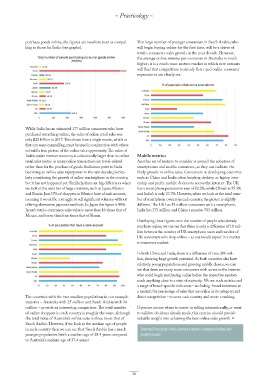
            purchase goods online, the figures are nowhere near as compel-  This large number of younger consumers in Saudi Arabia, who
            ling as those for India (see graphs).             will begin buying online for the first time, will be a driver of
                                                              total e-commerce sales growth in the next decade. However,
                                                              the average online revenue per consumer in Australia is much
                                                              higher; it is a much more mature market in which new entrants
                                                              will find that competition is already fierce and online consumer
                                                              expectations are clearly set.


            While India has an estimated 177 million consumers who have
            purchased something online, the value of online retail sales was
            only $22 billion in 2017. This shows how a single metric, which at
            first can seem compelling, must be used in conjunction with others
            to build a true picture of the online sales opportunity. The value of
            India’s wider internet economy is substantially larger than its online   Mobile metrics
            retail sales metric as many online transactions are travel-related   Another set of metrics to consider is around the adoption of
            rather than for the purchase of goods. Indicators point to India   smartphones and mobile commerce, as they can indicate the
            becoming an online sales superpower in the next decade, particu-  likely growth in online sales. Consumers in developing countries
            larly considering the growth of online marketplaces in the country,   such as China and India often leapfrog desktop or laptop own-
            but it has not happened yet. Similarly, there are big differences when   ership and prefer mobile devices to access the internet. The UK
            we look at the next tier of large countries, such as Japan, Mexico   has a smartphone penetration rate of 82.2%, while China’s is 55.3%
            and Russia. Just 37% of shoppers in Mexico have a bank account,   and India’s is only 27.7%. However, when we look at the total num-
            meaning it would be a struggle to sell significant volumes without   ber of smartphone owners in each country, the picture is slightly
            offering alternative payment methods. In Japan the figure is 98%.   different. The UK has 55 million consumers with a smartphone,
            Japan’s total e-commerce sales value is more than 10 times that of   India has 375 million and China a massive 783 million.
            Mexico, and more than four times that of Russia.
                                                              Overlaying these figures onto the number of people who already
                                                              purchase online, we can see that there is only a difference of 10 mil-
                                                              lion between the number of UK smartphone users and number of
                                                              UK consumers who shop online – as one would expect in a mature
                                                              e-commerce market.

                                                              In both China and India, there is a difference of circa 200 mil-
                                                              lion, showing huge growth potential. As both countries also have
                                                              relatively young populations and growing middle classes, we can
                                                              see that there are many more consumers with access to the internet
                                                              who could begin purchasing online before the respective markets
                                                              reach anything close to a state of maturity.  We use such metrics and
                                                              a range of brand-specific indicators – including: brand awareness in
                                                              a market; the percentage of sales that are online in its category; and
            The countries with the two smallest populations in our example   direct competition – to score each country and create a ranking.
            statistics – Australia with 25 million and Saudi Arabia with 34
            million – provide an interesting comparison. The total number   If you are unsure where to invest in selling internationally, or want
            of online shoppers in each country is roughly the same, although   to validate decisions already made, this exercise should provide
            the total value of Australia’s online sales is three times that of   valuable insight into achieving the best online sales growth. ••
            Saudi Arabia. However, if we look at the median age of people
            in each country then we can see that Saudi Arabia has a much   Download Practicology’s free e-commerce research at www.practicology.com/
            younger population (with a median age of 28.4 years compared   insights/research
            to Australia’s median age of 37.4 years).


                                                            38

