


Page 48 - CBM10
P. 48
~ GJS Consulting ~


             Import tax
             Import tax does not have to be calculated by a cross-border   Due to agreements and well-established service providers, it is
             company selling in Switzerland. Th  e Swiss Federal Customs   clear the Swiss market off ers lots of opportunities for cross-
             Administration (SFCA) levies this together with customs, if   border merchants. With an online minded population, high
             they arise. Schroeder explains what makes the Swiss market   growth and well working FTAs, boundaries that make cross-
             attractive: ‘Th  e current import tax rate is 7.7%, the same as the   border retailers hesitant are lifted. Are you the next online
             VAT on purchases in Switzerland. Certain industries, like food,   retailer entering the Swiss market? ••
             are subject to a reduced rate, currently 2.5%.

             Import tax aims at the taxation of domestic consumption.   About GJS Consulting
             Th  erefore, the country of destination-principle applies. If   GJS Consulting is a fiscal representation and partner for the Swiss
             a foreign merchant is fi scally registered for VAT purposes,   market, making it easy for cross-border online retailers to expand to
             and due to the export from the country of origin, items are   Switzerland. GJS consulting can provide merchants with the following
             exempted from VAT over there. In return, they are subject to   major advantages:
             respective VAT in the country of destination. In contrast to   •  Certified tax consultants with focus on e-commerce supporting you
             customs duties, import tax is a pass-through or zero-sum game.   in conquering the Swiss market as fiscal representation with focus on
             It can be claimed under certain conditions as input tax.’  e-commerce
             ‘Th  e easiest way to clarify is by giving an example,’ says Schroed-  •  Advice on all tax issues (sales tax, import tax, input tax, etc.)
             er. ‘If you import an article of 100 Swiss francs, that is charged   •  Establishment of a digital process for all information relevant to
             7.7% import tax into Switzerland and you sell it to the end-  Switzerland
             consumer, you normally have to pay 7.7% VAT later. However,   •  Strong partner network, e.g. in physical logistics in Switzerland and
             you can show that you paid 7.7% import VAT when the goods   abroad
             have been imported into Switzerland. Th  e Swiss government   •  Merchants are not tied to one logistic or fulfilment partner. Tax
             is not going to charge you again, stating you have already paid   consulting stays intact if you want to change.
             for it. It is why I advise to always set up a fi scal representation.
             A representative such as GJS Consulting can take care of your   What you need to register for VAT purposes by choosing a fiscal
             Swiss taxes and customs. With the help of a customs software,   representation is explained in a whitepaper by GJS Consulting that is
             we know what a company imports on a daily basis, making the   available on https://cross-border-magazine.com/e-commerce-switzerland/
             declaration process transparent and easier for all parties.’
                                                                You can contact Gerrit Schroeder from GJS Consulting direct too:
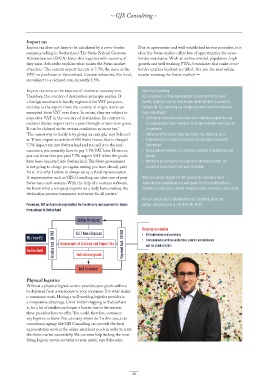
             Procedure, VAT and customs registration fro the delivery and payment for trades   [email protected] or +41 (0)44 387 46 40
             from abroad to Switzerland


             Physical logistics
             Without a physical logistic service provider, your goods will not
             be delivered from a warehouse to your consumer. It is what makes
             e-commerce work. Having a well-working logistics provider is
             a competitive advantage. Cross-border shipping to Switzerland
             is, for a lot of retailers, no longer a barrier due to the services
             these providers have to off er. ‘You could, therefore, outsource
             any logistics to Swiss Post, as many others do. ‘In this case, a tax
             consultancy agency like GJS Consulting can provide the fi scal
             representation services the online merchant needs in order to enter
             the Swiss market successfully. We can even help fi nding the most
             fi tting logistic service provider to your needs,’ says Schroeder.


                                                            48

