


Page 39 - CBM09
P. 39
~ Panel discussion ~


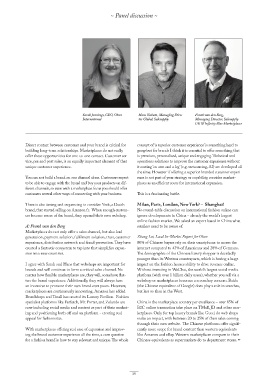
                                      Sarah Jennings, CEO, Oban   Hans Siebum, Managing Direc-  Frank van den Berg,
                                      International            tor Global, Salesupply   Managing Director, Salesupply
                                                                                        UK & Infinity Blue Marketplaces


            Direct contact between customer and your brand is critical for   concept of ‘a superior customer experience’ is something hard to
            building long-term relationships. Marketplaces do not really   grasp but for brands I think it is essential to offer something that
            offer these opportunities for one-to-one contact. Customer ser-  is premium, personalised, unique and engaging. Technical and
            vice, pre and post sales, is an equally important element of that   operations solutions to improve the customer experience without
            unique customer experience.                       it costing ‘an arm and a leg’ (e.g. outsourcing, AI) are developed all
                                                              the time. However if offering a superior branded customer experi-
            You can not build a brand on one channel alone. Customers expect   ence is not part of your strategy or capability, consider market-
            to be able to engage with the brand and buy your products on dif-  places as an efficient route for international expansion.
            ferent channels, so even with a marketplace focus you should offer
            customers several other ways of connecting with your business.  This is a fascinating battle.

            There is also timing and sequencing to consider. Yoek, a Dutch   Milan, Paris, London, New York? –  Shanghai!
            brand, that started selling on Amazon.fr.  When enough custom-  No round-table discussion on international fashion online can
            ers became aware of the brand, they opened their own webshop.  ignore developments in China - already the world’s largest
                                                              online fashion market. We asked an expert based in China what
            A: Frank van den Berg                             retailers need to be aware of.
            Marketplaces do not only offer a sales channel, but also lead
            generation, payment solution, fulfilment solution, trust, customer   Zhang Lei, Local In-Market Expert for Oban
            experience, distribution network and fraud prevention. They have   80% of Chinese buyers rely on their smartphone to access the
            created a fantastic ecosystem to tap into that simplifies expan-  internet compared to 43% of Americans and 28% of Germans.
            sion into new countries.                          The demographic of the Chinese luxury shopper is decidedly
                                                              younger than its Western counterparts, which is having a huge
            I agree with Sarah and Hans that webshops are important for   impact on the fashion houses ability to drive revenue online.
            brands and will continue to form a critical sales channel. No   Without investing in WeChat, the world’s largest social media
            matter how flexible marketplaces are, they will, somehow, flat-  platform (with over 1 billion daily users), whether you sell via a
            ten the brand experience. Additionally, they will always have   webshop or marketplaces becomes a secondary concern. Baidu
            an incentive to promote their own brand over yours. However,   (the Chinese equivalent of Google) does play a role in searches,
            marketplaces are continuously innovating. Amazon has added   but less so than in the West.
            Brandshops and Tmall has created its Luxury Pavilion.  Fashion
            specialist platforms like Farfetch, Mr. Porter, and Zalando are   China is the marketplace country par excellence – over 85% of
            now including social media and content as part of their market-  B2C online transaction take place on TMall, JD and other mar-
            ing and positioning both off and on platform - creating real   ketplaces. Only for top luxury brands like Gucci do web shops
            appeal for fashionistas.                          make an impact, with between 20 to 25% of their sales coming
                                                              through their own website.  The Chinese platforms offer signifi-
            With marketplaces offering real ease of expansion and improv-  cantly more scope for brand content than western equivalents
            ing the brand customer experience all the time, a core question   like Amazon and eBay. Western marketplaces compare to their
            for a fashion brand is how to stay relevant and unique. The whole   Chinese equivalents as supermarkets do to department stores. ••


                                                            39

