


Page 29 - CBM13
P. 29
~ Descartes pixi ~


            Today’s customers have high expectations. They look for fast shipping, visibility, the
            best prices, easy returns, and continuous communication from order to the point-of-
            delivery (POD). Warehouse operators and online retailers also know that high consumer

            expectations mean that they must get processes right to thrive. While this may sound easy,
            businesses not only face high customer demands but also industry challenges.


                       ith labour costs on the rise and the number   online shops, and international selling outlets are critical
                       of products increasing, it is critical to opti-  to standardising processes and driving down costs.
            W mise warehouse processes. While there has
            been much discussion on how to streamline operations, it   2. A Barcode-Driven Approach
            can be challenging to choose between the right shipping   Barcodes in the warehouse are an absolute “must” to be a
            and fulfilment methods to get the warehousing equation   top player. It can be challenging for workers to find the
            right.                                            correct size and colour at-a-glance. Barcode-based systems
                                                              mean added accuracy, improved productivity, and ultimate-
            This article features five aspects that can improve warehouse   ly, improved customer satisfaction.
            operations and how to pick, pack, and ship like the top play-
            ers.                                              With the right systems in place, market leaders know what
                                                              orders have been placed as well as what’s coming into and
            1. Automated Connections                          out of their doors. As a result, they can sell more inventory
            Many warehouse operators and online retailers know that   through better communication. It all starts with the right
            they can expand their fulfilment options by connecting to   technology to connect with sales channels and trading
            a diverse range of e-commerce marketplaces. Many busi-  partners.
            nesses quickly realise, however, that a multi-marketplace,
            multi-tactic strategy can be complex. Multiple processes   3. “Chaotic Storage”
            and systems may also lead to errors, contrasting pick, pack   When many envision a warehouse, they likely picture
            and ship processes, points-of-failure, and added labour.  groups of similar items organised by product type or in a
                                                              defined order. Such practices, however, may not make the
            A solution is required that can automate connectivity and   best use of space. For example, organising by strict product
            take the IT and data management issues out of market-  type does not necessarily mean that an item fits best in a
            place selling. Beyond this, technology is needed to ensure   given space. In addition, ordered space also does not mean
            that warehouse processes (i.e. receiving, picking, packing,   that popular items are placed within easy reach or as part
            shipping, and carrier selection) are similar regardless of the   of an optimised picking path.
            sales channel.
                                                              Using “chaotic storage”, free space can be filled more
            Best-in-class players know that systems that can seam-  quickly and used more effectively although the products
            lessly communicate with local online selling platforms,   may not appear to be neatly grouped or structured. Every
                              CONNECTIVITY TO MULTIPLE MARKETPLACES


                                      O R D E R   I M P O R T  S H I P M E N T   U P D A T E S


                                Receiving     Pick       Pack        Ship      Carriers
                 Suppliers                                                                     Customers


                                               I N   T H E   W A R E H O U S E
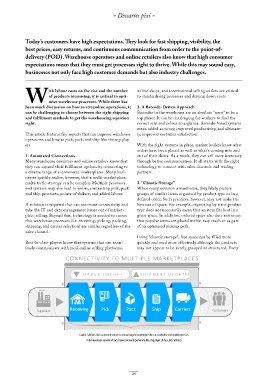
                                    Graphic: Solutions that can not only connect to a broad range of marketplaces but can standardise and simplify processes
                                        in the warehouse agnostic of sales channel are key to performing like a top player. (© Descartes Systems)


                                                            29

