


Page 25 - CBM14
P. 25
~ eShopWorld ~


                 ustainability attracts younger customers     sustainability. Brands are under increasing pressure to create
                 Sustainability has become more critical than ever.   transparency on their social and environmental sustainability
            SAround €350 billion worth of clothing is prematurely   performance internally. Consumers expect that brands will
            discarded every year. In addition, 108 million tons of non-  share this specific information with them. Finally, brands
            renewable resources are used annually to produce items of   will need to invest in supplier relationships to become more
            clothing. Not only does the government pressure brands   sustainable and efficient in their supply chain. Collaboration
            to increase their sustainability, but Millennials and Gen Z   across the entire value chain is essential for achieving an
            consumers are also demanding more sustainable products.   industry-wide sustainable transformation.
            It is possible to attract these younger generations by
            using sustainably harvested materials, recycled packaging   Fast fashion is being outpaced by second-hand clothing
            and efficient shopping and delivery methods. Also, this   Even though fast fashion has experienced and will continue
            responsible and forward-thinking strategy will help to build   to grow over the years, second-hand clothing has grown
            brand loyalty and lifetime value among these younger groups.  21 times faster over the past three years. The second-hand


            Customer expectations                             market has gone mainstream. Within the luxury industry,
            Consumers are becoming more environmentally conscious   the luxury resale market is the fastest-growing sector. And
            by the day. More than half of consumers want the fashion   it is not only second-hand clothing that has experienced a
            industry to become more sustainable. In addition, 59% of   rapid increase, but the online clothing rental market has also
            purchasers expect fashion brands to create clothes ethically.   grown in the last few years and will probably continue to do
            50% also plan to switch brands in the future to one that   so. Renting clothes offers a more sustainable model which
            acts more environmentally-friendly than their usual choice.   still gives shoppers access to new styles and garments to wear
            Across many categories, consumers have shown an appetite   regularly.
            for shifting away from traditional ownership to newer ways to
            access certain products.                          Overall, sustainability has become an essential aspect not
                                                              only for consumers but also for brands. Sustainability is an
            Sustainability from a brand’s perspective         exceptional added value in terms of environmental and social
            Currently, brands are investing more and more in   benefits to the consumer and thus enables differentiation
            sustainability. More than 60% claim that they spent more on   from competitors. ••
            sustainability in 2019 compared to 2018. Around 20% claim
            that they have invested the same amount, and only
            2% state that they are not investing in sustainability
            this year. In addition, 55% aim to source at least
            half of their products with sustainable materials by
            the year 2025. 66% expect sustainable sourcing to
            increase costs by between 1%-5% by 2025.

            Challenges for brands
            Even though sustainability is getting more
            important, there are some challenges for brands
            to reach a responsible and forward-thinking
            strategy to get it right. They will have to move away
            from mass-produced cheaper materials in favour
            of less water and chemical-intensive materials.
            Also, brands need to decide whether to shoulder
            the costs or pass them onto the shopper when it
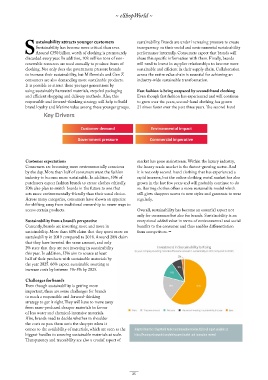
            comes to the availability of materials, which are seen as the   Adapted from the eShopWorld Market and Innovation Review 2020. Full report available at:
            biggest hurdles to sourcing sustainable materials at scale.   https://learning.eshopworld.com/whitepapers/market-and-innovation-review/
            Transparency and traceability are also a crucial aspect of


                                                            25

