


Page 60 - CBM31
P. 60
~ AEB ~


            makes sense to look at the e-commerce aspect in isolation   we mirror previous workflows so as not to overwhelm staff
            and build a process specifically for it, leaving everything   with too many changes at once.
            else untouched. This way, the project becomes much more
            manageable and can be accomplished a lot more quickly   In the end, what we really want to understand when a
            than if we rolled out the process for all sections of a   customer approaches us, is: what is their value proposition
            company or business. Such a specific market element can   towards their customers, where does our solution fit in, and
            then be built with its own data set, becoming as flexible   how it can best aid this proposition to achieve maximum
            and agile as a start-up.                          customer satisfaction.

            E-commerce wisdom: the most direct route isn’t
            always the best
            Other aspects we look at, before even beginning to
            sketch out a customs flow, is the country or countries
            the customer is situated in and the ones they wish to
            import and export goods to or from or use for transit.
            Because in trade, as in air travel, the most direct route
            isn’t necessarily the best. Or the cheapest. One example
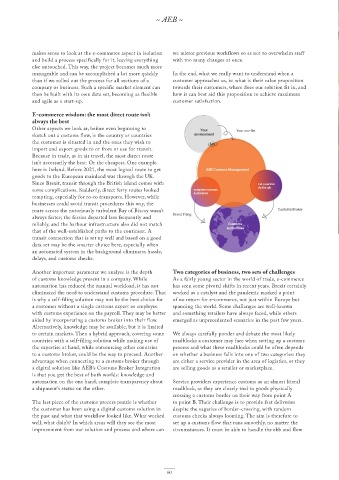
            here is Ireland. Before 2021, the most logical route to get
            goods to the European mainland was through the UK.
            Since Brexit, transit through the British island comes with
            some complications. Suddenly, direct ferry routes looked
            tempting, especially for ro-ro transports. However, while
            businesses could avoid transit procedures this way, the
            route across the notoriously turbulent Bay of Biscay wasn’t
            always faster; the ferries departed less frequently and
            reliably, and the harbour infrastructure also did not match
            that of the well-established paths to the continent. A
            transit connection that is set up well and based on a good
            data set may be the smarter choice here, especially when
            an automated system in the background eliminates hassle,
                                                                                                                                 Do your customers still have to
            delays, and customs checks.
                                                                                                                                 pay customs duties on delivery?
            Another important parameter we analyse is the depth   Two categories of business, two sets of challenges
            of customs knowledge present in a company. While   As a fairly young sector in the world of trade, e-commerce
            automation has reduced the manual workload, it has not   has seen some pivotal shifts in recent years. Brexit certainly
            eliminated the need to understand customs procedure. That   worked as a catalyst and the pandemic marked a point
            is why a self-filing solution may not be the best choice for   of no return for e-commerce, not just within Europe but
            a customer without a single customs expert or employee   spanning the world. Some challenges are well-known
            with customs experience on the payroll. They may be better   and something retailers have always faced, while others
            aided by incorporating a customs broker into their flow.   emerged as unprecedented scenarios in the past few years.
                                                                                                                                 Time for an optimized customer experience. Our end-to-end solution includes
            Alternatively, knowledge may be available, but it is limited
                                                                                                                                 automated customs and tax processing as well as a simple and trackable
            to certain markets. Then a hybrid approach, covering some   We always carefully ponder and debate the most likely
            countries with a self-filing solution while making use of   roadblocks a customer may face when setting up a customs
            the expertise at hand, while outsourcing other countries   process and what these roadblocks could be often depends   returns management. This way, we ensure your customers in non-EU countries
            to a customs broker, could be the way to proceed. Another   on whether a business falls into one of two categories: they
                                                                                                                                 receive their parcels just as quickly and easily as your domestic customers.
            advantage when connecting to a customs broker through   are either a service provider in the area of logistics, or they
            a digital solution like AEB’s Customs Broker Integration   are selling goods as a retailer or marketplace.
            is that you get the best of both worlds: knowledge and
                                                                                                                                 Your one-stop shop for
            automation on the one hand, complete transparency about   Service providers experience customs as an almost literal
            a shipment’s status on the other.                 roadblock, as they are closely tied to goods physically
                                                              crossing a customs border on their way from point A
            The last piece of the customs process puzzle is whether   to point B. Their challenge is to provide fast deliveries
            the customer has been using a digital customs solution in   despite the vagaries of border-crossing, with random
            the past and what that workflow looked like. What worked   customs checks always looming. The aim is therefore to
            well, what didn’t? In which areas will they see the most   set up a customs flow that runs smoothly, no matter the
            improvement from our solution and process and where can   circumstances. It must be able to handle the ebb and flow


                                                                                                                                                  For more information scan qr-code.
                                                            60


                                                                                                                                                                                                                                       30.07.24   10:59
                                                                                                                         2407-crossborder-mag-exporto-A4-v2.indd   1                                                                   30.07.24   10:59
                                                                                                                         2407-crossborder-mag-exporto-A4-v2.indd   1

