


Page 24 - CBM17
P. 24
~ ChannelEngine ~


            Why should you sell on marketplaces?              marketplace challenges faced by brands. Finally, they will
            The most important reason is, that’s where your customer is.   be able to extend their offering by becoming a marketplace
            If you’re not present with your products, you will be missing   themselves (when big enough).
            sales.
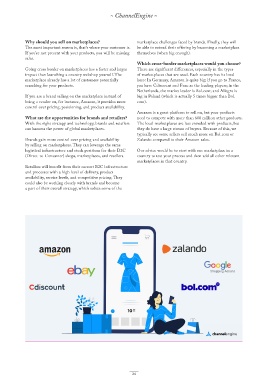
                                                              Which cross-border marketplaces would you choose?
            Going cross border on marketplaces has a faster and larger   There are significant differences, especially in the types
            impact than launching a country webshop yourself. The   of marketplaces that are used. Each country has its local
            marketplace already has a lot of customers potentially   hero: In Germany, Amazon is quite big; if you go to France,
            searching for your products.                      you have Cdiscount and Fnac as the leading players; in the
                                                              Netherlands, the market leader is Bol.com; and Allegro is
            If you are a brand selling on the marketplace instead of   big in Poland (which is actually 5 times bigger than Bol.
            being a vendor on, for instance, Amazon, it provides more   com).
            control over pricing, positioning, and product availability.
                                                              Amazon is a great platform to sell on, but your products
            What are the opportunities for brands and retailers?   need to compete with more than 600 million other products.
            With the right strategy and technology, brands and retailers   The local marketplaces are less crowded with products, but
            can harness the power of global marketplaces.     they do have a large stream of buyers. Because of this, we
                                                              typically see some sellers sell much more on Bol.com or
            Brands gain more control over pricing and availability   Zalando compared to their Amazon sales.
            by selling on marketplaces. They can leverage the same
            logistical infrastructure and stock positions for their D2C   Our advice would be to start with one marketplace in a
            (Direct-to-Consumer) shops, marketplaces, and resellers.   country to test your process and then add all other relevant
                                                              marketplaces in that country.
            Retailers will benefit from their current B2C infrastructure
            and processes with a high level of delivery, product
            availability, service levels, and competitive pricing. They
            could also be working closely with brands and become
            a part of their overall strategy, which solves some of the


                                                            24

