
A new survey from Temu suggests that the marketplace is helping European small businesses grow beyond their domestic markets, increase operational capacity, and create new jobs.
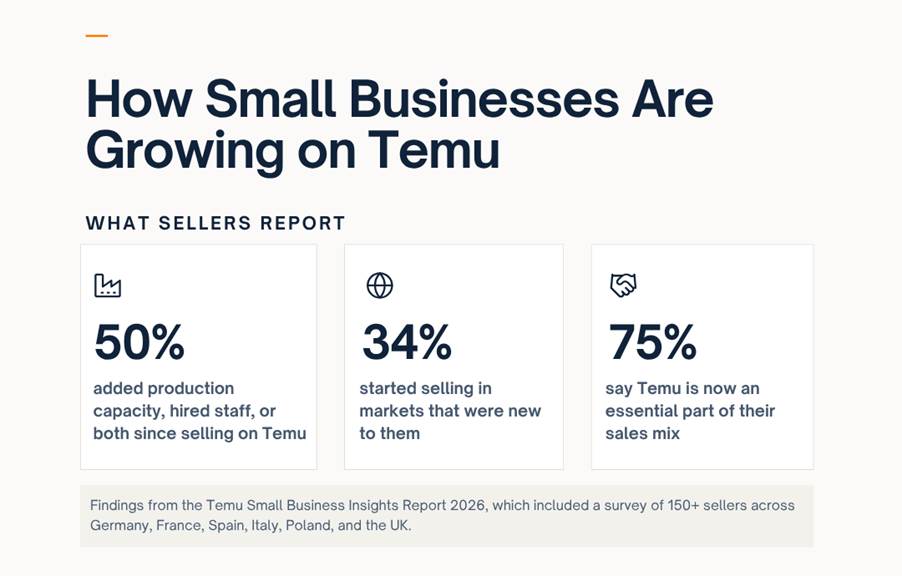
According to the Temu European Seller Survey, half of the participating businesses said they had either increased production or operational capacity, hired additional staff, or done both since joining the platform. At the same time, 34% of sellers operating in EU markets said they had expanded into new international markets.
The survey, conducted in June and July 2026, gathered responses from 152 local Temu sellers across Germany, France, Spain, Italy, Poland and the UK.
While the sample is relatively small and Temu conducted the research, the findings point to a clear theme: for many participating sellers, access to the marketplace has been linked to tangible business expansion, including new employees, larger operations, and cross-border sales.
The strongest finding relates directly to business growth. Temu said 50% of respondents reported increasing production or operational capacity, hiring additional staff, or both after joining the marketplace.
For small businesses, this matters because online marketplace growth is not always reflected in broader investment. In the cases highlighted by Temu, however, additional sales have translated into larger warehouse teams, new administrative roles, investment in automation and founders moving into their businesses full-time.
Temu argues that this demonstrates how easier access to online demand can give smaller businesses the confidence and revenue needed to invest in their operations. “The survey findings underscore the immense potential of Europe's small businesses and aspiring entrepreneurs to grow if there were simpler, more affordable ways to reach new customers,” a Temu spokesperson said. “We look forward to continuing our work in helping sellers grow at home and abroad and create jobs within their communities.”
Spanish spare-parts retailer Recamania is one of the examples Temu cited. The Albacete-based family business had operated for more than 40 years before joining the marketplace but struggled to establish a strong online sales channel. Recamania opened its Temu store in March 2025. According to the company, monthly orders through the platform eventually reached around 4,000.
That additional volume led the business to expand both its warehouse and administrative teams. “Temu has impacted the business very positively, without a doubt. It has meant significant growth for Recamania,” said Natalia Collado Castillo, who joined the family-owned company as the operation expanded.
The case illustrates the central claim behind Temu's survey: marketplace access can provide established SMEs with additional demand that, in some cases, translates directly into new employment.
In the UK, Leeds-based Money Cruncher, which also trades online as Spot On-Line, offers another example of job creation linked to increased marketplace volume. The retailer has fulfilled more than one million orders since joining Temu at the beginning of 2025, according to the company.
To handle the additional demand, the business added more than 20 warehouse positions over the following 18 months. For Temu, examples such as Money Cruncher matter because they shift the discussion around marketplace participation beyond simple sales growth.
The company increasingly presents its Local Seller Program as a tool that can contribute to broader business development, including employment, warehousing, and fulfillment capacity.
The same pattern is also emerging among younger companies. French entrepreneurs Mathis Rouchouze and Charles Jeuffrain launched their ube powder brand Ubedia on Temu in September 2025. Within weeks, the Aix-en-Provence company had sold more than 1,400 packets of ube powder through organic traffic on the platform, according to Temu.
Those early sales allowed both founders to leave their previous jobs and work on Ubedia full-time. The company now employs six people across production, shipping and marketing and is investing in automated packing equipment. It also plans to recruit additional employees as it expands into more European markets.
“Temu gave us instant visibility,” co-founder Mathis Rouchouze said. “Good reviews brought more exposure, which led to more sales.” For smaller brands, this type of marketplace visibility can reduce the cost and complexity of building an audience from scratch, particularly when entering e-commerce for the first time.
The second major finding from the survey concerns cross-border growth. According to Temu, 34% of respondents operating in EU markets said they had expanded into new international markets after joining the platform.
For small businesses, international expansion can be difficult because every new market can require additional investment in marketing, customer acquisition, localization, payments, logistics, returns, and regulatory compliance. Marketplaces can potentially simplify part of that process by giving sellers access to existing traffic and customers across several countries through one platform. This appears to be one of the main ways Temu says it is helping European SMEs move beyond their domestic markets.
Italian family-run specialty food company SD Calabria said joining Temu significantly changed its customer base. Before selling on the marketplace, most of its international customers were Italian expatriates. After joining Temu, owner Antonino Quaranta said the company began receiving orders from a much broader range of European consumers.
“Now I see Spanish customer names, German surnames, buyers from the Netherlands, Poland, Austria, Ireland, Denmark, and the Czech Republic,” Quaranta said. “Before, I only saw Italian names. Now it's a completely different picture.”
For SD Calabria, the main advantage was reaching customers in several countries without funding a separate marketing campaign for each market. That distinction matters especially for SMEs, which often have limited resources for international customer acquisition.
Polish electronics distributor Euroelectronics provides one of the clearest examples of rapid cross-border expansion. According to Temu, the company entered 18 European markets within weeks of joining the marketplace, including countries where it had not previously operated.
Instead of developing individual market-entry strategies for every country, Euroelectronics was able to make its product catalog available across multiple European markets using its existing warehousing operation. For smaller and mid-sized merchants, that type of expansion model can significantly reduce the initial commercial burden of entering new markets.
Rather than building local demand independently in each country, sellers can potentially use marketplace traffic to test products, identify demand and decide where further investment makes sense.
Temu said it developed its Local Seller Program partly through more than 100 discussions with industry bodies, trade associations and other stakeholders. According to the company, three recurring barriers for SMEs emerged from those conversations: complexity, cost and connection.
The survey found that 38% of respondents identified Temu's easy-to-use seller platform as one reason for choosing the marketplace. Another 35% highlighted its cost structure. The strongest result, however, related to support. More than 65% of respondents said they valued the personal or dedicated support available to sellers.
For smaller companies without dedicated e-commerce, internationalization or marketplace teams, these factors can be particularly important. Reducing onboarding complexity and providing direct support can make it easier for businesses to enter online channels, scale sales and eventually expand into additional markets.
The survey also challenges the idea that Temu's local seller base consists mainly of newly launched companies. Some 43% of respondents had already been trading for more than ten years before joining the marketplace.
That means a significant proportion of participating sellers were established businesses using Temu as an additional growth channel rather than as the foundation of a new company. Meanwhile, 75% of respondents described Temu as either an important additional sales channel or their primary sales channel.
Together, these findings suggest that traditional SMEs are increasingly using the marketplace for additional digital reach, not only marketplace-native sellers.
Temu launched in Europe in April 2023 and began welcoming local European businesses onto the platform in 2024. Its Local Seller Program is now available to businesses of all sizes in more than 35 markets.
The company says it operates in more than 90 markets globally, including all EU Member States, and offers products across more than 700 categories. As the program expands, Temu is increasingly positioning local sellers as central to its European strategy.
The model also marks a shift from Temu's earlier reputation as a platform dominated by cross-border products shipped from overseas. By adding more European merchants, Temu can potentially increase locally available inventory, support faster fulfillment and give domestic businesses access to consumers across multiple markets.
The most notable message from the latest survey is not simply that European businesses are selling through Temu. It is that participating businesses say the marketplace is affecting what happens beyond the platform itself.
According to the survey, sellers are hiring warehouse staff, expanding administrative teams, investing in equipment, increasing production capacity and entering countries where they had not previously sold. The examples of Recamania, Money Cruncher, Ubedia, SD Calabria and Euroelectronics illustrate different versions of the same pattern: additional marketplace demand can create a pathway from online sales growth to wider business expansion.
At the same time, the results should be interpreted with appropriate caution. The survey covered 152 sellers and was conducted by Temu, meaning it does not provide an independent or representative assessment of all European SMEs selling through marketplaces. Nevertheless, the findings offer a useful indication of how Temu wants its European Local Seller Programme to develop.
For the marketplace, the next stage of growth in Europe appears increasingly tied to a simple proposition: helping local businesses reach more international customers while turning additional online demand into investment, capacity and employment at home.


By continuing to use the site, you agree to the use of cookies. more information
The cookie settings on this website are set to "allow cookies" to give you the best browsing experience possible. If you continue to use this website without changing your cookie settings or you click "Accept" below then you are consenting to this.