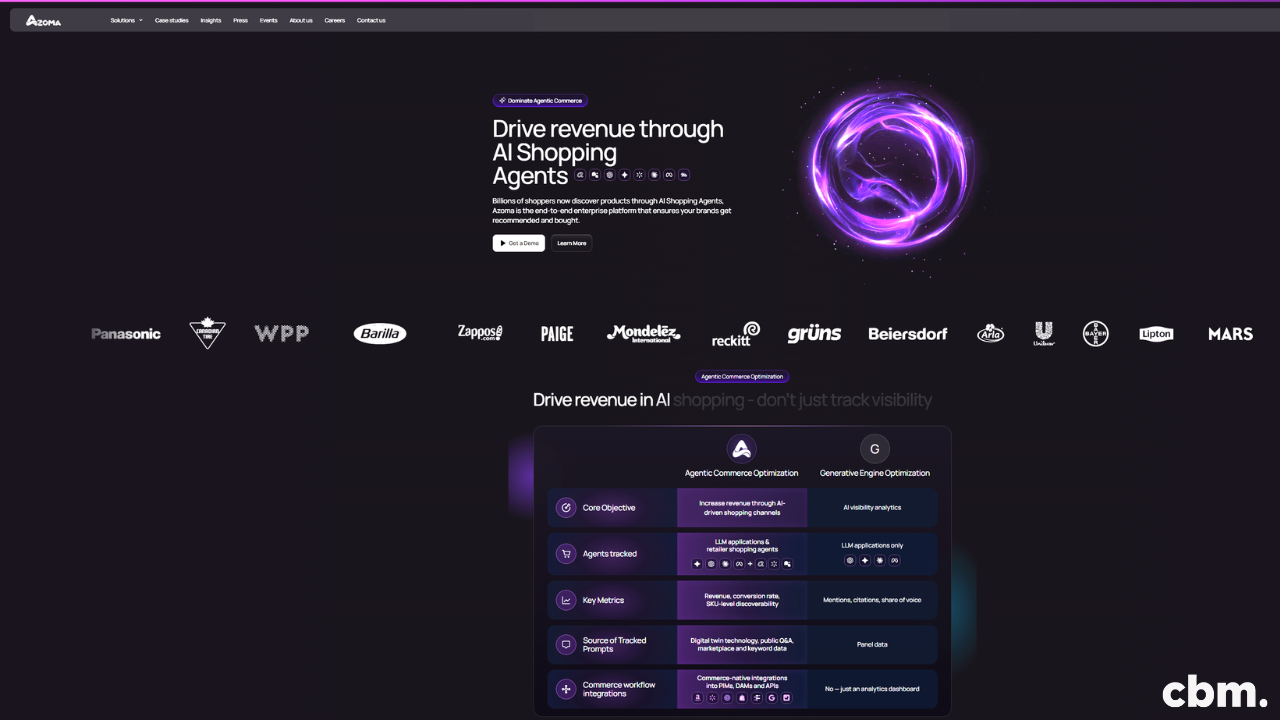
Azoma, a London- and Toronto-based technology company specializing in Agentic Commerce Optimization (ACO), has secured $11.2 million in Series A funding to expand its artificial intelligence platform and help global consumer brands improve product visibility across AI-powered shopping assistants.
The investment, announced on October 21, 2026, was led by Puma Growth Partners, with participation from dunnhumby, Twin Path, MaRS IAF, Rank Ventures and Ignite Ventures, alongside angel investors.
The funding comes as artificial intelligence increasingly influences how consumers discover, compare and purchase products online, creating new challenges for traditional e-commerce marketing strategies.
Founded in 2022 by former Amazon executive Max Sinclair and machine learning researcher Timur Luguev, Azoma develops technology designed to help brands understand how AI shopping agents discover and recommend their products.
Unlike traditional search engine optimization, which focuses on improving website rankings in search results, Agentic Commerce Optimization aims to ensure that products are accurately represented and recommended by AI-powered platforms.
These include conversational AI applications such as ChatGPT and Google Gemini, alongside shopping assistants integrated into retail platforms, including Amazon's Alexa for Shopping and Walmart Sparky.
Azoma's platform combines AI visibility measurement, product content optimization and performance analysis to help businesses adapt to this emerging commercial environment.
The company reported that its revenue increased almost tenfold over the previous year, while its workforce expanded from 12 to 40 employees across London and Toronto.
Its enterprise customers include L'Oréal, Unilever, Mars, Beiersdorf and Reckitt.
The latest financing follows a $4 million seed round announced in December 2025 and an investment from dunnhumby ventures disclosed in September 2026.
The $11.2 million financing will support three principal areas of development: expanding compatibility with AI shopping agents, strengthening product optimization and attribution capabilities, and recruiting additional artificial intelligence specialists.
A central priority will be extending Azoma's technology beyond conventional conversational search platforms to AI assistants capable of carrying out purchasing activities on behalf of consumers.
The company is also developing tools that connect product visibility within AI-generated recommendations to measurable commercial outcomes.
By leveraging dunnhumby's retail data capabilities, Azoma aims to improve its understanding of the relationship between AI-powered product discovery and subsequent sales.
Another component of Azoma's technology is its Digital Twin system, which simulates different AI shopper personas. This enables brands to assess how their products may be presented to shoppers with different purchasing preferences and requirements.
The company is also positioning its platform around emerging commerce interoperability frameworks, including the Universal Commerce Protocol and Agentic Commerce Protocol, which aim to facilitate interactions between AI agents and commercial systems.
The expansion of AI-powered shopping assistants represents a significant transformation in how online retailers compete for consumer attention.
Traditionally, e-commerce companies have relied on search engine rankings, sponsored product placements, marketplace advertising and product listing optimization to attract customers.
However, AI shopping agents are increasingly becoming intermediaries between consumers and retailers.
Instead of browsing multiple websites and manually comparing products, consumers can ask an AI assistant to identify suitable options based on price, specifications, availability, delivery conditions or personal preferences.
This introduces a new competitive challenge: products must not only be visible to human shoppers but also accessible, understandable and relevant to the AI systems generating recommendations.
According to Azoma, different AI systems rely on substantially different information sources when generating answers.
The company's analysis of 38 million citations found that editorial content represented 51.9% of citations within Google Gemini but only 7.6% within Google AI Overviews.
Meanwhile, affiliate content accounted for 39.6% of citations generated by Alexa for Shopping, compared with less than 2% across the other engines examined.
These findings suggest that brands cannot assume a single optimization strategy will deliver consistent visibility across every AI shopping platform.
To address these challenges, Azoma collaborated with the Digital Shelf Institute to develop a framework structured around five principles of Agentic Commerce Optimization.
Known as the Five C's, the framework focuses on completeness, context, citations, correctness and customer acquisition.
These principles aim to ensure that AI systems have access to detailed product information, understand the relevance of products to specific purchasing needs, reference reliable external information and provide accurate recommendations that can ultimately translate into commercial results.
According to Azoma, the framework is being deployed by 40% of the world's 50 largest consumer packaged goods companies, reflecting growing interest among multinational brands in managing product visibility within AI-driven commerce environments.
The investment in Azoma reflects broader expectations surrounding the economic potential of agentic commerce.
Research projections cited by the company from McKinsey suggest that AI-powered commerce agents could orchestrate between $3 trillion and $5 trillion in global retail revenue by 2030, including as much as $1 trillion in the United States.
Although these figures represent projections rather than realized transaction volumes, they illustrate the potential scale of a market in which artificial intelligence systems increasingly participate in purchasing decisions.
For retailers and consumer brands, the implications extend beyond marketing.
As AI agents become more involved in purchasing processes, businesses may need to reconsider how they structure product catalogs, maintain inventory information, communicate delivery options and distribute product data across external platforms.
For cross-border e-commerce businesses, this evolution could create opportunities to improve product discovery across languages and national boundaries, provided AI assistants can reliably interpret regional availability, pricing and fulfilment conditions.
Azoma's latest funding round highlights increasing investor interest in the infrastructure required to support AI-driven purchasing experiences.
While conventional e-commerce technology has historically focused on storefronts, payments, logistics and marketplace integrations, agentic commerce is creating demand for platforms that help businesses remain competitive within AI-generated recommendations.
This transition could prove particularly relevant for multinational consumer brands managing thousands of products across different retailers, marketplaces and geographic regions.
Nevertheless, the commercial impact of agentic commerce will depend on consumer adoption, the reliability of autonomous purchasing technologies and the ability of retailers to connect AI interactions with completed transactions.
With $11.2 million in additional financing, Azoma is positioning itself within an emerging segment of e-commerce technology where product visibility may increasingly depend not only on search rankings but also on how effectively AI agents understand, evaluate and recommend products.


By continuing to use the site, you agree to the use of cookies. more information
The cookie settings on this website are set to "allow cookies" to give you the best browsing experience possible. If you continue to use this website without changing your cookie settings or you click "Accept" below then you are consenting to this.