
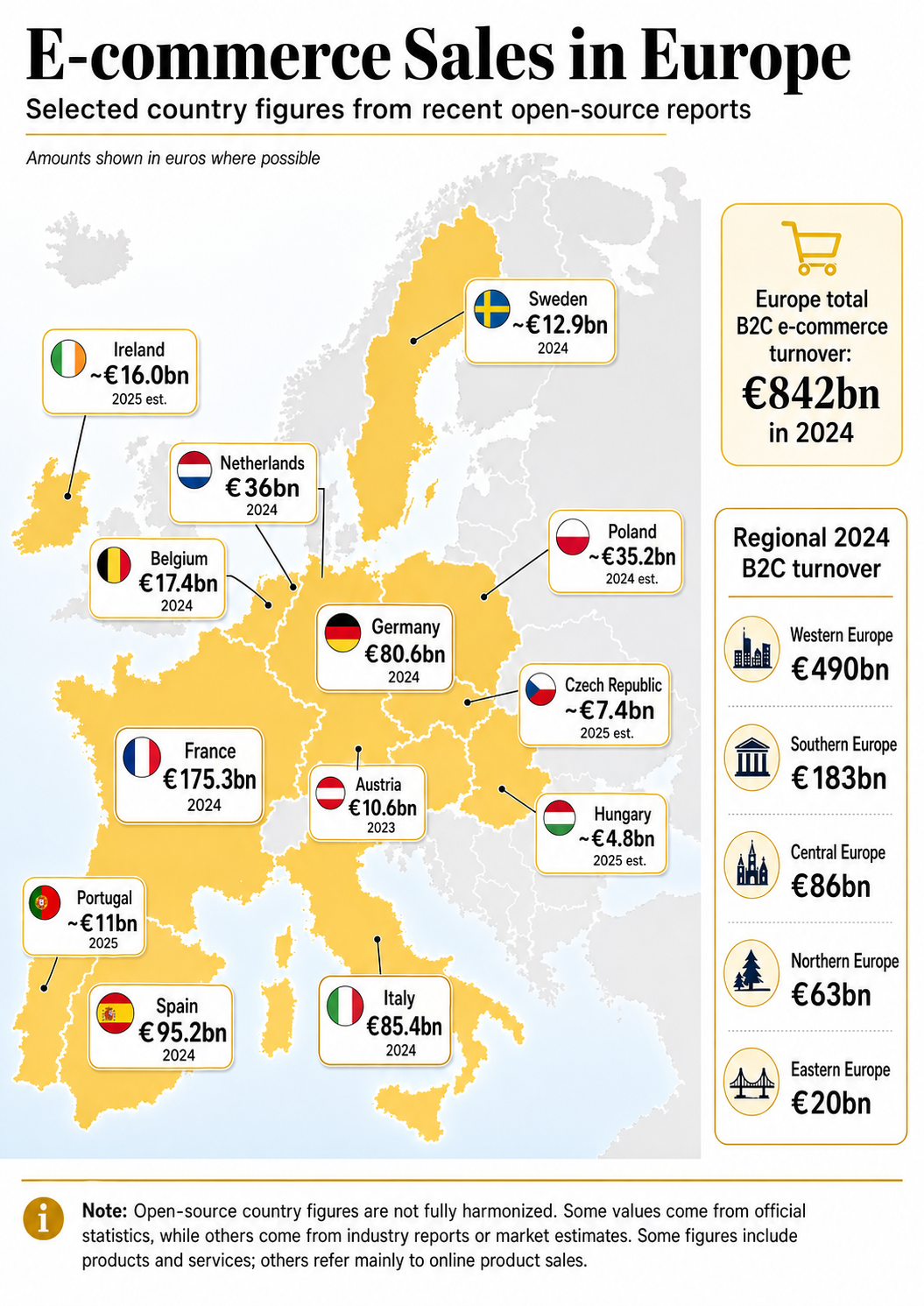
Europe’s e-commerce market continues to expand, but the scale of online sales varies sharply from one country to another. According to the European E-commerce Report 2025, European B2C e-commerce turnover reached €842 billion in 2024, up from €784 billion in 2023, representing 7% nominal growth.
However, comparing e-commerce sales across European countries is not always straightforward. Some national figures include both products and services, while others focus mainly on online product sales. Some come from official statistics, others from industry associations or market estimates. Even with those caveats, the available data shows a clear picture: France, Spain, Italy and Germany remain among the largest e-commerce markets in Europe, while countries such as the Netherlands, Poland, Belgium and Sweden also represent significant online sales volumes.
The latest open-source figures show that Europe’s B2C e-commerce sector has become a mature, large-scale digital economy. The €842 billion turnover figure for 2024 reflects both the continued growth of online retail and the increasing role of digital services in consumer spending.
Regional data also shows that e-commerce activity is heavily concentrated in Western and Southern Europe. Western Europe generated around €490 billion in B2C e-commerce turnover in 2024, making it the largest regional market by far. Southern Europe followed with approximately €183 billion, while Central Europe reached €86 billion. Northern Europe accounted for around €63 billion, and Eastern Europe for approximately €20 billion.
This regional distribution highlights a key feature of European e-commerce: the market is highly developed across the continent, but its economic weight remains unevenly distributed.
France stands out as one of the largest e-commerce markets in Europe. The country reached €175.3 billion in e-commerce sales in 2024, according to FEVAD data. This figure includes online sales of both products and services, making it broader than some other national estimates.
The size of the French market reflects the maturity of its digital retail ecosystem, strong consumer adoption, and the role of online services such as travel, ticketing and subscriptions. For cross-border merchants, France remains one of Europe’s most attractive markets due to its scale, purchasing power and established logistics infrastructure.
Spain recorded €95.2 billion in online revenue in 2024, according to CNMC data.
This places Spain among the largest e-commerce markets in Europe by available national figures. The Spanish market has benefited from strong consumer adoption, marketplace growth, mobile commerce, and the digitalization of sectors such as fashion, electronics, travel and food delivery.
For international retailers, Spain is especially relevant because it combines a large domestic consumer base with strong cross-border shopping behavior and growing digital payment adoption.
Italy generated €85.4 billion in online sales in 2024, according to Casaleggio Associati.
The Italian e-commerce market has historically lagged behind some Western European countries in digital adoption, but recent figures show a much more mature and competitive landscape. Italy’s growth is being driven by marketplace adoption, improved logistics, stronger digital payment penetration and the increasing online presence of traditional retailers.
Italy is also one of the most important Southern European markets for cross-border sellers, especially in categories such as fashion, beauty, consumer electronics, home goods and specialty food products.
Germany recorded €80.6 billion in online product sales in 2024, according to BEVH data.
This figure is not directly comparable with broader e-commerce totals that include services, but it confirms Germany’s role as one of Europe’s largest online retail markets. Germany has one of the most mature e-commerce infrastructures in Europe, with high consumer expectations around delivery reliability, returns, payment options and customer service.
For merchants, Germany is both highly attractive and highly competitive. The market is large, but consumers are demanding, logistics standards are high, and marketplaces play a major role in discovery and conversion.
The Netherlands reached €36 billion in online consumer spending in 2024, according to Thuiswinkel.org-related reporting.
Belgium reached €17.4 billion in online consumer spending in 2024, while Sweden recorded approximately SEK 140 billion, equivalent to around €12.9 billion, in 2024.
These countries may be smaller in population than France, Germany, Italy or Spain, but they are highly relevant in European e-commerce. The Netherlands and Sweden, in particular, have strong digital adoption, mature logistics networks and consumers accustomed to buying online. Belgium also plays an important cross-border role due to its location between major European markets and its multilingual consumer base.
Poland’s e-commerce market was estimated at around €35.2 billion in 2024, making it one of the most important online markets in Central and Eastern Europe.
The growth of Poland reflects a wider trend: Central and Eastern Europe are becoming increasingly important for cross-border e-commerce. Consumers in the region are buying more online, local marketplaces are expanding, logistics infrastructure is improving, and out-of-home delivery options such as parcel lockers are increasingly popular.
The Czech Republic was estimated at around €7.4 billion in 2025, while Hungary’s 2025 online retail figure of HUF 1,945 billion converts to approximately €4.8 billion.
Although these markets are smaller in absolute terms, they offer growth opportunities for merchants willing to adapt to local payment preferences, delivery expectations and language requirements.
Portugal’s online shopping market was estimated at around €11 billion in 2025, according to AED data.
Austria recorded €10.6 billion in online sales in 2023, with forecasts pointing to further growth.
Ireland’s e-commerce market was estimated at approximately €16 billion in 2025, based on available market estimates converted from US dollars.
These countries show that European e-commerce is not only concentrated in the largest economies. Smaller and mid-sized markets can also generate substantial online sales, especially where internet penetration, digital payments and cross-border shopping are well established.
One of the biggest challenges in analyzing e-commerce sales in Europe is the lack of a single harmonized public dataset for all EU countries.
Some figures include products and services. Others only include retail goods. Some are based on consumer spending, while others measure enterprise turnover. In addition, national reports may use different methodologies, definitions and time periods.
Eurostat offers a useful official perspective, but it does not publish the same type of simple “e-commerce sales in euros by country” table. Instead, Eurostat tracks indicators such as the share of enterprise turnover generated through e-sales. In 2024, EU enterprises generated 19.49% of total turnover from e-sales, split between 8.39% via websites or apps and 11.07% via EDI-type sales.
Eurostat also shows strong differences between EU countries. The share of enterprise turnover from e-sales ranged from 7.63% in Bulgaria and 9.49% in Greece to 38.25% in Ireland, 33.31% in Denmark and 30.13% in Finland.
This makes Eurostat highly valuable for understanding digital business intensity, but less suitable for creating a direct consumer e-commerce revenue ranking.
The available data points to several important conclusions.
First, Europe’s e-commerce market is already massive, with total B2C turnover of €842 billion in 2024. Second, the largest country-level figures are concentrated in major Western and Southern European economies, especially France, Spain, Italy and Germany. Third, mid-sized markets such as the Netherlands, Poland, Belgium and Sweden remain strategically important because of their digital maturity, purchasing power or growth potential.
The data also shows that e-commerce opportunity in Europe is not limited to the biggest markets. Smaller economies such as Austria, Portugal and Ireland can still represent valuable opportunities for online retailers, especially when combined with cross-border strategies.
For e-commerce companies, the main lesson is that Europe should not be treated as a single uniform market. The region contains highly mature online economies, fast-growing markets, different consumer habits, different payment preferences and different logistics expectations.
France, Spain, Italy and Germany offer scale. The Netherlands, Belgium and Sweden offer high levels of digital maturity. Poland and Central Europe offer growth potential. Portugal, Austria and Ireland show that smaller markets can still deliver meaningful online sales value.
The opportunity is substantial, but success depends on localization. Retailers need to adapt their language, checkout, delivery, returns, customer service and marketplace strategy to each target market.
E-commerce sales in Europe continue to rise, but the market remains fragmented by country, methodology and consumer behavior. The headline number is clear: Europe reached €842 billion in B2C e-commerce turnover in 2024. Beneath that figure, however, the country-level landscape is much more complex.
France, Spain, Italy and Germany dominate the available national sales figures, while the Netherlands, Poland, Belgium, Sweden, Portugal, Austria and Ireland add further depth to the European online economy. For retailers, marketplaces, logistics providers and payment companies, this fragmentation is not just a challenge. It is also where the opportunity lies.




By continuing to use the site, you agree to the use of cookies. more information
The cookie settings on this website are set to "allow cookies" to give you the best browsing experience possible. If you continue to use this website without changing your cookie settings or you click "Accept" below then you are consenting to this.