Europe’s technology economy is not built around one single industrial model. Instead, the European Union is a mosaic of national specializations. Germany remains the bloc’s industrial and automotive powerhouse. The Netherlands has become strategically essential to the global semiconductor supply chain. Ireland is one of Europe’s strongest ICT and pharma hubs. Denmark leads in wind energy and life sciences. Sweden and Finland stand out in innovation, telecom, software, and advanced engineering. Meanwhile, Central and Eastern Europe has become increasingly important for automotive components, battery supply chains, software services, and manufacturing technology.
Understanding the EU's main industries per nation is essential for investors, policymakers, technology companies, and cross-border businesses. The European Union’s competitive position depends not only on its largest economies but also on smaller countries that dominate specific niches such as fintech, medtech, cybersecurity, e-government, lasers, logistics, gaming, or renewable energy.
This country-by-country overview explains the main technology-linked industries across the EU, the key performance indicators behind them, and what they reveal about Europe’s industrial future.
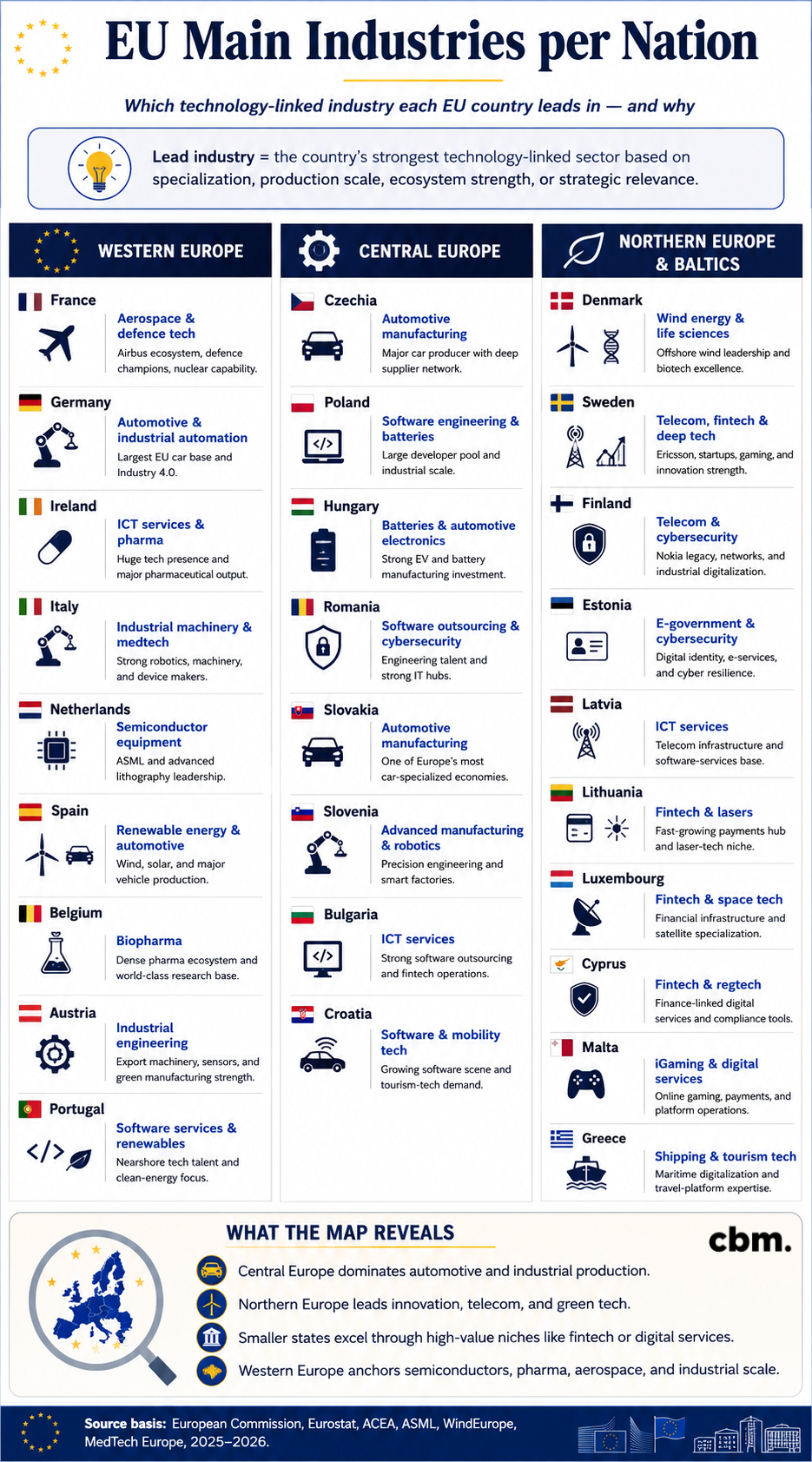
Unlike the United States, where technological power is heavily concentrated around a few large ecosystems, the EU’s industrial strength is more fragmented. Each country tends to lead in a specific cluster, often shaped by historic manufacturing strengths, education systems, regulation, infrastructure, public investment, and export specialization.
This creates a complex but resilient map of European technology. Germany leads in automotive engineering and industrial machinery. France combines aerospace, defense, nuclear energy, and AI ambitions. The Netherlands is globally critical because of ASML and semiconductor equipment. Ireland has become a major ICT and pharmaceutical hub. Belgium and Denmark are deeply embedded in life sciences. Sweden and Finland lead in innovation-driven digital and industrial technologies. Estonia is a benchmark in digital government. Lithuania has carved out a niche in fintech and laser technology. Czechia, Slovakia, Hungary, and Poland have become essential to Europe’s automotive and industrial supply chain.
The result is a European technology model based on specialization rather than uniformity.
Germany remains the EU’s largest industrial technology economy. Its strongest industries are automotive manufacturing, industrial automation, machinery, robotics, chemicals, and advanced engineering.
The country’s automotive sector remains central to its technology identity. Germany continues to be the EU’s largest passenger car producer and is home to major global groups such as Volkswagen, BMW, Mercedes-Benz, and Bosch. Its industrial base also supports the development of automation, sensors, factory software, robotics, and precision engineering.
Germany’s challenge is not industrial scale but transition speed. The shift to electric vehicles, software-defined cars, battery supply chains, and AI-driven manufacturing is forcing German industry to modernize quickly. Its leadership in traditional automotive engineering remains strong, but competition from China and the United States is reshaping the market.
France’s strongest technology-linked industries are aerospace, defense, nuclear energy, AI, transport systems, and luxury-tech manufacturing.
Airbus, Safran, Thales, and Dassault make France one of Europe’s strategic aerospace and defense centers. The country also has one of the EU’s most important nuclear technology ecosystems, giving it a distinctive role in energy security and low-carbon electricity.
France is also investing heavily in artificial intelligence and deep tech. Paris has become one of Europe’s leading AI and startup hubs, supported by public funding, elite engineering schools, and a growing venture-capital ecosystem.
France’s industrial profile is therefore more strategic than purely commercial. It is one of the EU countries most focused on technological sovereignty, defense autonomy, aerospace leadership, and high-value public-private innovation.
Italy is often underestimated in European technology rankings because it has fewer large digital platforms than northern Europe. However, it remains one of the EU’s most important advanced manufacturing economies.
Its strongest sectors include industrial machinery, robotics, packaging technology, automation, medical devices, aerospace components, fashion-tech, and design-led manufacturing. Northern Italy, in particular, has dense clusters of small- and medium-sized industrial companies that export specialized equipment worldwide.
Italy’s technological strength lies in applied industrial know-how. It may not dominate cloud computing or semiconductor equipment, but it is highly competitive in machinery, precision manufacturing, mechatronics, and automated production systems.
Spain’s strongest technology-linked industries are renewable energy, automotive manufacturing, smart mobility, travel technology, and digital services.
Spain is one of Europe’s major wind and solar energy markets. Its renewable energy sector has created globally active companies in electricity generation, grid operations, engineering, and energy infrastructure. The country is also one of the EU’s largest vehicle producers, with major plants serving European and global markets.
Spain’s technology profile is becoming more diversified. Barcelona and Madrid have grown into startup hubs, especially in travel tech, mobility, SaaS, fintech, and e-commerce services. The country’s opportunity is to integrate its strengths in renewable energy, automotive, and digital services into a stronger industrial technology ecosystem.
The Netherlands is one of Europe’s most strategically important technology countries because of its semiconductor equipment. ASML, based in Veldhoven, is the global leader in advanced lithography machines used to manufacture cutting-edge microchips.
This makes the Netherlands essential not only to Europe but to the global semiconductor supply chain. No serious discussion about chip sovereignty, AI infrastructure, or advanced manufacturing can ignore the Dutch role.
Beyond semiconductors, the Netherlands also leads in photonics, agritech, water technology, logistics technology, and digital infrastructure. Rotterdam and Schiphol support one of Europe’s most advanced logistics ecosystems, while Dutch universities and research institutes support strong innovation in engineering and life sciences.
Belgium’s strongest industries are biopharma, chemicals, logistics, medtech, and semiconductor research.
The country has a dense pharmaceutical and biotech ecosystem, supported by major research centers, universities, and multinational investment. Belgium is also a major logistics platform because of its ports, central location, and strong integration into European supply chains.
Another important Belgian asset is imec, one of the world’s leading semiconductor research institutions. While Belgium does not manufacture chips at the same scale as Asia, its role in semiconductor R&D is highly strategic.
Belgium’s technology economy is therefore built around life sciences, chemicals, logistics, and advanced research.
Luxembourg’s main technology-linked industries are fintech, space technology, satellite services, cybersecurity, and data infrastructure.
The country has long been a European financial center, and this has supported growth in financial technology, digital payments, fund administration software, and regulatory technology. Luxembourg has also positioned itself as a space-economy hub, particularly in satellite communications and space-resources policy.
Its small size limits industrial volume, but Luxembourg’s strength lies in high-value niches connected to finance, regulation, data, and space.
Ireland is one of the EU’s clearest examples of a specialized technology economy. Its strongest sectors are ICT services, pharmaceuticals, medical technology, cloud infrastructure, and data centers.
Major US technology companies have large European operations in Ireland, making the country a central hub for software, digital advertising, cloud services, and platform operations. At the same time, Ireland is one of Europe’s largest pharmaceutical and life sciences manufacturing bases.
This dual specialization in ICT and pharma gives Ireland one of the highest concentrations of technology in the EU. The country’s model depends heavily on multinational investment, but it has also created a strong local base of digital talent, business services, and regulatory expertise.
Denmark’s leading technology-linked industries are wind energy, life sciences, health technology, and digital public services.
The country is one of Europe’s most important wind-energy economies, with strong companies in turbines, offshore wind, energy systems, and green engineering. Denmark also has a globally significant life-sciences sector, including pharmaceuticals, diabetes care, enzymes, and biotech.
Digital public infrastructure is another Danish strength. The country consistently ranks highly in digital government, trust-based public services, and technology adoption.
Denmark’s industrial model combines clean energy, health innovation, and high levels of digital maturity.
Sweden is one of Europe’s strongest innovation economies. Its leading sectors include telecom, software, gaming, fintech, batteries, green industrial technology, and advanced manufacturing.
Ericsson gives Sweden a major role in telecom networks. Spotify and Klarna demonstrate the country’s ability to scale digital companies internationally. Northvolt, despite the challenges facing Europe’s battery industry, reflects Sweden’s ambition to lead in green industrial technology.
Sweden also has a strong gaming sector, with companies such as King, Mojang, and Embracer-linked studios contributing to its global digital footprint.
The Swedish model is built around engineering talent, startup culture, internationalization, and strong public-private innovation systems.
Finland’s main technology-linked industries are telecom networks, cybersecurity, industrial digitalization, gaming, and clean technologies.
Nokia remains central to Finland’s global technology identity, particularly in telecom infrastructure and networks. The country also has a strong cybersecurity ecosystem, supported by high digital literacy, defense awareness, and advanced public-sector technology.
Finland is also strong in industrial software, forest-industry technology, clean tech, and gaming. Its technology economy is smaller than those of Germany and France, but it is highly specialized and innovation-intensive.
Austria’s strongest technology-linked industries are industrial engineering, electronics, environmental technology, mobility systems, and advanced materials.
The country has a strong base of export-oriented manufacturing companies, especially in machinery, sensors, transport equipment, and energy-efficient industrial systems. Austria is also important in automotive components and semiconductor-related electronics.
Its technology profile is similar to Germany’s but more specialized. Austria’s competitive strength lies in high-quality engineering, industrial reliability, and green manufacturing.
Portugal’s leading technology-linked industries are software services, renewable energy, nearshore IT, fintech, and startup services.
Lisbon and Porto have become increasingly visible European technology hubs, especially for startups, software development, and international tech events. Portugal is also strong in renewable energy deployment and has built a reputation as a competitive nearshore technology location for European companies.
The country does not yet lead Europe in high-tech manufacturing, but it is becoming more relevant in digital services, remote talent, green energy, and startup ecosystems.
Greece’s main technology-linked industries are maritime technology, shipping services, tourism technology, renewable energy, and digital public services.
The Greek economy has a global maritime tradition, making shipping digitalization, port technology, fleet management, and marine services natural areas of strength. Tourism also supports technology demand in payments, platforms, booking systems, and digital customer experience.
Greece’s renewable-energy sector is growing, particularly in solar and wind. Its challenge is to convert sectoral strengths into a larger, export-oriented technology ecosystem.
Cyprus has built its technology profile around fintech, regtech, trading platforms, ICT services, and professional digital services.
The country’s role as a financial and business-services hub supports demand for compliance software, digital payments, online trading infrastructure, and cybersecurity. Cyprus also has a relatively high share of ICT-related business R&D compared with many larger economies.
Its market is small, but its specialization is clear: finance-linked digital services and regulatory technology.
Malta’s leading technology-linked industries are iGaming, fintech, digital platforms, ICT services, and regulatory services.
The country has one of the EU’s highest contributions of the ICT sector to national value added. Its iGaming industry has attracted international companies in online entertainment, payments, compliance, platform management, and customer operations.
Malta’s technology model is heavily service-based. It does not compete in manufacturing scale, but it has carved out a strong digital-services position through regulation, language skills, and international business infrastructure.
Estonia is one of Europe’s clearest digital-state success stories. Its strongest industries are e-government, digital identity, cybersecurity, SaaS, and public-sector digital infrastructure.
Estonia’s national digital identity system, online public services, and e-residency program have made it a benchmark for digital government. The country also has a strong cybersecurity reputation, influenced by its geopolitical position and early investment in digital resilience.
Estonia’s technology leadership is not based on sales volume but on the exportability of its models. Many countries look to Estonia as an example of how public services can be digitized efficiently.
Latvia’s strongest technology-linked sectors are ICT services, telecom, fintech support, business-process services, and digital infrastructure.
Latvia has a relatively high ICT contribution compared with several EU peers. Its strengths are concentrated in software services, digital operations, telecom networks, and back-office technology functions.
The country’s opportunity is to deepen its role in the Baltic digital economy, especially by connecting ICT talent with fintech, cybersecurity, and e-government services.
Lithuania has become one of the EU’s most interesting small-country technology stories. Its leading industries are fintech, laser technology, cybersecurity, payments, and regtech.
Vilnius has become a major fintech hub, particularly for electronic money institutions, payments companies, and financial infrastructure providers. Lithuania also has a long-standing niche in laser technology, supported by scientific research and export-oriented companies.
This combination of fintech regulation and deep-tech specialization gives Lithuania a distinctive position in the EU technology landscape.
Poland’s strongest technology-linked industries are software engineering, gaming, automotive components, batteries, business services, and industrial technology.
Poland has one of Europe’s largest pools of software developers and IT professionals. It is also globally visible in gaming through companies such as CD Projekt and a broader ecosystem of studios and service providers.
At the industrial level, Poland is increasingly important in automotive components, battery supply chains and manufacturing services. Its scale, cost competitiveness, and engineering base make it one of the EU’s most important emerging technology-industrial economies.
Czechia’s leading technology-linked industries are automotive manufacturing, industrial automation, cybersecurity, machinery, and electronics.
The country is one of the EU’s largest vehicle producers per capita and has a deep supplier base linked to German and Central European manufacturing. Czechia also has a strong cybersecurity brand, supported by companies such as Avast and a wider software-security ecosystem.
Czechia’s advantage lies in combining industrial production with increasingly sophisticated digital and engineering capabilities.
Slovakia is one of the most automotive-specialized countries in the EU. Its leading technology-linked industry is vehicle manufacturing, supported by automotive components, industrial automation, and emerging EV supply-chain investments.
The country has a high concentration of car production relative to its population. This creates strong manufacturing expertise but also a strategic risk: Slovakia’s economy is highly exposed to the transition from combustion-engine vehicles to electric and software-defined mobility.
Its future competitiveness will depend on how successfully it upgrades from assembly strength to higher-value EV, battery, software, and component capabilities.
Hungary’s strongest technology-linked industries are battery manufacturing, automotive electronics, vehicle production, industrial components, and electronics assembly.
The country has attracted significant foreign direct investment in battery plants and EV-related manufacturing. It is also part of the wider Central European automotive supply chain, serving German, Korean, Chinese, and other international manufacturers.
Hungary’s technology position is highly manufacturing-driven. Its main challenge is to increase local R&D value and avoid becoming overly dependent on foreign-owned production capacity.
Slovenia’s main technology-linked industries are advanced manufacturing, robotics, automotive suppliers, green technology, and industrial equipment.
The country has a strong engineering base and performs well in specialized manufacturing. It benefits from its position between Central Europe, the Balkans, and Italy, with close links to automotive, machinery, and components supply chains.
Slovenia’s technology leadership is niche-based rather than large-scale. Its strengths are precision, engineering quality, and industrial specialization.
Croatia’s leading technology-linked sectors are software, gaming, electric mobility, tourism technology, and digital services.
The country gained international visibility through mobility and software companies, while its tourism economy drives strong demand for digital platforms, payments, booking systems, and customer-experience technologies.
Croatia’s challenge is scale. It has promising technology companies and talent, but its ecosystem remains smaller than those of Poland, Czechia, or the Baltic states.
Romania’s strongest technology-linked industries are software outsourcing, cybersecurity, IT services, automotive components, and engineering services.
Bucharest, Cluj-Napoca, Iași, and Timișoara have become important technology centers, especially for software development and outsourced engineering. Romania also has a strong industrial base connected to automotive production and components.
Its competitive advantage lies in technical talent, cost competitiveness, and multilingual service delivery. The next step is moving from outsourcing to more product-led technology companies.
Bulgaria’s leading technology-related industries are ICT services, software outsourcing, fintech operations, cybersecurity support, and business process technology.
The country has one of the highest contributions of the ICT sector to gross value added in the EU. Sofia in particular has become a regional technology hub for software development, support operations, and digital services.
Bulgaria’s technology economy is service-oriented, with strong potential in nearshore software, fintech infrastructure, and cybersecurity services.
The country-level picture shows that the EU’s technology economy is not dominated by a single sector. Instead, it is divided into several major industrial clusters.
The first cluster is automotive and industrial technology. Germany, Spain, Czechia, Slovakia, Hungary, Poland, Austria, Romania, and Slovenia are deeply connected to vehicle production, components, machinery, and factory automation.
The second cluster is life sciences and health technology. Ireland, Belgium, Denmark, Germany, France, Italy, and the Netherlands all play important roles in pharmaceuticals, biotech, medical devices, and health innovation.
The third cluster is digital services and ICT. Ireland, Malta, Estonia, Latvia, Lithuania, Cyprus, Bulgaria, Romania, and Portugal stand out for software, fintech, digital platforms, or ICT value added.
The fourth cluster is strategic deep tech. The Netherlands leads in semiconductor equipment, Belgium in semiconductor research, France in aerospace and defense, Sweden and Finland in telecom and innovation, and Lithuania in lasers.
The fifth cluster is green technology. Denmark, Spain, Germany, Portugal, Greece, Sweden, Finland and Austria all have strong positions in renewable energy, smart grids, clean manufacturing or energy systems.
Europe’s largest strength is industrial depth. The EU has world-class companies and research ecosystems in automotive engineering, aerospace, pharmaceuticals, medtech, renewable energy, industrial machinery, semiconductors, and telecom equipment.
Another strength is specialization. Smaller countries often lead in focused niches. Estonia shows how digital government can become an international model. Lithuania has built a profile in fintech and laser technology. Malta has become a major iGaming and ICT-services center. Luxembourg has built a position in fintech and space. Denmark has combined wind energy and life sciences into a powerful innovation model.
Europe also benefits from strong regulation, skilled labor, public research systems, and high-quality manufacturing. These factors make the EU highly competitive in industries where trust, safety, compliance, and precision matter.
The EU’s biggest weakness is scale. Europe produces many excellent companies, but fewer global digital giants than the United States or China. Venture capital remains concentrated in a few markets, especially the UK, Germany, France, Sweden, and the Netherlands. Many promising companies struggle to scale across fragmented national markets.
Another weakness is dependency. Europe remains exposed to foreign suppliers in semiconductors, batteries, cloud infrastructure, critical raw materials, and some AI technologies. Even where Europe has strong industrial capabilities, key parts of the value chain may sit outside the EU.
The third weakness is uneven digital adoption. Some countries are highly advanced in cloud, AI, data analytics, and digital public services, while others lag behind. This creates a divided digital economy inside the single market.
For cross-border companies, understanding the EU's main industries per nation is more than a macroeconomic exercise. It helps identify where to find suppliers, partners, customers, innovation clusters, and investment opportunities.
A company looking for automotive technology should pay close attention to Germany, Czechia, Slovakia, Hungary, Poland, and Spain. A firm focused on fintech should monitor Ireland, Lithuania, Luxembourg, Cyprus, and Malta. A life sciences company should look closely at Ireland, Belgium, Denmark, Germany, and France. A renewable-energy business should analyze Denmark, Spain, Germany, and Portugal. A semiconductor or photonics company should look at the Netherlands, Belgium, Germany, Austria, and Lithuania.
The EU’s single market makes these national specializations even more powerful. Companies can combine Dutch semiconductor expertise, German industrial production, Polish software talent, Danish energy technology, Irish ICT infrastructure, and Baltic digital-government know-how into cross-border value chains.
The keyword “EU main industries per nation” captures one of the most important realities of the European economy: the EU is not a single technology ecosystem but a network of specialized national strengths.
Germany leads in automotive and industrial automation. France is powerful in aerospace, defense, and strategic technology. The Netherlands is essential to the global semiconductor industry. Ireland dominates in ICT services and pharma manufacturing. Denmark is strong in wind energy and life sciences. Sweden and Finland lead in innovation, telecom, and digital-industrial technology. The Baltic states are highly relevant in fintech, cybersecurity, and e-government. Central and Eastern Europe has become essential to automotive, batteries, software, and manufacturing supply chains.
Europe’s challenge is to connect these strengths more effectively. If the EU can reduce fragmentation, scale its technology companies, strengthen strategic supply chains, and accelerate digital adoption, its country-by-country industrial map could become one of its greatest competitive advantages.


By continuing to use the site, you agree to the use of cookies. more information
The cookie settings on this website are set to "allow cookies" to give you the best browsing experience possible. If you continue to use this website without changing your cookie settings or you click "Accept" below then you are consenting to this.