Hot Sale Mexico 2026 arrives with a clear question for retailers, marketplaces, and logistics providers: Can the country’s largest online shopping campaign beat the record set in 2025?
According to AMVO’s public Hot Sale 2025 results, last year’s campaign generated 19.2 million orders, 38.8 million units sold, and an average ticket of MXN $1,100. AMVO’s figures show that the campaign has already reached a scale where it is no longer only a promotional event, but a major test of Mexico’s digital commerce infrastructure.
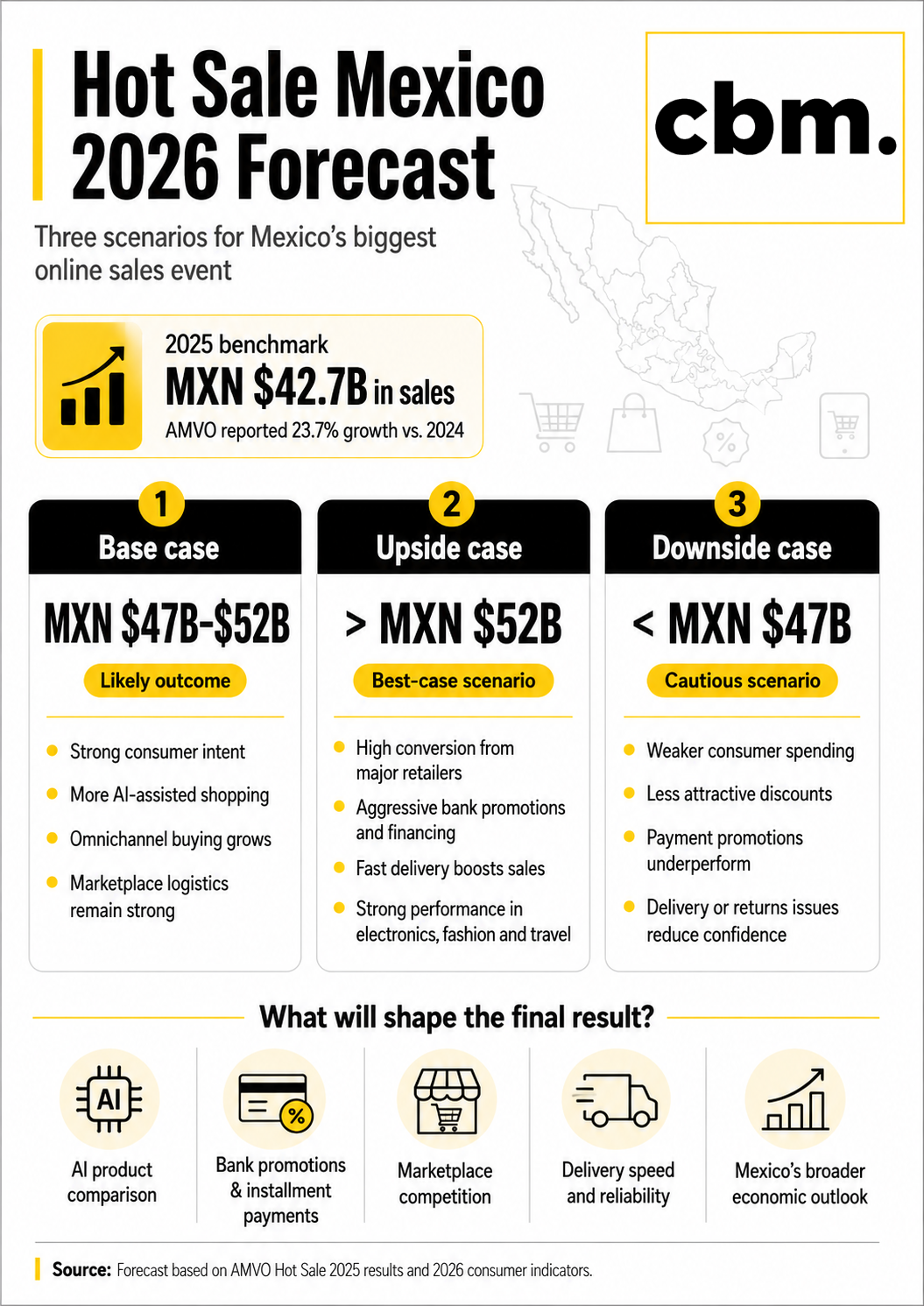
The sales benchmark is also significant. Hot Sale 2025 reached MXN $42.725 billion in sales, representing 23.7% growth versus 2024, according to AMVO figures reported by Mexican business media.
For Hot Sale Mexico 2026, the central forecast is positive, but more complex than in previous years. The campaign is likely to grow again, supported by strong purchase intent, wider use of AI-assisted comparison, omnichannel participation, marketplace competition, and faster delivery options. However, Mexico’s softer macroeconomic outlook could moderate the pace of growth.
Based on AMVO’s 2025 benchmark, the 2026 purchase-intent data, and Mexico’s broader e-commerce trajectory, a reasonable forecast range for Hot Sale Mexico 2026 is MXN $47 billion to MXN $52 billion in sales.
That range would imply an approximate growth of 10% to 22% compared with the MXN $42.725 billion reported for 2025. It would be slower than the 23.7% increase seen last year, but still strong enough to confirm Hot Sale as one of the most important commercial moments in Mexican retail.
This is not an official AMVO forecast. It is an editorial forecast based on the available public indicators: the scale of Hot Sale 2025, AMVO’s 2026 consumer signals, Mexico’s continued online retail growth, the rise of marketplace logistics, and the broader economic outlook.
The strongest argument for another record year is consumer intent. AMVO’s Pulso Hot Sale 2026 says that 8 out of 10 internet users plan to buy during Hot Sale 2026. The same AMVO summary also highlights two structural changes: 50% of consumers will use AI to compare products, and 76% plan to buy both online and in physical stores.
That combination points to a more mature campaign. Hot Sale is not only attracting bargain hunters; it is attracting consumers who plan purchases, compare prices, move between channels, and use digital tools to validate offers.
AMVO’s broader e-commerce data also supports the growth case. The association’s Estudio de Venta Online 2025 reported that Mexico’s online retail market reached MXN $789.7 billion in 2024, after 20% nominal growth that year. AMVO also notes that online retail sales in Mexico have posted double-digit growth for six consecutive years.
In that context, Hot Sale 2026 is entering a market that remains structurally expansionary, even if the macroeconomic environment is less supportive than in previous years.
One of the biggest differences between Hot Sale 2025 and Hot Sale 2026 is the role of artificial intelligence in the shopping journey.
AMVO’s 2026 summary states that 50% of consumers will use AI to compare products during the campaign. Other coverage of AMVO’s findings has reported even stronger consumer interest in AI-assisted shopping, including product comparison, recommendations, and feature research.
This matters because AI can change how consumers evaluate promotions. In previous editions, retailers and marketplaces competed mainly through banners, email campaigns, app notifications, marketplace rankings, and bank promotions. In 2026, a larger share of shoppers may use AI tools to check whether a discount is real, compare similar products, summarize reviews, and identify better alternatives.
That could increase conversion for well-prepared sellers, but it could also expose weak product data. Retailers with incomplete descriptions, inconsistent specifications, poor review quality, or unclear pricing may struggle to convert more analytical shoppers.
For cross-border sellers, this is particularly relevant. AI-assisted comparison may make foreign sellers more visible when they offer attractive prices, but it may also punish weak localization, unclear delivery timelines, and vague return policies.
Hot Sale began as a digital campaign, but AMVO’s 2026 signals suggest this year’s edition may be the most omnichannel yet. AMVO’s public summary says 76% of consumers plan to buy both online and in physical stores during Hot Sale 2026.
This changes the meaning of the campaign. Hot Sale is no longer only about e-commerce transactions. It increasingly shapes the full retail journey: online research, mobile comparison, marketplace discovery, physical-store validation, click-and-collect, home delivery, and post-purchase service.
For retailers with both digital and physical operations, this creates an opportunity to use stores as fulfillment points, return locations, pickup hubs, and trust anchors. For pure players, it raises the pressure to compete on delivery reliability, customer service, and payment flexibility.
The likely result is that Hot Sale 2026 will generate not only online sales growth, but also broader retail influence across physical and digital channels.
Marketplaces are expected to be one of the main engines of Hot Sale Mexico 2026. Mercado Libre, in particular, is positioning the campaign around promotions, financial incentives, AI, and same-day delivery in 37 cities, according to DPL News coverage of the company’s 2026 Hot Sale plans.
This is important because logistics speed has become a central differentiator in Latin American e-commerce. Reuters reported that Latin American online shopping is projected to reach $215.31 billion in 2026, with growth driven by reliable delivery and transparent pricing. The same report noted that Argentina, Brazil, and Mexico accounted for nearly 85% of regional online sales in 2025, and that 84% of purchases in the region were made via smartphones.
For Hot Sale Mexico 2026, this means marketplaces are not only competing on discounts. They are competing on fulfillment capacity, app experience, returns, payments, credit and trust. The sellers that benefit most will likely be those that can combine competitive prices with fast delivery and clear post-purchase conditions.
Hot Sale in Mexico is strongly shaped by payment promotions. Discounts matter, but conversion often depends on whether consumers can access months-without-interest offers, bank bonuses, cashback, digital wallets, or marketplace credit.
AMVO’s 2026 public page says its full report includes a detailed analysis of payment and delivery incidents, buyer profiles, purchase motivators, and banking usage, showing how central payments have become to campaign performance.
This is why the 2026 forecast should not be based only on traffic or purchase intent. The final sales figure will depend on how effectively retailers and financial partners convert interest into purchases. In a softer economic environment, financing can become even more important, especially for higher-ticket categories such as electronics, appliances, furniture, travel and personal technology.
The main reason to avoid an overly aggressive forecast is Mexico’s economic context. The IMF projects 1.6% real GDP growth for Mexico in 2026 and 3.9% consumer price inflation.
The World Bank’s 2026 outlook is slightly more cautious, projecting 1.3% GDP growth in 2026, with a gradual recovery toward 2028. It also points to trade policy uncertainty, fiscal constraints and investment risks as factors that could moderate the rebound.
More recent economic data also suggests caution. Reuters reported that Mexico’s economy contracted 0.6% quarter-on-quarter in Q1 2026, although it still grew slightly year-on-year.
This does not mean Hot Sale 2026 will underperform. Promotional campaigns can perform well in slower economies because consumers concentrate planned purchases around discount windows. However, it does mean growth may be more dependent on financing, essential categories, clear discounts and trust in delivery.
The base case is that Hot Sale Mexico 2026 surpasses the 2025 record, but grows more moderately than last year. Strong consumer intent, AI-assisted shopping, omnichannel behavior and marketplace logistics should support another expansion. Under this scenario, sales would land between MXN $47 billion and MXN $52 billion.
The upside case would require strong performance from marketplaces, major retailers and banks, plus a high conversion rate in categories such as electronics, appliances, fashion, beauty, travel and home goods. Same-day delivery, aggressive financing and successful mobile campaigns could push the event above MXN $52 billion.
The downside case would emerge if consumer spending weakens, discounts are perceived as less attractive, payment promotions underperform, or delivery and return issues reduce confidence. In that case, Hot Sale 2026 could still grow, but at a much slower rate, landing below MXN $47 billion.
The categories most likely to perform strongly are those where consumers actively compare prices and wait for promotional periods. Electronics, appliances, fashion, beauty, personal care, home goods and travel are likely to remain central to the campaign.
AI-assisted comparison may especially benefit categories with high product complexity, such as smartphones, laptops, televisions, home appliances, and consumer electronics. These are areas where shoppers need to compare technical specifications, prices, warranties, reviews and delivery timelines before purchasing.
Fashion and beauty should also benefit from mobile-first behavior, marketplace traffic and social media influence. However, these categories may face stronger competition and higher return rates, making fulfillment and post-purchase experience important for profitability.
For cross-border sellers, Hot Sale Mexico 2026 offers a strong opportunity, but the market is becoming harder to win without localization.
The campaign will reward sellers who can offer Spanish-language product content, transparent prices, reliable delivery estimates, local payment options, clear return policies and competitive fulfillment. It will be harder for foreign merchants to rely only on low prices, especially as consumers use AI tools to compare alternatives and detect weak offers.
The 2026 edition also shows why Mexico should be treated as a strategic e-commerce market in Latin America. Regional data cited by Reuters shows that Mexico is part of the group of markets that dominate Latin American online sales, while AMVO’s own data confirms that Mexico’s online retail channel continues to grow at double-digit rates.
Hot Sale Mexico 2026 is likely to surpass the MXN $42.725 billion benchmark set in 2025. A realistic forecast places this year’s campaign between MXN $47 billion and MXN $52 billion, assuming that strong consumer intent translates into actual purchases.
The key difference in 2026 is that a more sophisticated digital consumer will drive growth. Shoppers are expected to use AI to compare products, move between online and offline channels, rely on payment promotions, and judge sellers on delivery reliability as much as on price.
For Mexico’s e-commerce ecosystem, Hot Sale 2026 is more than another promotional campaign. It is a forecast of where the market is heading: more omnichannel, more mobile, more AI-assisted, more dependent on logistics execution, and more competitive for both domestic and cross-border sellers.




By continuing to use the site, you agree to the use of cookies. more information
The cookie settings on this website are set to "allow cookies" to give you the best browsing experience possible. If you continue to use this website without changing your cookie settings or you click "Accept" below then you are consenting to this.