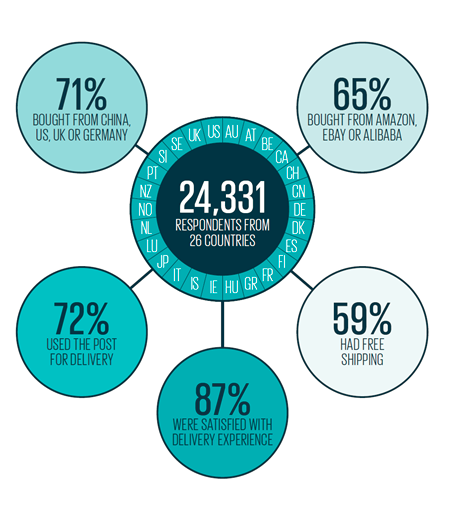
In its second edition of the cross-border e-commerce shopper survey, IPC has considerably increased the reach of the survey, extending to over 24,000 respondents in 26 markets across North America, Asia-Pacific and Europe. View the document here.
What are consumers’ preferences?
Consumer preferences in China differed from other developed markets. Chinese consumers are more likely to shop online than consumers in any other country, with 36% shopping online at least once a week. Given that China is the largest e-commerce market in the world ranked by retail e-commerce sales, it provides an insight into the future of cross-border online shopping in other markets.
The most popular device for shopping online was a laptop (41%), followed by a desktop (36%) and a smartphone (14%). Shopping online with a smartphone is becoming increasingly popular. Smartphone preference increased from 9% in the 2015 survey to 14% in 2016. The Chinese lead this trend, with 29% of consumers preferring to shop with a smartphone. Smartphone usage is expected to rapidly grow in the years to come.
The survey indicated that clear information about delivery charges, free returns and free delivery over a particular value are the most important drivers for cross-border online shoppers.
Considering cross-border purchases, consumers are more likely to pay extra for tracking rather than for speed of delivery. Consumers are more willing to pay for delivery of a tracked item that takes 5-8 days that an untracked item that takes 3-4 days.
Where are consumers buying from?
China is the most popular market for consumers around the world to shop from, accounting for 26% of most recent cross-border purchases, followed by the US (16%), Germany (15%) and the UK (15%).

The US and China are the main markets cross-border shoppers bought from in Asia-Pacific and Canada. China is the overall favoured market for Europeans, but notable differences are seen in Luxembourg,
Belgium, Austria or Switzerland where cross-border shoppers mainly bought from neighbouring countries with a shared language.
Amazon, eBay and Alibaba were the top three websites used by cross-border consumers in almost all countries. Overall, they accounted for 65% of most recent cross-border purchases.
What are consumers buying?
The top four categories bought cross-border are clothing, footwear & apparel (33%); consumer electronics (21%); books, music & media (14%) and health & beauty (13%). When looking at the value of the goods bought by cross-border online shoppers, goods ordered online cross-border are mostly low-weight and low-value items, with 45% weighing less than 500g, and 16% valued less than €10, with a further 40% valued between €10 and €49.
What are consumers’ delivery experiences?
This year’s survey confirms that most cross-border purchases had free shipping. 59% of respondents received free shipping for their most recent cross-border e-commerce purchase. Chinese consumers benefited the most from free shipping (78%). 70% of cross-border online shoppers were offered tracking and 88% used it, mostly in the interim stage to check on delivery progress. Almost three-quarters of shoppers used the post for their most recent cross-border purchase. Overall, 87% were satisfied with their delivery experience.
Overall, 30% of purchases included a free return label. Only 6% returned their cross-border purchase, mostly using the post for this return.
To download the key findings from the research click here.




By continuing to use the site, you agree to the use of cookies. more information
The cookie settings on this website are set to "allow cookies" to give you the best browsing experience possible. If you continue to use this website without changing your cookie settings or you click "Accept" below then you are consenting to this.