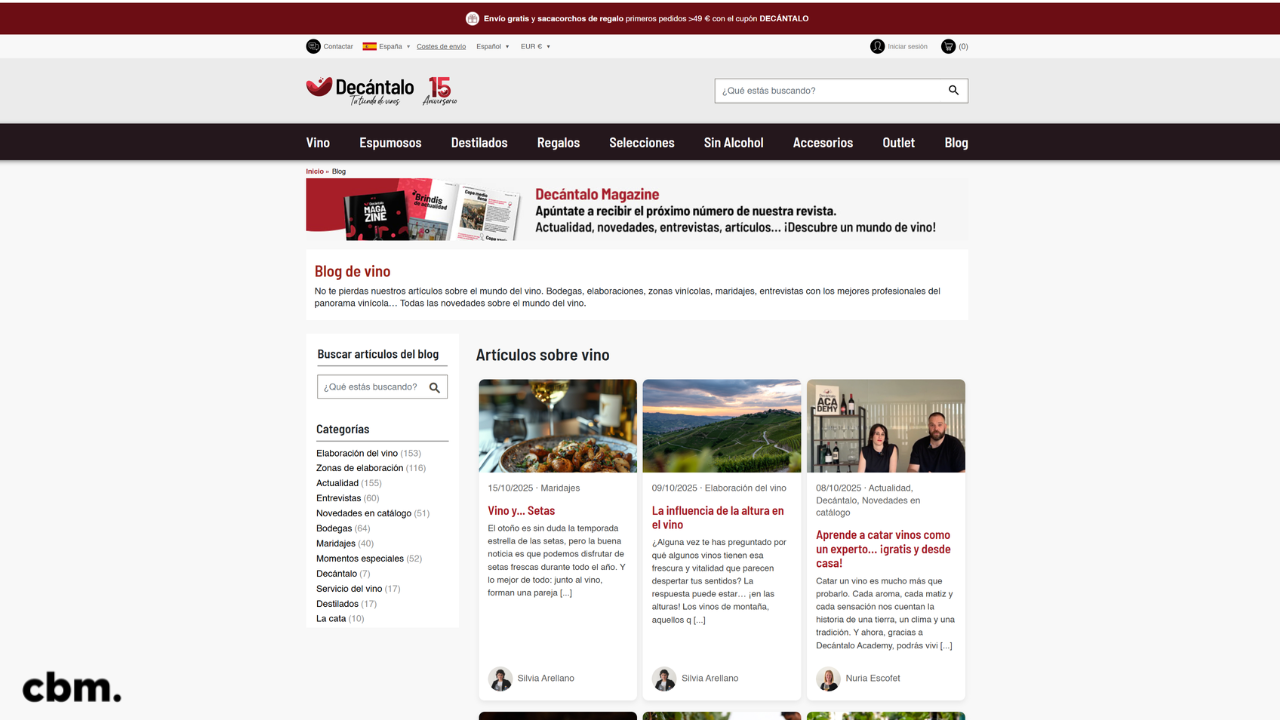
By Salesupply- Decántalo has become one of Spain’s leading online wine retailers, bringing the country’s finest wines to customers across nearly 40 countries. Founded in 2010 by Héctor and Oriol, what began as a side project during the financial crisis evolved into a thriving international e-commerce success story.
In this exclusive interview conducted by Olga Pijanowska, cross-border and e-commerce expert from Salesupply, Cross-Border Magazine uncorks Decántalo’s remarkable journey — from its origins as a small experiment to a global wine destination. Discover how the brand mastered cross-border sales, adapted to diverse markets, and embraced AI to elevate its customer experience while staying true to the soul of Spanish wine.
OLGA: Héctor, thank you for taking the time to talk to us. Let's start at the beginning: how did Decántalo come about? What inspired you to launch an online wine store? It's been 15 years now, right?
HÉCTOR: Yes, we celebrated our 15th anniversary this February. Decántalo was founded in 2010, and to be honest, it was almost by chance. There were two of us partners—Oriol and I—and we had a web development studio. We designed websites for different brands, but with the real estate crisis in Spain, it became very difficult to sell projects. At the same time, e-commerce was starting to take off, and we were very attracted to that world, although launching an online store at that time was very expensive.
We thought: why not create our own store to show what we can do? That's how Decántalo was born, almost as a test. Soon, orders started coming in: one, three, ten, thirty... until one day we said, “Hey, this works, and we're hardly paying any attention to it. What if we take it seriously?” That's how it all started.
OLGA: And from that start in Spain, how did you approach internationalization? What strategy did you follow to enter other markets?
HÉCTOR: It was quite natural. In the midst of the economic crisis, consumption in Spain was low, so we realized that if we wanted to grow, we had to go abroad. From day one, we had the website in Spanish, French, English, and German. That allowed us to target markets such as France, the United Kingdom, Switzerland, and Germany, which were already more digitally mature and had greater purchasing power. And, of course, an affinity for Spanish wine.
OLGA: How many countries do you currently sell to?
HÉCTOR: Right now, we ship to 38 countries. We sell throughout the European Union, as well as in the United Kingdom, Switzerland, some in the United States, although less since tariffs went up, and in some parts of Asia.
OLGA: As this is an interview for Cross Border Magazine, I'd like to focus a little on the internationalization aspect. From your experience, how have you approached expansion into new countries?
HÉCTOR: For me, the most important thing when selling abroad is to understand the mindset of the local consumer. It sounds simple, but even within the EU there are many cultural differences. Some markets are more sensitive to price, others to the payment method, the carrier, or even how you present the product. The big challenge is to adapt both the message and the service to the expectations of each customer according to their country.
OLGA: Could you give us some specific examples of these differences between countries?
HÉCTOR: Sure. One example I always mention is the contrast between Switzerland and Germany. They are neighboring countries, and they share part of their language, but their consumers couldn't be more different.
In Switzerland, customers buy higher-value bottles and greatly value quality, service, and detailed information. Average basket sizes are very high. In contrast, Germany is our market with the lowest average ticket sizes. German consumers are very price-sensitive, look for deals, and feel they are getting a good deal when they get a good price.
There are even cultural differences. For example, in Spain, when you have guests, you tend to open your best wine. In Germany, it is often the opposite: people opt for a cheaper bottle to avoid appearing ostentatious. These kinds of nuances are key to connecting with each market.
OLGA: It's very similar to what happens in Central Europe, such as in Poland or the Czech Republic. The languages and cultures are similar, but purchasing behaviors are very different.
HÉCTOR: Exactly. That's why we have native speakers on the team. They are the ones who best understand these sensitivities. Knowing how your customer thinks is essential.
OLGA: Let's talk about payments now. Have you encountered any challenges in offering local payment methods? How important is payment localization to you?
HÉCTOR: It's crucial. Although we use the euro in Europe, there are countries like the United Kingdom with the pound and Switzerland with the Swiss franc. We offer 10 payment methods and 7 different currencies. We always try to offer the most common payment options in each country.
Let me tell you a story: in Germany, we decided to remove PayPal because of its fees. We thought it would help us improve our margins. The result: sales fell 40% overnight. That's when we realized that even if something doesn't make financial sense for us, if the customer wants it, we have to offer it. In Germany, PayPal inspires a lot of confidence, and removing it was a big mistake.
OLGA: Let's move on to logistics. How do you manage storage and international shipping? Have you had to adapt your operations for certain markets?
HÉCTOR: We have a single 2,000 m² warehouse in Barcelona, which is refrigerated and powered by solar panels. We manage everything from there. We use a lot of technology to optimize stock and replenish products quickly. Approximately 95% of our catalog is always available, and what isn't, we replenish in less than 24 hours so we can ship it the same day or the next.
OLGA: I imagine that wine is not a product for immediate consumption, so perhaps the customer is more willing to wait a few days...
HÉCTOR: In general, yes. Wine is often bought to have at home or for a future occasion. But we also have customers who need wine for a wedding or urgent celebration. So even though there is more time, customers still expect speed. It's part of today's expectations.
OLGA: And how do you handle international returns?
HÉCTOR: Fortunately, we have very few returns. It's not a sector like fashion, for example, where this is a problem. Our problem is the fragility of the product. To address this, we are working on developing our own protective packaging for the boxes, which helps us to keep the breakage rate very low.
OLGA: In terms of customer service, how do you manage it in so many languages and markets?
HÉCTOR: We have an internal multilingual team that covers Spanish, German, French, and English. We provide customer service through three main channels: phone, email, and web chat.
We handle phone calls directly from Barcelona. For emails, we use an AI-powered ticketing system that suggests responses to frequently asked questions, but these are always reviewed by a native agent. For chat, we use artificial intelligence with Oct8ne as the first layer, although customers can request to speak to a person if they wish.
OLGA: I was just about to ask you about Oct8ne. How has its use impacted your customer service?
HÉCTOR: We've been using chat for about six years, and in the last year we incorporated AI. Today, 97% of chats are handled directly by artificial intelligence, with the option to escalate to a human. Response speed has improved significantly, and we are available 24/7. The most interesting thing is that indicators such as “add to cart” or conversions have not only not decreased, but have actually increased.
OLGA: Impressive! It seems that AI is working very well for you.
HÉCTOR: Yes, but it's key to feed it well. We train our system with 14 years of customer service history. That allows it to understand very well how we respond, what values we convey, how we treat the customer. AI is only as good as the information you give it.
And something important: we haven't reduced staff. We've simply reassigned them to more valuable tasks. For example, personalized attention for event quotes such as weddings. We find it more useful for them to be there, rather than answering “Where is my order?” all day long.
OLGA: Throughout this international journey, have you made any mistakes that you have learned from?
HÉCTOR: Several. The most obvious was removing PayPal in Germany, as I already told you. Another was not being clear from the outset about how to handle international taxation. When we started out, the legal framework was not entirely defined, and we gradually regularized it over time. If I could go back, I would have informed myself better about the tax requirements in each country from the outset. Today, fortunately, it is much easier.
OLGA: That's very valuable advice for any company starting to sell abroad. The initial decisions set the course.
Finally, what is the next step for Decántalo? Is there a project that you are particularly excited about?
HÉCTOR: Although we have been around for 15 years, we feel that there is still a lot to do. We are very visible in Spain, but we want to strengthen our brand in markets where we are already present, such as Germany, France, Switzerland, and the United Kingdom. And then grow in the rest of Europe. Our focus continues to be on consolidating what we do well, but with ambition. I think we still have another 15 years of growth ahead of us.
OLGA: That's entrepreneurial spirit! Thank you very much for sharing your experience so clearly. There are very few companies in the world of wine that can boast such an international reach. Congratulations and see you next time!



By continuing to use the site, you agree to the use of cookies. more information
The cookie settings on this website are set to "allow cookies" to give you the best browsing experience possible. If you continue to use this website without changing your cookie settings or you click "Accept" below then you are consenting to this.