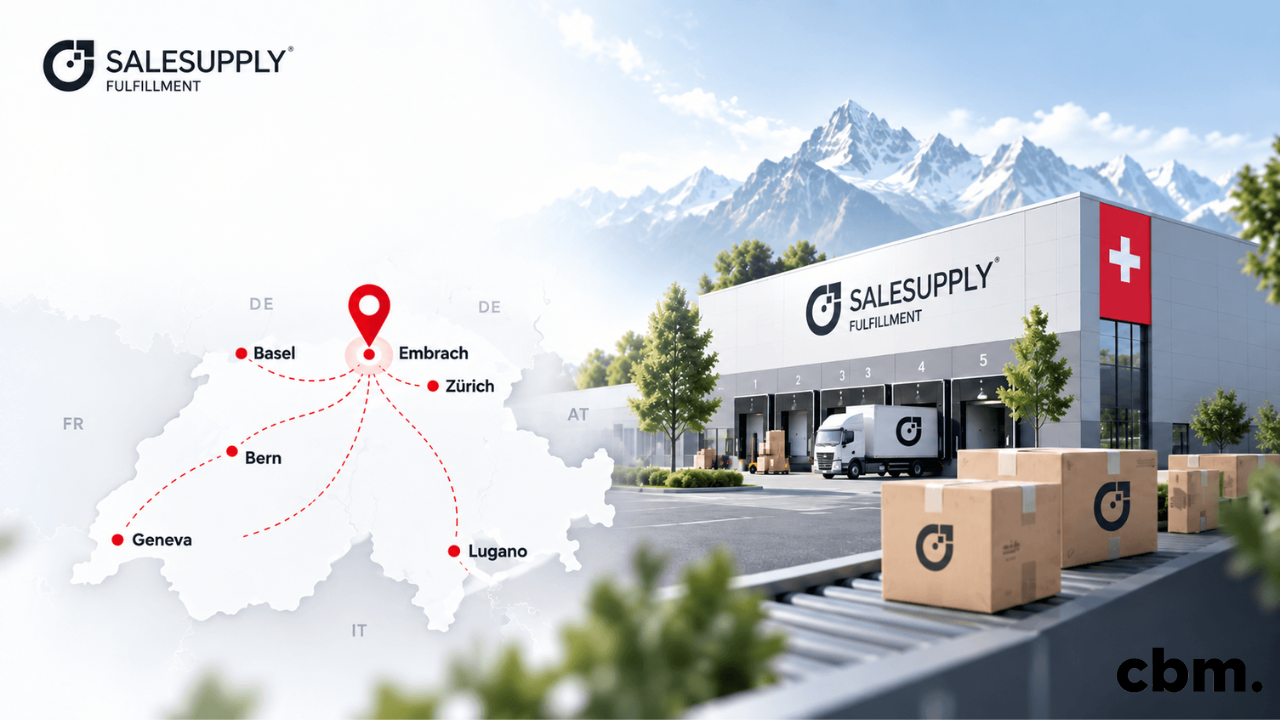
Salesupply has expanded its international logistics network by opening a new fulfillment center and returns hub in Switzerland. Located in Embrach, in the canton of Zurich, the facility lets international e-commerce brands store inventory, fulfill domestic Swiss orders, and process returns without repeatedly moving goods across the Swiss-EU border.
The location is situated close to Zurich Airport and the surrounding customs infrastructure, positioning the facility to support both domestic distribution and international inventory flows. For Salesupply, Switzerland becomes the latest node in a fulfillment network that already covers multiple markets across Europe, North America, and other international regions.
The expansion is particularly relevant for cross-border merchants because Switzerland is not part of the European Union or the EU customs union. Consequently, an e-commerce shipment entering Switzerland from an EU member state is treated as an import and must comply with Swiss customs and VAT requirements.
For European online retailers, Switzerland represents an attractive but operationally distinct e-commerce market. Unlike shipments moving between EU member states, goods entering Switzerland are subject to customs procedures and potentially import VAT.
Switzerland currently applies a standard VAT rate of 8.1%, while certain categories of goods qualify for the reduced 2.6% rate. Import VAT can therefore become an important part of the customer experience when retailers sell into the country from warehouses located elsewhere in Europe.
Depending on the shipping and customs arrangement the merchant uses, customers may face additional charges for taxation, customs processing, or carrier handling when their parcel enters Switzerland. These additional steps can make the buying experience less predictable compared with a purely domestic transaction.
By placing inventory in Switzerland before fulfilling individual customer orders, merchants can ship subsequent orders domestically. Salesupply argues this can provide customers with clearer pricing while reducing the customs administration associated with individual cross-border parcels.
Returns are another area where the Swiss border can add complexity.
When a product originally shipped into Switzerland is subsequently returned to a warehouse in the European Union, the parcel crosses a customs border again. Depending on how the process is structured and documented, merchants can face customs-clearance requirements and additional administrative costs.
For categories with relatively high return rates, these costs can matter more. Fashion, footwear and consumer electronics retailers, for example, may need to manage substantial volumes of merchandise moving back through their supply chains.
Salesupply's new Swiss returns hub is intended to keep returned merchandise in the country. Products can be received and processed locally before the retailer decides whether they should be restocked, consolidated or otherwise handled.
The model effectively separates consumer returns from international inventory movement. Rather than sending every individual return back across the border, merchants can manage the return locally and potentially consolidate subsequent international movements.
The new center in Embrach gives Salesupply customers the option to hold stock directly in Switzerland and fulfill orders through domestic delivery networks. For international brands, this approach can help create a customer experience that more closely resembles purchasing from a Swiss-based retailer. Inventory is already in the country, customer orders don't need to complete an individual import process, and returns can be directed to a domestic location.
Local inventory can also become more valuable as consumers expect shorter, more predictable delivery windows. Cross-border shipping can add variables, including customs processing, documentation requirements, and potential border delays. A Swiss fulfillment operation removes the international customs process from the final delivery leg once inventory has entered the country.
The new operation may also be relevant to brands selling through Swiss marketplaces, particularly Digitec Galaxus.
Switzerland's largest e-commerce platforms place significant emphasis on product availability, delivery performance, and reliable after-sales processes. Sellers operating internationally therefore need logistics infrastructure that meets Swiss consumer expectations while complying with individual marketplace requirements.
Salesupply specifically highlighted Galaxus when announcing the new facility, noting that delivery speed, availability and returns infrastructure can influence marketplace operations. The company says that sellers on the platform require access to a Swiss returns address.
For brands entering Switzerland through marketplace channels, combining local inventory with a domestic returns operation can therefore provide both logistical and commercial advantages.
Instead of treating Switzerland simply as another European destination served from an EU warehouse, merchants can operate with a dedicated local logistics setup.
Switzerland represents an unusual opportunity for European e-commerce businesses. Geographically, it sits at the center of Western Europe and borders major EU economies including Germany, France, Italy and Austria. From a customs perspective, however, it remains a separate market.
This distinction means that fulfillment strategies commonly used across the European Union do not necessarily produce the same results in Switzerland. A retailer can, for example, serve customers in Germany, France, the Netherlands, and many other EU markets from a single European warehouse without customs declarations for every intra-EU consumer shipment. Sending the same product into Switzerland creates a formal import. That difference makes inventory positioning especially important.
Moving goods into Switzerland in larger inventory shipments and then fulfilling consumer orders domestically can shift customs processing from the individual customer transaction to the retailer's supply-chain operation. For companies generating sufficient Swiss order volumes, local fulfillment can therefore become increasingly attractive.
Salesupply says the Swiss facility will operate using the same infrastructure as its other international fulfillment locations. Customers using multiple Salesupply warehouses can manage operations through a single IT integration and a real-time inventory dashboard. The company also monitors the network through its Fulfillment Control Tower, which oversees operations and identifies potential disruptions across fulfillment locations.
The objective is to allow existing Salesupply customers to add Switzerland to their fulfillment footprint without establishing an entirely separate logistics system.
For brands entering the country for the first time, the company says the service combines local inventory management, domestic order fulfillment, returns processing and support with Swiss VAT and customs operations.
The launch in Switzerland is part of Salesupply's wider strategy to help online retailers position inventory closer to consumers in individual markets. The Dutch e-commerce service provider offers international fulfillment, customer service and returns solutions. According to the company, more than 500 online brands and retailers use its services, including Carhartt, Segway Ninebot and Panasonic.
Salesupply also provides customer service in more than 25 languages across three time zones and operates fulfillment infrastructure designed to help merchants expand internationally while delivering locally. The company is headquartered in Nijmegen, the Netherlands, and operates across markets including the United States, United Kingdom, Germany, France, Poland, Spain, Italy, and the Nordic region.
Adding Switzerland gives Salesupply another strategically important European fulfillment location while addressing a key challenge of Swiss cross-border e-commerce: the customs border separating the country from the European Union. For retailers with meaningful sales volumes in Switzerland, local fulfillment could reduce customs interactions affecting individual customer orders while creating a more predictable domestic delivery and returns experience.


By continuing to use the site, you agree to the use of cookies. more information
The cookie settings on this website are set to "allow cookies" to give you the best browsing experience possible. If you continue to use this website without changing your cookie settings or you click "Accept" below then you are consenting to this.