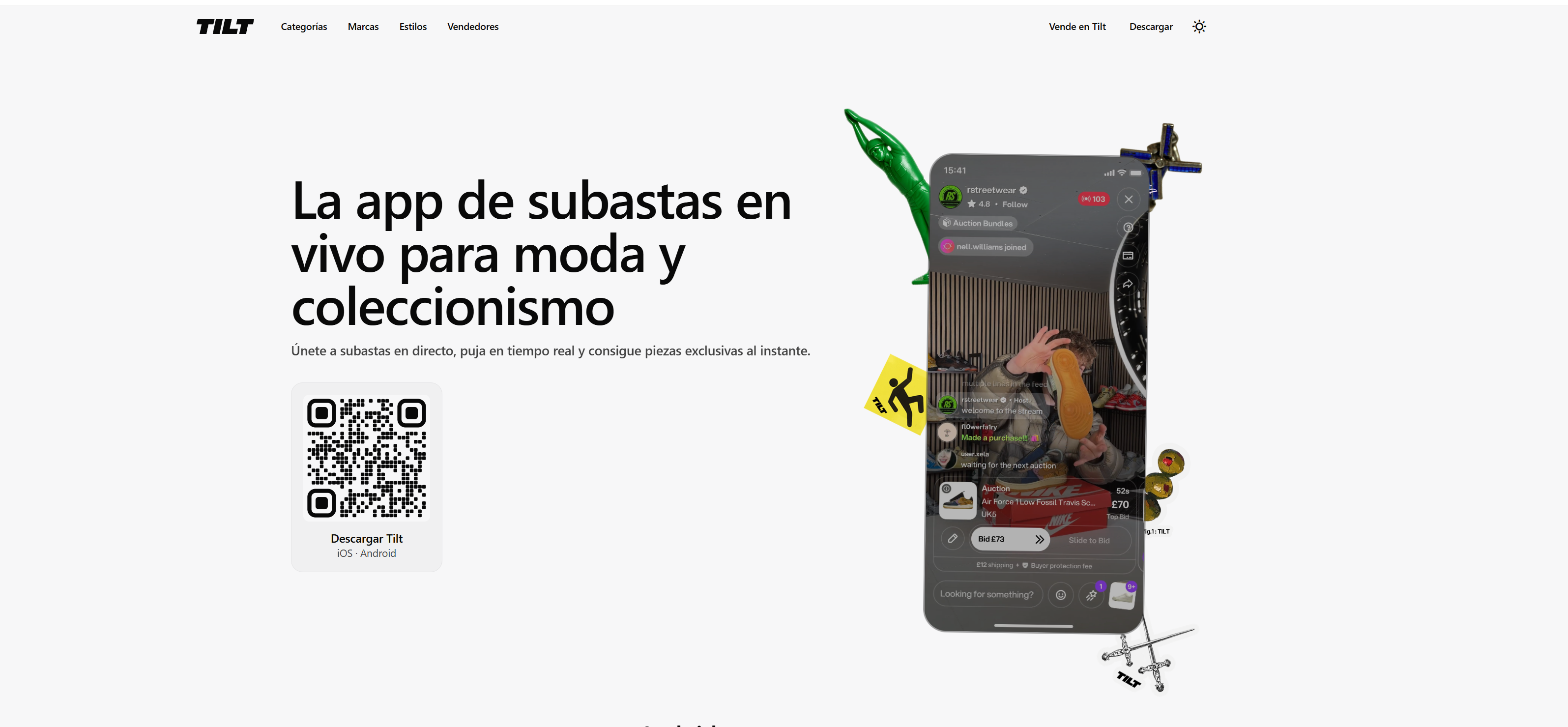
London-based live commerce platform Tilt has raised $26 million in fresh funding, marking one of the most notable recent funding rounds in Europe’s e-commerce startup ecosystem. The investment comes as live shopping, social commerce and AI-powered seller tools move from experimental formats to serious strategic priorities for online retailers, marketplaces and recommerce platforms.
The round includes Vinted Ventures, the investment arm of second-hand marketplace Vinted, as a new investor, alongside existing backers TQ Ventures, Balderton Capital, Earlybird, Seedcamp and others. According to Tilt, the new capital brings the company’s total funding raised to over $50 million.
Founded in 2021 by former Revolut employees Abhi Thanendran and Neil Shah, Tilt is building a live auction app where sellers showcase products in real time and buyers can bid, interact and purchase through livestreams. The company positions itself as a European answer to the rise of entertainment-driven commerce, combining video, community, auctions and AI-powered discovery into one shopping experience.
For years, European e-commerce has been defined by search, static listings, price comparison and increasingly efficient checkout flows. Tilt’s model points in a different direction: one where online shopping becomes more interactive, social and content-led.
That shift is already visible across the wider market. TikTok Shop has been expanding across Europe, joining existing markets including France, Germany, Ireland, Italy, Spain and the UK. TikTok has also reported that more than 100,000 European businesses had already joined TikTok Shop across France, Germany, Italy, Spain and Ireland, with strong growth in daily gross merchandise value across those markets.
Tilt operates in the same broader movement, but with a more focused live auction and community-commerce model. Instead of simply adding shoppable videos to a social network, Tilt is building a dedicated marketplace around real-time selling. This makes the company especially relevant for fashion, sneakers, collectibles, second-hand items and categories where scarcity, trust, personal presentation and community can influence conversion.
Traditional e-commerce is built around product pages. Tilt is built around live interaction.
Sellers go live, show items on camera, answer questions and create a sense of urgency through auctions. Buyers do not only browse; they watch, interact, bid and return to sellers or communities they trust. This is why live commerce can create a very different type of retention from conventional marketplace shopping.
Tilt says it has grown 8x since its 2024 Series A. The company also reports that buyers spend over an hour a day on the app, that 70% return week-on-week, and that 70% of monthly GMV comes from repeat buyers. The platform is currently live across the UK, Italy, Spain and Poland.
These figures matter because they suggest Tilt is not only acquiring occasional buyers. It is trying to build a repeat shopping habit around live discovery, seller personality and community engagement.
Tilt’s funding round is not just a live shopping story. It is also an AI e-commerce story.
The company has developed a set of AI tools designed to reduce friction for sellers and improve product discovery for buyers. These include Snap, a tool that can turn an item shown on camera into a listing within seconds; a real-time AI copilot that supports sellers with pricing and responses during livestreams; natural-language search across live sessions; and AI-generated clips that can repurpose livestream content for social media distribution.
This is strategically important. One of the challenges of live commerce is operational intensity. Sellers need to source products, present them, answer questions, price items, manage auctions, create content and maintain community engagement. AI can help reduce that workload and make live selling more scalable for smaller merchants.
For buyers, AI also helps solve a discovery problem. In a live shopping environment, inventory is fluid and time-sensitive. Traditional search is less effective when the best product may be inside a livestream happening right now. Tilt’s AI-powered matching and search tools are designed to connect users with relevant live sessions in real time.
The participation of Vinted Ventures is one of the most significant elements of the round. Vinted is one of Europe’s best-known second-hand marketplaces, and its venture arm’s investment in Tilt suggests that live commerce is increasingly relevant to the future of recommerce.
Second-hand and resale categories are particularly well suited to live selling. Items are often unique, condition varies, trust matters, and buyers may want to see products from different angles before purchasing. A livestream can make resale feel more transparent and more engaging than a static listing.
Tilt itself framed Vinted’s backing as a strategic signal. In the company’s announcement, CEO and co-founder Abhi Thanendran said that the next generation will not browse static listings in the same way, but will discover and buy through video, conversation and live interaction. Vinted’s Martijn van Heeswijk also highlighted Tilt’s differentiated experience in live selling, with potential in fashion and beyond.
For European recommerce, this could be an important development. If resale marketplaces increasingly move toward video-led discovery, the competitive landscape could shift from who has the largest catalogue to who can create the strongest buyer-seller interaction.
Live commerce has already become a major retail format in Asia. Tilt says the category is a $370 billion-plus industry in Asia, while Western markets are still at an earlier stage of adoption.
In Europe, the format is now becoming more competitive. TikTok Shop is expanding its European footprint. Whatnot has established itself as a major live auction player globally. At the same time, local platforms such as Tilt are trying to build a European model adapted to regional consumer behaviour, seller communities and recommerce habits.
The wider e-commerce context supports this shift. Eurostat data shows that in 2024, EU enterprises generated 19.49% of total turnover from e-sales, with websites and apps accounting for 8.39% and EDI-type sales accounting for 11.07%. Web sales remain the dominant e-sales method among enterprises, but the next layer of competition is increasingly about discovery, attention and conversion rather than simply having an online sales channel.
This is where live commerce becomes strategically relevant. As more businesses sell online, standing out through static listings becomes harder. Content-led and community-led formats offer a new way to reach buyers, especially younger audiences already accustomed to discovering products through short video and creator recommendations.
Tilt says the new funding will be used to accelerate its AI roadmap, expand its seller base across new markets and continue scaling the team. The company currently has a team of around 60 people.
The expansion strategy appears to focus on three areas.
First, Tilt needs to continue improving the seller experience. Live commerce only works at scale if sellers can list products quickly, manage livestreams efficiently and reach relevant audiences without excessive manual work.
Second, the company needs to expand geographically. Tilt is already active in the UK, Italy, Spain and Poland, but Europe remains fragmented by language, payment habits, delivery expectations and local marketplace preferences.
Third, Tilt needs to defend its position as larger players move into the same space. TikTok Shop has enormous distribution. Whatnot has significant funding and category experience. Traditional marketplaces could also add more livestreaming and auction features over time.
Tilt’s raise is relevant beyond the startup itself. It reflects a broader direction of travel in e-commerce.
Retailers, brands and marketplaces are under pressure to reduce customer acquisition costs, increase retention and create more engaging shopping experiences. Live commerce offers a possible answer by combining product discovery, entertainment, community and conversion in the same environment.
For fashion and second-hand sellers, the opportunity is particularly clear. Products can be demonstrated in real time, condition can be shown more transparently, and scarcity can create urgency. For niche categories such as sneakers, collectibles or limited drops, live auctions can turn shopping into an event rather than a transaction.
However, the model also creates new operational requirements. Sellers need presentation skills, inventory discipline, fast fulfilment, clear returns policies and strong customer service. Platforms need trust and safety systems, payment infrastructure, moderation, buyer protection and logistics partnerships. In that sense, live commerce is not simply a marketing format. It is a full e-commerce operating model.
Tilt’s $26 million funding round sits at the intersection of three major e-commerce trends.
The first is AI automation. E-commerce companies are increasingly using AI to support product listing, discovery, search, content generation and customer interaction.
The second is video-led shopping. TikTok Shop’s expansion across Europe shows that major platforms believe content-driven commerce can become a mainstream sales channel.
The third is recommerce. Vinted Ventures’ participation highlights the relevance of live selling for second-hand and resale categories, where trust, uniqueness and product condition are especially important.
Together, these trends suggest that the future of online shopping in Europe may not be defined only by faster delivery or lower prices. It may also be defined by richer interaction, stronger communities and smarter discovery.
Tilt’s $26 million raise shows that investor interest in European e-commerce is moving beyond traditional marketplace models. The new capital, combined with Vinted Ventures’ participation, positions Tilt as one of the most closely watched European startups in live commerce.
The company still faces major challenges. Live shopping adoption in Europe remains less mature than in Asia, competition from TikTok Shop and Whatnot is intensifying, and scaling across Europe requires strong localization. But Tilt’s growth metrics, AI tooling and recommerce relevance make the company an important indicator of where the market may be heading.
For European e-commerce, the message is clear: the next wave of competition will not only be about who sells online. It will be about who can turn shopping into discovery, interaction and repeat engagement.




By continuing to use the site, you agree to the use of cookies. more information
The cookie settings on this website are set to "allow cookies" to give you the best browsing experience possible. If you continue to use this website without changing your cookie settings or you click "Accept" below then you are consenting to this.