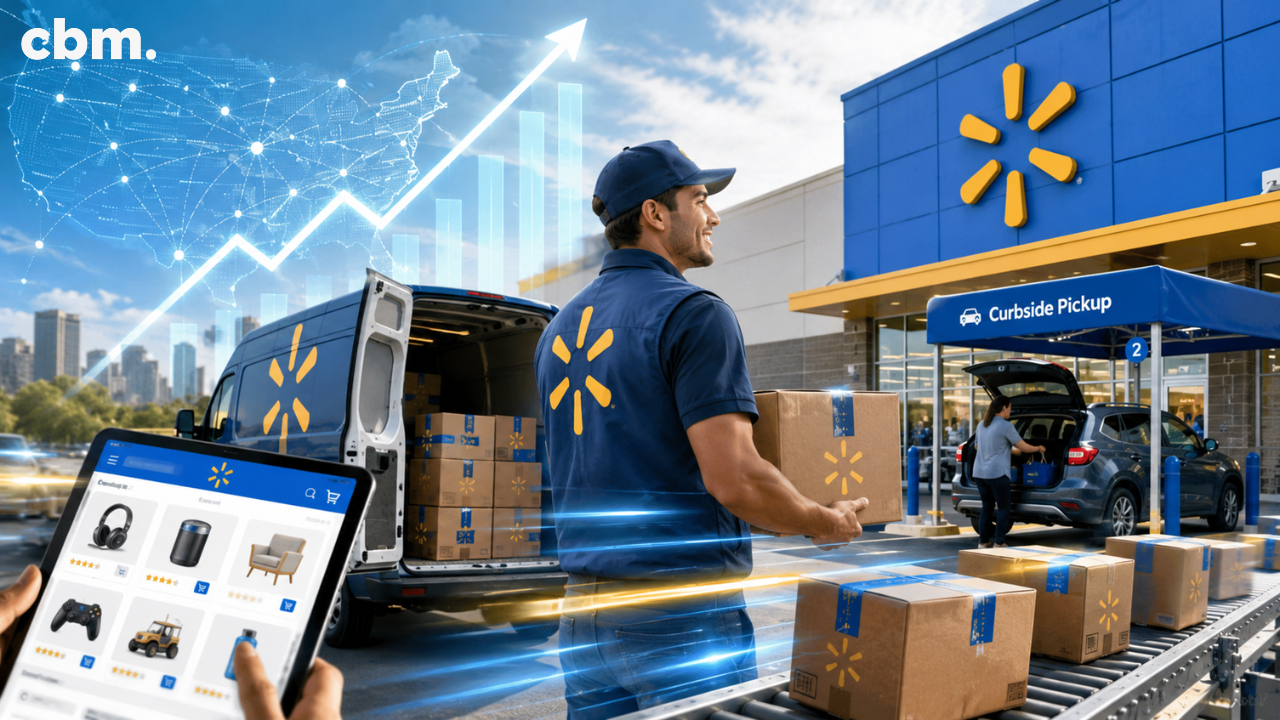
Walmart’s U.S. e-commerce business continued to outpace its traditional retail operations in the second quarter of fiscal 2027, with online sales increasing 24% year over year as the retailer leaned further into store-based fulfilment, marketplace expansion and faster delivery.
The performance reinforces Walmart’s transformation from a predominantly store-led retailer into a broader omnichannel commerce platform. While comparable U.S. sales increased at a much more modest pace during the quarter, digital channels remained one of the strongest areas of the business.
According to Walmart’s Q2 FY27 results, global e-commerce sales increased 23%, while Walmart U.S. e-commerce grew 24%. Online sales now account for approximately 23% of Walmart U.S. sales, illustrating how central digital commerce has become to the company’s overall retail model.
One of the key drivers of Walmart’s e-commerce growth is its growing use of physical stores as fulfillment hubs. Walmart said store-fulfilled delivery increased 40% during the quarter. Rather than depending exclusively on large regional fulfillment centers, the company is increasingly using inventory already located in its thousands of stores to fulfill online orders closer to the end customer.
The approach gives Walmart an important structural advantage in last-mile delivery. Stores historically designed primarily for in-person shopping can increasingly perform multiple roles simultaneously: retail location, pickup point, fulfillment node, and local delivery hub.
This distributed model can shorten the distance between inventory and consumers, allowing Walmart to expand same-day and rapid delivery services while making greater use of an existing physical network. Walmart described strong demand for convenient and fast delivery as one of the principal drivers of its global digital growth during the quarter.
The growing importance of store fulfillment reflects a broader shift across retail logistics. Traditionally, large e-commerce operations concentrated inventory inside dedicated warehouses positioned strategically around a country or region. Walmart is increasingly combining this model with a vast network of stores already located close to population centers.
This creates a distributed fulfillment network. For customers, the visible result is faster delivery. Behind the scenes, however, the model requires much deeper integration between inventory management, order orchestration, store operations and last-mile logistics. Walmart needs to determine in real time whether an online order should be fulfilled from a store, distribution center or another part of its network while simultaneously preserving enough inventory for customers shopping physically.
Successfully coordinating these channels is becoming one of the defining logistical challenges of large-scale omnichannel retail.
Walmart is also seeing strong momentum from its third-party marketplace. The company reported that Walmart U.S. marketplace net sales increased by more than 50% during Q2 FY27. Nearly half of Walmart's marketplace business globally now flows through the company's fulfillment services.
That combination is strategically important. A marketplace lets Walmart expand its product assortment without owning all the inventory being sold. Fulfillment services, meanwhile, enable the company to generate additional revenue by storing, processing and delivering products on behalf of third-party merchants.
The model increasingly resembles the ecosystem strategy that has helped Amazon expand beyond direct retail. Rather than generating revenue only from the final product sale, a marketplace operator can earn revenue across several layers of the transaction, including seller commissions, fulfillment, advertising and membership services.
Walmart's digital growth is increasingly connected to several of the company's other strategic priorities. Its Q2 results showed global advertising revenue increasing 38%, while Walmart Connect in the United States grew 43% excluding Vizio. The company has been expanding advertising alongside marketplace, membership and fulfillment services as it seeks to generate more revenue from each customer and merchant interaction.
These businesses are particularly important because many of them can carry higher margins than traditional retail. The result is a commerce ecosystem in which a marketplace transaction can potentially generate revenue from the seller, fulfillment, advertising, and the customer relationship, in addition to the underlying retail transaction.
Walmart highlighted marketplace, fulfillment services, membership, advertising, and other commerce solutions as businesses strengthening the company's economics.
The e-commerce performance was particularly notable because Walmart's broader U.S. retail growth was considerably slower. U.S. comparable sales excluding fuel increased 2.6% during the quarter. Reuters reported that this represented Walmart's slowest comparable-sales growth in approximately six years and fell below market expectations.
Walmart nevertheless raised its full-year sales and profit outlook. The contrasting results underline a key shift within the company: digital commerce is expanding much faster than the traditional store business.
Walmart U.S. e-commerce grew 24%, compared with 2.6% comparable sales growth, while Sam's Club U.S. e-commerce sales increased 26%. Walmart International e-commerce increased another 19%.
The divergence suggests that consumers are not necessarily abandoning Walmart's physical infrastructure. Instead, they are increasingly accessing the same inventory through digital channels.
Amazon remains the dominant e-commerce operator in the United States, but Walmart possesses an asset that is difficult for digital-native competitors to replicate: an enormous network of stores already positioned close to consumers. Walmart has increasingly treated those locations as logistics infrastructure.
That strategy changes the competitive equation around delivery. Instead of trying to reproduce Amazon's fulfillment network exactly, Walmart can combine dedicated e-commerce facilities with thousands of existing retail locations that can support pickup and local delivery.
The company is therefore competing not only through product pricing and assortment but increasingly through fulfillment speed and convenience. Its continued investment in automation, digital platforms and fulfillment technology is designed to make that network more productive while reducing the cost of serving increasingly demanding online customers.
Fast delivery can improve customer loyalty and conversion, but it also creates significant cost pressures. Picking individual orders from stores, coordinating delivery drivers, and transporting smaller baskets directly to homes can become expensive if order density is insufficient.
Scale is therefore crucial. The more orders Walmart can consolidate within the same geographic area, the easier it becomes to improve route density and spread delivery costs across more transactions. Marketplace growth can help by bringing more products and order volume into Walmart's logistics ecosystem.
Fulfillment services provide another layer of scale by encouraging marketplace sellers to place inventory within Walmart's distribution network. The objective is ultimately not simply to grow online sales, but to make those transactions increasingly profitable.
Walmart noted that its international operating-income growth benefited from improving e-commerce economics, particularly in China, India and Canada, suggesting that digital profitability remains a major focus across the group.
Walmart's results also illustrate a broader shift within global e-commerce. Competition between major retailers is increasingly determined by logistics capabilities rather than simply website traffic, product selection or pricing.
Consumers now expect accurate inventory visibility, multiple fulfillment options, convenient returns and increasingly rapid delivery. Meeting those expectations requires retailers to connect stores, warehouses, marketplaces and delivery networks into a single fulfillment system.
For retailers with large physical networks, this creates an opportunity. Stores can become strategic assets rather than liabilities in the age of e-commerce, provided their inventory and operations are integrated effectively with digital ordering systems. Walmart's 24% U.S. e-commerce growth suggests that this strategy is gaining momentum.
The longer-term significance of Walmart's digital growth extends beyond online retail sales. The company increasingly resembles a commerce infrastructure provider connecting consumers, merchants, advertisers and logistics services.
Its marketplace provides access to additional assortment. Walmart Fulfillment Services allows merchants to outsource logistics. Walmart Connect monetizes shopper traffic through advertising. Membership programs increase customer loyalty, while its store network provides local fulfillment capacity.
Together, these businesses create an increasingly interconnected commercial ecosystem. Amazon pioneered a similar model in which retail, marketplace services, fulfillment, advertising, and subscriptions reinforce each other. Walmart's advantage is that it can combine those digital capabilities with one of the world's largest physical retail networks.
Walmart's latest results reinforce one of the most important trends shaping modern retail: the distinction between physical commerce and e-commerce continues to disappear. The company's stores are increasingly becoming components of its digital fulfillment infrastructure, while its online marketplace feeds additional volume into logistics, advertising and fulfillment businesses.
For other retailers, the lesson may be less about matching Walmart's scale than about integrating channels more effectively. Inventory visibility, flexible fulfillment and delivery speed are becoming increasingly important competitive factors.
Walmart's Q2 FY27 results suggest that retailers that can turn physical locations into distributed e-commerce infrastructure may have a significant advantage as consumers increasingly prioritize convenience and faster delivery. For Walmart, the 24% increase in U.S. e-commerce sales is therefore more than another strong digital quarter.
It is further evidence that logistics and fulfillment are becoming central to the company's strategy for competing in the next phase of global e-commerce.



By continuing to use the site, you agree to the use of cookies. more information
The cookie settings on this website are set to "allow cookies" to give you the best browsing experience possible. If you continue to use this website without changing your cookie settings or you click "Accept" below then you are consenting to this.