
Artificial intelligence is no longer a future trend in online retail. It is already reshaping how American companies attract shoppers, convert traffic, fulfill orders, and build long-term customer loyalty. Across the United States, businesses are using AI not simply to automate tasks, but to grow faster in a market where competition is intense, and consumer expectations continue to rise.
That makes AI driving e-commerce growth in the USA one of the most important stories in modern retail. The U.S. remains one of the world’s largest digital commerce markets, with online sales reaching $1.233 trillion in 2025, up 5.4% year over year, according to the U.S. Census Bureau. E-commerce also accounted for 16.4% of total retail sales, continuing its steady share gains across the broader economy.
The key question is no longer whether AI matters. It is how much of future growth will belong to the companies that implement it best.
Growth in American e-commerce has become harder to achieve. Paid acquisition costs have increased, customer loyalty is weaker, and shoppers can compare prices, reviews, and alternatives in seconds.
In that environment, AI gives retailers an edge by improving the economics of growth. Instead of relying only on more traffic or bigger discounts, companies can use data and automation to make every customer interaction more valuable.
AI is helping U.S. retailers improve:
For many brands, that combination is more powerful than traffic growth alone.
The strongest argument for AI in retail is measurable performance. Several recent studies show that AI is already influencing online shopping behavior in the United States.
Adobe Analytics reported that AI-driven visits to U.S. retail sites grew 4,700% year over year in July 2025. While AI traffic still represents a relatively small share of total visits, the growth rate suggests a new discovery channel is emerging.
During Black Friday 2025, U.S. online spending reached a record $11.8 billion, up 9.1% from the previous year. Adobe linked part of that momentum to AI-powered shopping tools that helped consumers find deals faster and compare products more efficiently. AI-driven retail traffic during the event surged 805% year over year.
Additional research found that traffic referred by AI tools converted 31% higher than other traffic sources and produced 27% lower bounce rates, suggesting AI-assisted shoppers may arrive with stronger purchase intent.
Those figures do not prove that AI alone created all the growth, but they strongly suggest that AI is becoming a meaningful commercial lever.
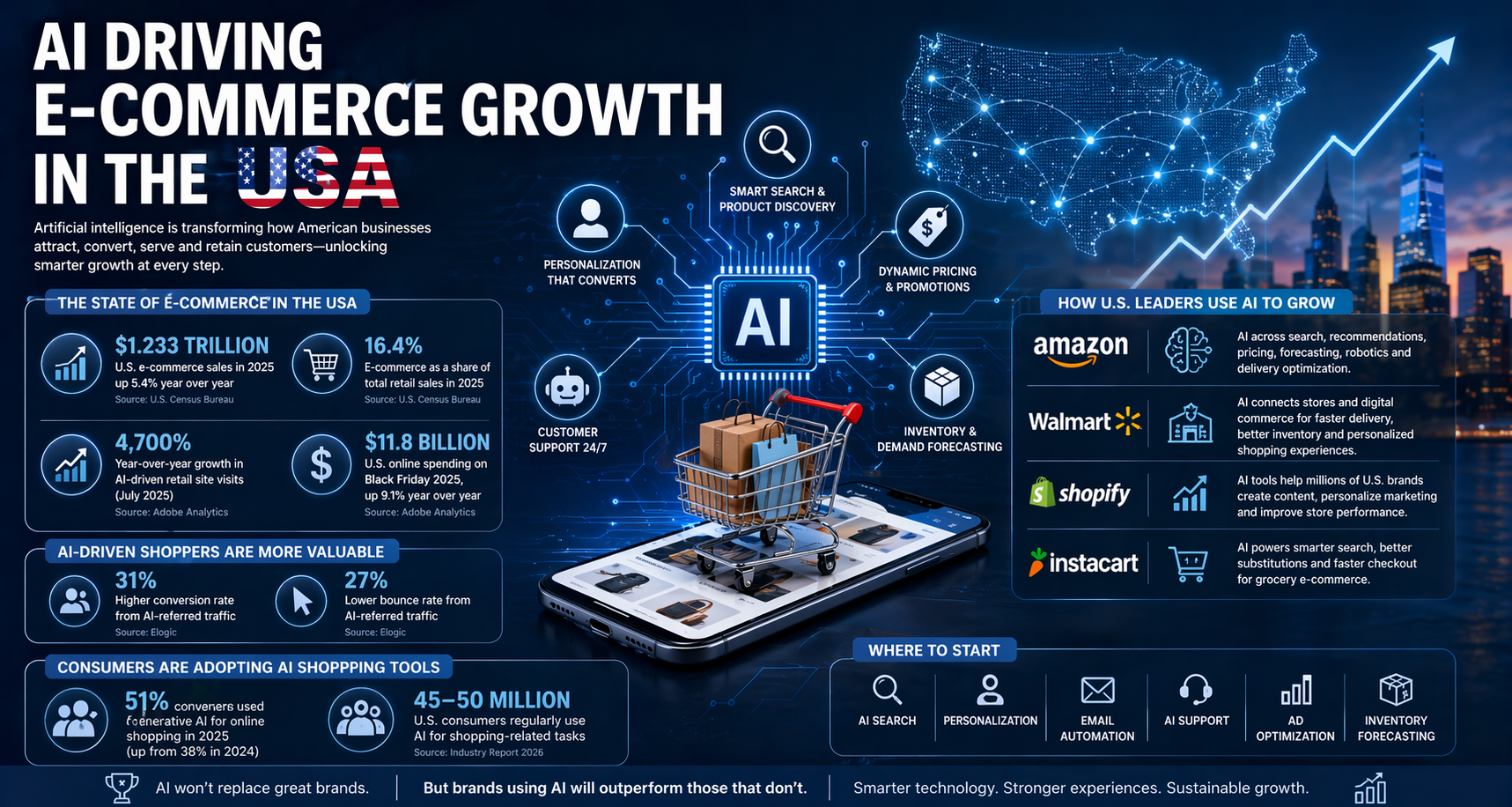
Amazon has integrated artificial intelligence across nearly every layer of its e-commerce model. Customers experience it through smarter search results, personalized recommendations, and conversational tools such as Rufus. Behind the scenes, Amazon uses AI in pricing, forecasting, warehouse robotics, and delivery routing.
This matters because growth at Amazon’s scale depends on efficiency as much as demand. Faster recommendations, better search relevance, and lower fulfillment costs can create billions in incremental value over time.
Amazon’s strategy also reflects a broader U.S. trend: AI works best when it improves both customer experience and operations simultaneously.
Walmart shows how AI can help a legacy retailer compete aggressively online. Rather than separating stores from digital commerce, Walmart uses AI to connect them.
That includes:
Because Walmart stores are close to most American households, AI helps transform physical proximity into an e-commerce advantage. Faster pickup, same-day delivery, and more accurate stock availability all contribute to digital growth.
Not every U.S. retailer is Amazon or Walmart. Millions of smaller brands rely on platforms like Shopify, and AI is making advanced capabilities accessible to them.
Instead of hiring large technical teams, merchants can now use AI for:
This is important because AI-driven growth in the USA is not limited to enterprise retailers. Smaller businesses can now compete with tools that were once available only to major corporations.
Consumer behavior is changing alongside retailer adoption. One 2026 industry report found that 51% of consumers had used generative AI for online shopping in 2025, up from 38% in 2024. It is also estimated that roughly 45 to 50 million U.S. consumers regularly use AI for shopping-related tasks.
That does not mean shoppers want AI to replace human decision-making entirely. In many categories, people still value trust, brand reputation, and human recommendations. But AI is increasingly becoming part of the shopping journey, especially in product research, comparisons, and discovery.
Not every AI use case creates the same commercial impact. In the U.S. market, several areas consistently stand out.
Many online stores lose sales when shoppers cannot quickly find the right product. AI-powered search understands intent rather than matching only keywords, which can improve relevance and shorten the path to purchase.
Modern AI can adapt product rankings, homepage content, promotions, and recommendations in real time. More relevant experiences often lead to higher conversion rates and larger baskets.
Some industry estimates suggest personalization leaders can see revenue lifts of up to 40%, though results vary widely depending on execution and data quality.
As paid media becomes more expensive, AI helps brands target audiences more accurately, test creatives faster, and allocate budgets more effectively. This can lower acquisition costs while improving return on ad spend.
Stockouts and overstock both damage profitability. AI helps predict demand using historical sales, seasonality, and customer trends, leading to better inventory decisions and stronger margins.
AI assistants can answer common questions instantly, recommend products, and resolve routine issues 24/7. That improves customer satisfaction while reducing support costs.
AI is powerful, but it is not magic. Many companies still struggle to move from pilots to scaled results.
One 2026 analysis found that while AI adoption is widespread, only a small share of retailers have fully scaled their programs across the organization. In other words, many companies are experimenting, but fewer are capturing the full growth opportunity.
That gap usually comes down to three issues:
AI systems are only as good as the data behind them.
Disconnected platforms reduce the value of automation.
Businesses that chase trends without measurable use cases often underperform.
The United States is especially well-positioned for AI-led e-commerce growth because it combines:
When innovation creates even small percentage gains in a market worth more than a trillion dollars, the impact can be enormous.
The evidence is increasingly clear: AI is becoming a real driver of e-commerce growth in the USA.
It is helping retailers attract higher-intent traffic, convert more shoppers, personalize experiences, optimize supply chains, and operate more profitably. The strongest companies are not using AI as a gimmick. They are embedding it into the foundations of their growth.
As competition increases and margins tighten, the next chapter of American e-commerce will likely be shaped less by who spends the most on ads and more by who applies artificial intelligence most effectively.