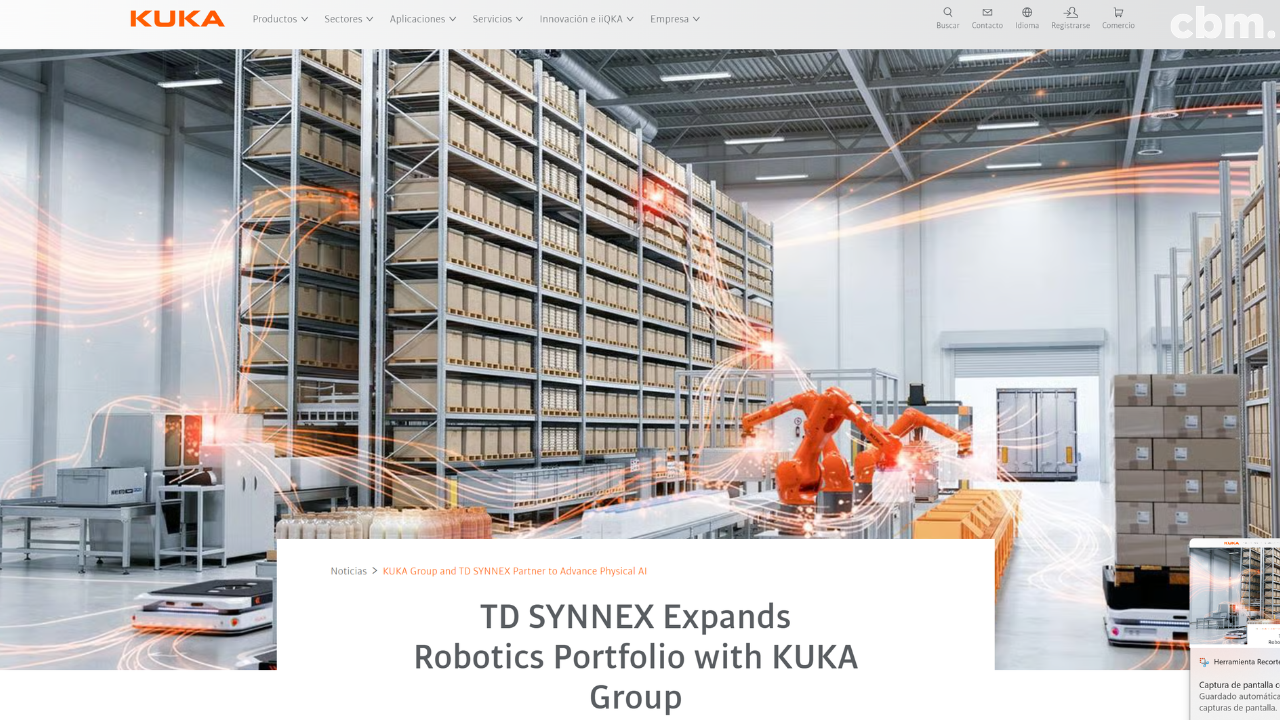
Industrial automation specialist KUKA Group has expanded access to its autonomous mobile robot portfolio through a distribution agreement with technology distributor TD SYNNEX, targeting businesses across Europe and North America. The partnership initially covers the United Kingdom, France, Spain, Benelux and the United States, with additional markets expected to follow in the coming quarters.
The agreement aims to make advanced robotics and automation technologies more accessible to companies in logistics, e-commerce, manufacturing, and other industries. By combining KUKA's industrial automation expertise with TD SYNNEX's established technology distribution network, the companies aim to accelerate the adoption of autonomous mobile robots and artificial intelligence in physical operating environments.
The initiative also reflects a broader transformation in warehouse automation, as businesses increasingly explore robotics to improve internal transportation, operational efficiency and the scalability of fulfillment operations.
Under the agreement, TD SYNNEX's distribution partners will gain access to KUKA Group's autonomous mobile robot (AMR) portfolio, supported by technical training, commercial assistance and business development resources.
The initial rollout covers several major European markets, including the United Kingdom, France, Spain, Belgium, the Netherlands and Luxembourg, alongside the United States. The companies plan additional geographic expansion in the coming quarters, although they have not disclosed a detailed timetable or identified all future markets.
The partnership initially focuses on autonomous mobile robots, with collaborative robots, educational solutions, and industrial software expected to join the distribution offering as the relationship develops. TD SYNNEX will also provide technical workshops, training programs, and demand-generation support to help its partners build the expertise needed to sell and implement robotics solutions.
For KUKA, the agreement represents an opportunity to reach businesses beyond its traditional industrial automation customer base. For TD SYNNEX, it marks an expansion into a technology segment increasingly connected to artificial intelligence, cloud computing and enterprise digital transformation.
Autonomous mobile robots transport goods and materials through warehouses, distribution centers, and other industrial facilities without requiring continuous manual control. Unlike traditional automated guided vehicles, which often rely on fixed routes or physical guidance systems, AMRs typically use sensors, mapping technologies, and navigation software to navigate changing environments.
In e-commerce fulfillment centers, these systems can support several operational activities, including transporting inventory between storage locations, delivering goods to picking stations, and moving completed orders toward packing or dispatch areas. Their potential value is especially relevant to facilities that handle large volumes of orders with varying product characteristics and delivery requirements.
As online retailers expand their product selections and seek faster delivery times, fulfillment operations must manage increasingly complex internal material flows. Autonomous mobile robots can reduce the time employees spend transporting merchandise between warehouse areas, allowing personnel to focus on picking, packing, quality control, and other activities.
However, the benefits depend on warehouse layout, operational processes, integration capabilities, and the suitability of individual robotic systems. The KUKA–TD SYNNEX agreement does not include published performance figures demonstrating specific productivity improvements for e-commerce customers. Nevertheless, the broader availability of these technologies could help logistics providers and retailers evaluate automation projects through a larger network of technology partners.
One of the agreement's most significant aspects is the decision to distribute industrial robotics through an established information technology channel. Historically, specialized operational technology providers, system integrators, and engineering companies have supplied robotics and industrial automation.
These businesses typically possess expertise in industrial machinery, production systems and physical automation infrastructure. Traditional IT distributors, by contrast, focus on products and services such as enterprise computing, networking, cloud infrastructure, cybersecurity, and software.
TD SYNNEX intends to connect these two markets by introducing robotics solutions to partners already serving businesses in logistics, e-commerce, healthcare, manufacturing and automotive industries. This approach could expand the number of companies that can identify automation opportunities and support customers interested in adopting robotics.
It may also encourage closer integration between warehouse automation and existing enterprise technology infrastructure. For example, a logistics company considering autonomous mobile robots may also require wireless connectivity, edge computing, data management systems, and integration with warehouse management software. Providing access to these complementary technologies through established distribution relationships could simplify certain aspects of project development.
However, deploying warehouse robotics still requires specialist engineering, operational assessment and appropriate integration capabilities. The distribution agreement should therefore be understood as an expansion of market access rather than a replacement for specialized robotics expertise.
The partnership also places considerable emphasis on the emerging concept of Physical AI. While conventional artificial intelligence applications primarily analyze information, generate content or automate digital processes, Physical AI involves systems capable of interpreting and interacting with real-world environments.
Robotics represents one of the principal applications of this approach. Autonomous mobile robots combine physical equipment with navigation software, sensors and computational systems that allow them to operate within warehouses and industrial facilities. More advanced implementations may incorporate AI technologies to support navigation, task coordination, obstacle avoidance and adaptation to changing operating conditions.
KUKA and TD SYNNEX believe combining robotics with cloud infrastructure, edge computing, and enterprise data systems could help businesses deploy smarter automation solutions. Christoph Schell, CEO of KUKA Group, emphasized that expanding AI into physical environments creates opportunities to improve productivity, operational resilience, and competitiveness.
Companies also see an opportunity to bridge the traditional divide between information technology and operational technology. For logistics providers, this convergence could become increasingly important as warehouse equipment, software platforms and business systems become more interconnected. Rather than operating as isolated machines, robotic systems may increasingly become part of integrated fulfillment environments that coordinate information and physical operations.
The agreement includes a structured program designed to help TD SYNNEX partners develop robotics capabilities. Partner engagement has begun across the initial launch markets, including executive briefings, technical workshops, and digital training initiatives.
KUKA will provide product and technical education through its KUKA Colleges, including training sessions in local languages. PartnerFirst will also provide additional resources through TD SYNNEX's digital partner development platform.
The training component matters because industrial robotics requires expertise beyond conventional IT product distribution. Partners may need to understand operational safety, navigation systems, warehouse workflows, software integration, and the technical requirements of different industrial environments. For companies adopting automation, access to knowledgeable implementation partners can be as important as access to the robotic equipment itself.
By investing in training and technical support, the two companies aim to build a broader ecosystem that can support robotics projects across industries. The agreement also creates potential business opportunities for technology resellers seeking to diversify beyond traditional computing and networking solutions.
The initial inclusion of the United Kingdom, France, Spain and Benelux makes the agreement particularly relevant to European warehouse operators and fulfillment companies. These markets contain major logistics hubs, distribution networks and e-commerce fulfillment operations serving both domestic and international customers.
As retailers pursue faster delivery and more flexible inventory distribution, warehouse operators face pressure to improve productivity while keeping operating costs under control. Automation can address certain challenges, particularly repetitive internal transportation tasks and moving goods between warehouse zones.
However, technology availability alone does not determine adoption. Businesses must evaluate implementation costs, operational disruption, maintenance requirements, integration with existing systems, and the expected return on investment. Smaller fulfillment operators may also face different constraints from large distribution centers with substantial automation budgets.
The expansion of robotics distribution channels could make it easier for a wider range of companies to explore available solutions, although the partnership does not guarantee lower equipment prices or faster implementation. For cross-border logistics providers, warehouse automation may also support more consistent order processing across regional fulfillment networks. This could become increasingly valuable as international retailers seek to distribute inventory closer to European consumers and improve delivery performance.
The agreement between KUKA Group and TD SYNNEX illustrates how industrial robotics is moving closer to the broader enterprise technology market. By making autonomous mobile robots available through established IT distribution channels, the companies aim to expand access to automation while developing the technical expertise required for implementation.
The initiative initially targets Europe and North America, with additional geographic markets and product categories expected to follow. For e-commerce businesses and fulfillment providers, the development creates another potential route to warehouse automation technologies that can support internal transportation and material handling.
The partnership also reflects the growing convergence between artificial intelligence, industrial equipment and enterprise digital infrastructure. However, the commercial impact will depend on how successfully distribution partners develop the necessary technical capabilities and whether customers can demonstrate measurable operational benefits.
As warehouse operations become increasingly connected and automated, partnerships linking industrial robotics manufacturers with established technology distributors could play a growing role in bringing advanced automation solutions to a broader range of businesses.


By continuing to use the site, you agree to the use of cookies. more information
The cookie settings on this website are set to "allow cookies" to give you the best browsing experience possible. If you continue to use this website without changing your cookie settings or you click "Accept" below then you are consenting to this.