
The Eurovision Economic Impact debate has become increasingly relevant for cities, broadcasters, tourism boards, and public authorities across Europe. Hosting the Eurovision Song Contest is no longer viewed simply as a cultural honor. It is now treated as a major urban event with measurable effects on tourism, hospitality, retail, media visibility, local employment, city branding, and public spending.
Over the last decade, Eurovision has produced several strong economic success stories, especially in Liverpool, Malmö, Turin, and Basel. Yet the picture is not universally positive. Some host cities and broadcasters have faced high organizational costs, uneven tourism returns, or complex post-event financial results. The key lesson is clear: Eurovision can generate significant economic activity for a host city, but the final return depends heavily on cost control, tourism capacity, public funding, local business participation, and how the impact is measured.
The phrase "Eurovision Economic Impact" can refer to several types of value. Some reports measure direct visitor spending. Others calculate broader economic turnover, added value, job creation, or net additional expenditure. This makes year-to-year comparisons difficult.
For example, Liverpool 2023 reported a £54.8 million net boost to the Liverpool City Region economy, including hospitality, retail, transport, restaurants, bars, and accommodation providers. The same evaluation recorded 473,000 attendees at Eurovision events and 306,000 additional visitors to the city.
Malmö 2024, by contrast, reported 445 million SEK in tourism-related economic turnover, with most of the benefit going to Greater Malmö and a smaller spillover effect reaching Copenhagen. Basel 2025 used another framework again, reporting CHF 248 million in revenue across Switzerland and CHF 115 million in added value, including CHF 53 million in the Basel region.
These examples show why Eurovision’s economic value cannot be judged by one simple metric. A host city may report visitor spending, total turnover, regional value added, media exposure, or net economic boost. Each figure tells part of the story, but not the whole story.
Basel 2025 produced one of the strongest economic-impact results of the last decade. According to Eurovision’s own post-event report, the contest generated CHF 248 million in revenue across Switzerland, including CHF 110 million in the Basel region. The total added value was reported at CHF 115 million, of which CHF 53 million accrued in the Basel region.
The result is significant because it shows Eurovision’s ability to generate both direct local activity and broader national economic effects. Basel also benefited from regional procurement, with a large share of host-city services sourced from companies in the Basel region.
From an economic development perspective, Basel demonstrates the value of aligning Eurovision with a broader city-branding strategy. The event was not just a week of live shows; it became a platform for tourism promotion, regional business participation, mobility planning, and international exposure.
Liverpool 2023 remains one of the clearest recent examples of positive Eurovision Economic Impact. The city hosted the contest on behalf of Ukraine, creating a politically and culturally unique edition with strong international attention.
The economic assessment found that Eurovision boosted the Liverpool City Region economy by £54.8 million net. The event attracted 473,000 attendees across Eurovision-related events, while 306,000 additional visitors came to the city as part of the celebrations. Hotel demand also surged, with 175,000 city-center hotel rooms sold in May, the best monthly performance since 2018, according to the cited STEAM data.
The University of Liverpool’s later reporting also emphasized that the event supported jobs and generated gross value added. One assessment found £54.8 million in net additional expenditure, supporting 611 one-year full-time-equivalent jobs and £24.4 million in GVA in 2023.
Liverpool’s case is especially important because it shows how Eurovision can act as a catalyst for more than short-term tourism. The city used the event to reinforce its music identity, international visibility, community programming, and cultural diplomacy.
Malmö 2024 generated a reported tourism-related economic turnover of 445 million SEK, equivalent to approximately €38.5 million at the reported exchange rate. Of that total, about 378.1 million SEK was expected to benefit Greater Malmö, while 64.2 million SEK was attributed to neighboring Copenhagen.
Malmö’s own reporting highlighted several additional figures: 163 million TV viewers, 159,680 visits to official Eurovision venues, 51,430 unique visitors, and 71,737 commercial overnight stays in Greater Malmö.
This case is particularly useful because it shows Eurovision’s cross-border regional effect. Malmö’s proximity to Copenhagen meant that accommodation, transport, hospitality, and visitor spending were not confined to one city. For host regions with strong transport links and neighboring urban centers, Eurovision can create a wider tourism economy beyond the host city's boundary.
Turin 2022 offers a more technical example of Eurovision Economic Impact because the study considered direct, indirect, and induced effects. The Cultural Observatory of Piedmont, with support from the Chamber of Commerce of Turin, studied the economic impact generated in the Turin area.
Reported figures placed the total direct and indirect effects at €22.8 million, with each euro spent by tourists generating €2.08 in the Turin area. Other reporting noted around 55,000 tourists and an overall economic impact of €22.8 million.
Turin’s case shows the importance of multiplier effects. Eurovision not only generates value when visitors buy tickets or book hotels. It also creates secondary activity through suppliers, local services, restaurants, transport, production work, cultural programming, and income spent again in the local economy.
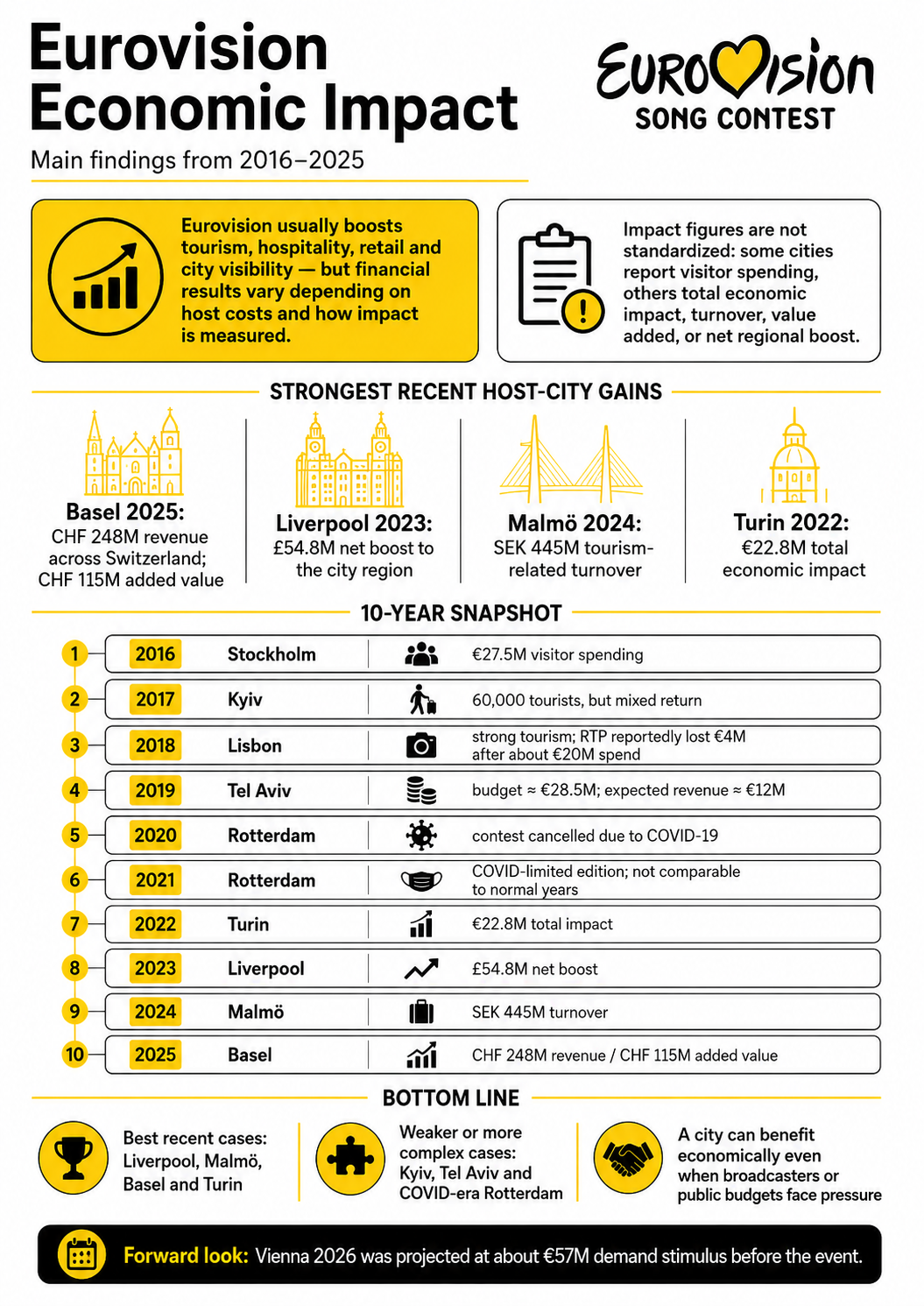
Stockholm 2016 generated around €27 million in spending from 38,000 unique visitors, according to SVT’s evaluation. Other reporting placed the revenue effect at 263 million SEK, corresponding to 175 jobs annually.
However, the host-city investment was also substantial. Stockholm reportedly spent around 95 million SEK, or about €10 million, on promoting and assisting the staging of the contest.
Stockholm, therefore, appears to have been a positive case overall, but it also illustrates the need to compare visitor spending with public investment and broadcaster costs.
Kyiv 2017 is one of the more complex examples. Tourism Review reported that Ukraine spent around €30 million on the 2017 contest and argued that the broader profit picture was less favorable than the visitor numbers initially suggested. Kyiv Post also noted that officials expected around 20,000 Eurovision visitors, with projected spending that would cover only part of the outlay.
This does not mean Eurovision failed as a cultural event for Kyiv. The contest brought international visibility and helped present Ukraine to a European audience. But from a strictly short-term economic perspective, Kyiv faces the risk of high public spending without sufficient visitor expenditure to offset costs fully.
Lisbon 2018 demonstrates one of the most important distinctions in the Eurovision Economic Impact debate: a city may benefit from tourism while the broadcaster still loses money.
Portuguese broadcaster RTP reportedly invested around €20 million to host the contest and incurred a €4 million loss. Another report also cited a €4 million loss for RTP from hosting Eurovision 2018.
At the same time, tourism-related sources described significant benefits for Lisbon’s hospitality and tourism economy. Some estimates suggested major gains in hotel, restaurant, and tourist-tax revenue.
Lisbon is therefore not a simple success-or-failure case. It is better understood as a split outcome: positive tourism visibility and hospitality activity, but a difficult financial result for the public broadcaster.
Tel Aviv 2019 was also financially complex. Before the contest, municipal officials expected around 20,000 tourists from abroad and approximately 100 million shekels in direct revenue for the city. However, the total Eurovision 2019 budget was later reported at around 120 million Israeli shekels, or about €28.5 million, while expected ticket and sponsorship revenue was estimated at around 50 million shekels, or about €12 million.
Other reporting suggested that actual tourism numbers may have fallen short of expectations, while the public broadcaster and municipality faced substantial costs.
Tel Aviv’s experience reinforces a key point: Eurovision can attract global attention, but high accommodation prices, security costs, travel conditions, and local affordability can affect the final economic outcome.
Rotterdam is the unavoidable exception in any Eurovision Economic Impact analysis. The 2020 contest was canceled due to the COVID-19 pandemic, and the city later hosted a restricted 2021 edition. This makes Rotterdam difficult to compare with normal host years.
The European Broadcasting Union confirmed that Eurovision would return to Rotterdam in 2021 after the cancellation of the 2020 contest. The 2021 edition could not deliver the same tourism and hospitality benefits as a typical Eurovision year because audience access, travel, and public events were severely restricted.
For economic analysis, Rotterdam should be treated separately. There is no evidence that Eurovision lacks economic value. Rather, it reflects the extraordinary disruption of the pandemic.
Eurovision creates a dense week of activity around semi-finals, the grand final, fan zones, public screenings, cultural programming, media events, and nightlife. This concentrates spending across hotels, short-term rentals, restaurants, bars, cafés, taxis, local transport, retail, entertainment venues, and tourist attractions.
The Liverpool case illustrates this clearly. The city recorded hundreds of thousands of event attendees and additional visitors, with accommodation providers and city-center businesses benefiting from the influx.
Eurovision is also a broadcast and media event. Malmö 2024 reported 163 million TV viewers and attracted significant visits to its official event venues. This level of exposure gives host cities a global branding opportunity that would be expensive to purchase through traditional advertising.
For cities trying to reposition themselves as cultural, creative, open, or tourism-friendly destinations, Eurovision can create image value beyond immediate visitor spending.
Hosting Eurovision requires production, staging, hospitality, security, transport, communications, event staffing, cultural programming, venue management, accessibility planning, cleaning, infrastructure support, and media operations.
Basel’s post-event reporting highlighted that 61% of the services procured by Host City Basel were provided by companies in the Basel region, demonstrating how local procurement can strengthen regional economic value.
This matters because the local impact is higher when contracts and services are awarded to regional businesses rather than external suppliers.
Major events create temporary employment and skills development across hospitality, event production, security, logistics, media, and visitor services. Liverpool’s assessment found that Eurovision supported 611 one-year full-time-equivalent jobs in 2023.
For cities with strong creative industries, Eurovision can also leave behind expertise in event management, live broadcast coordination, cultural programming, and destination marketing.
Eurovision is expensive to stage. Costs fall on broadcasters, host cities, regional governments, national governments, or a combination of these. Expenses can include venue adaptation, production, security, public spaces, transport planning, fan zones, marketing, and technical infrastructure.
Stockholm, Kyiv, Lisbon, and Tel Aviv all show that high costs can complicate the economic picture even when tourism benefits exist.
A host city can benefit economically while the broadcaster faces losses. Lisbon 2018 is the clearest example: RTP reportedly lost money, even as tourism-related activity in Lisbon appeared strong.
This distinction matters for public debate. The question is not simply whether Eurovision “makes money.” The better question is: who pays, who benefits, and over what timeframe?
Tel Aviv 2019 shows the risk of optimistic tourism expectations. Pre-event estimates pointed to tens of thousands of international visitors and strong direct revenue, but later reports suggested that visitor numbers may have fallen short while costs remained high.
Cities need realistic demand forecasts, especially when accommodation prices, flight costs, security concerns, or geopolitical issues may affect travel behavior.
One of the biggest challenges in Eurovision Economic Impact analysis is the lack of a consistent methodology across all host years. Some cities report visitor spending. Others report tourism turnover, added value, net additional expenditure, or media value.
This means a headline figure such as “€22.8 million impact” cannot be directly compared with “£54.8 million net boost” or “CHF 248 million revenue” without understanding the underlying methodology.
The last decade of Eurovision host-city data suggests a clear pattern. Eurovision tends to generate positive short-term economic activity, especially when the host city has strong hotel capacity, good transport links, a clear event strategy, and the ability to convert global attention into local spending.
The strongest recent cases are:
Liverpool 2023, with a £54.8 million net economic boost.
Malmö 2024, with 445 million SEK in tourism-related turnover.
Basel 2025, with CHF 248 million in revenue and CHF 115 million in added value.
Turin 2022, with a total economic impact of € 22.8 million.
The more complex cases include Kyiv 2017, Lisbon 2018, Tel Aviv 2019, and pandemic-era Rotterdam. These examples show that Eurovision’s benefits are not automatic. High costs, weaker-than-expected tourism, broadcaster losses, or external disruptions can reduce financial returns.
Future host cities should treat Eurovision as a strategic economic-development project, not just a music event. The best-performing cities appear to do three things well.
First, they integrate Eurovision into a wider tourism and city-branding strategy. This allows the event to create value before, during, and after the live shows.
Second, they maximize local procurement and business participation. Basel’s regional procurement results show how host-city spending can be converted into local economic value.
Third, they manage expectations. Eurovision can bring major visibility, strong visitor spending, and measurable economic activity. But it is not a guaranteed profit machine. Public authorities must be transparent about costs, benefits, and who receives the economic return.
Although Vienna 2026 is outside the completed 2016–2025 period, early projections already show how seriously the contest is now treated as an economic event. Pre-event estimates for Vienna 2026 projected approximately €57 million in demand stimulus, around €52 million in value added, and roughly 550 full-time-equivalent jobs. These are forecasts, not final results, but they show the growing sophistication of Eurovision economic planning.
Vienna will therefore become an important test case for whether a major established tourism city can convert Eurovision’s global visibility into measurable local and national economic value.
The Eurovision Economic Impact over the last decade shows that the contest can deliver substantial value for host cities. It can fill hotels, increase spending at restaurants and retailers, boost transport usage, support jobs, activate local suppliers, and put a city in front of a global audience.
However, the benefits are uneven. Eurovision works best when public authorities and broadcasters control costs, build strong local partnerships, use the event to promote the city internationally, and measure results transparently.
The most successful recent hosts, especially Liverpool, Malmö, Turin, and Basel, show that Eurovision can be much more than a song contest. It can be a short-term tourism engine, a city-branding platform, and a measurable economic development opportunity. At the same time, the more complicated cases remind future hosts that cultural prestige must be balanced with financial discipline.
For cities that plan carefully, Eurovision can be a powerful investment. For those who underestimate costs or overestimate visitor returns, it can become a very expensive week of television.




By continuing to use the site, you agree to the use of cookies. more information
The cookie settings on this website are set to "allow cookies" to give you the best browsing experience possible. If you continue to use this website without changing your cookie settings or you click "Accept" below then you are consenting to this.