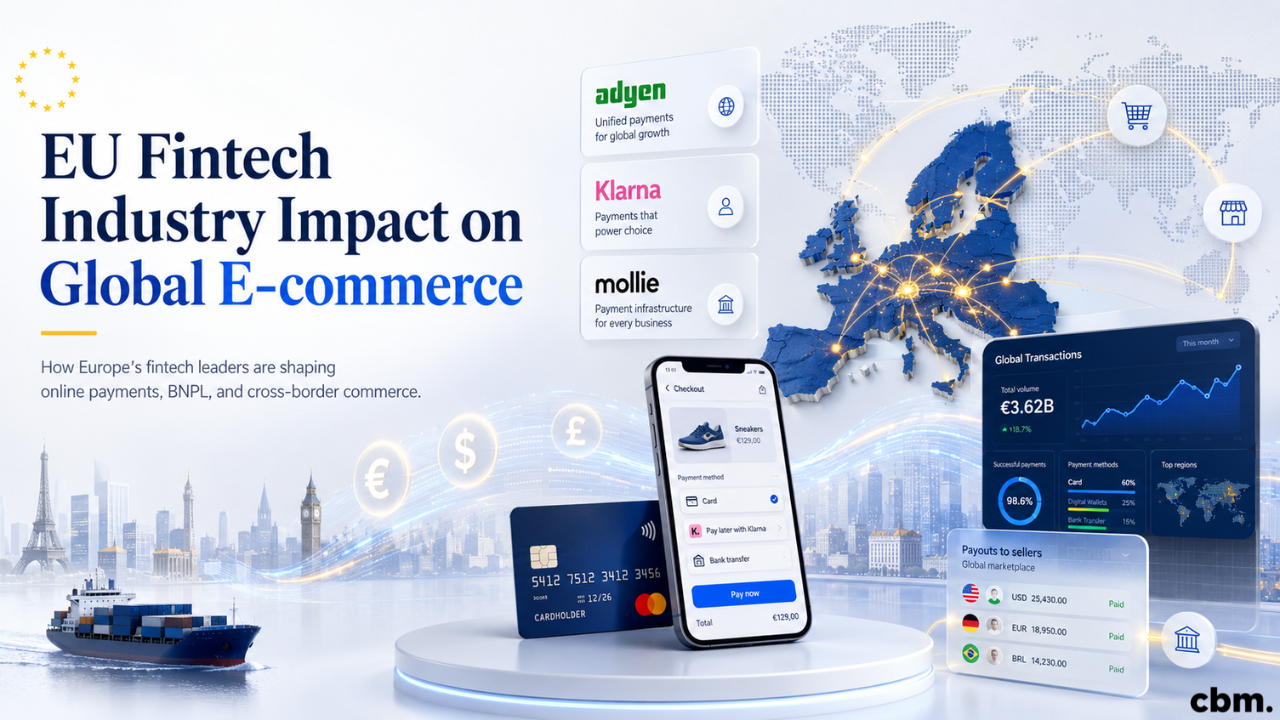
The European Union’s fintech industry has become a major infrastructure provider for global e-commerce. European companies now process trillions of euros in payments, provide financing to millions of online shoppers, connect merchants to local payment methods, and enable marketplaces to manage sellers, currencies, fraud, and payouts through a single platform.
The industry’s global importance is visible in the numbers:
These figures show that EU fintech is no longer a niche financial-technology sector. It is part of the core infrastructure supporting international digital commerce.
European B2C e-commerce turnover increased from €784 billion in 2023 to €842 billion in 2024.
That represented:
The expansion of online commerce is also reflected in consumer adoption.
In 2025, approximately 78% of EU internet users purchased goods or services online. In 2015, the equivalent share was approximately 62%.
Online-shopping adoption was particularly high among younger European consumers:
Fintech companies support this market by connecting shoppers, merchants, banks, card networks and local payment systems.
The volume of European payments is considerably larger than e-commerce turnover alone. The euro area recorded approximately 77.7 billion non-cash payments in the first half of 2025, an increase of about 7.7% compared with the same period one year earlier.
Excluding e-money payments, cards represented approximately 73.9% of the number of non-cash transactions. Credit transfers represented around 19.3%, while direct debits accounted for approximately 3.3%.
This scale provides European payment companies with a large domestic market in which to develop technology before expanding internationally.
Amsterdam-headquartered Adyen is one of the clearest examples of the EU fintech industry’s international impact.
During 2025, Adyen processed approximately €1.394 trillion in payment volume.
Its results included:
Adyen’s 2025 processed volume was approximately 65% larger than the entire €842 billion European B2C e-commerce market reported for 2024.
The comparison is not exact because Adyen processes both online and physical-store transactions. Nevertheless, it demonstrates the scale achieved by a single European fintech company.
Adyen provides payment infrastructure to international retailers, digital platforms, subscription companies and marketplaces. Its services can include:
Adyen’s platform business also provides evidence of the growth of embedded finance.
In the third quarter of 2025, its platform net revenue reached €68.6 million, increasing by 50% year over year.
This suggests that marketplaces and software platforms increasingly want to integrate payments and financial services directly into their own products.
Sweden’s Klarna has helped turn buy now, pay later from a regional payment option into a global e-commerce product. Klarna reported $127.9 billion in gross merchandise volume in 2025, representing 22% annual growth.
By the end of that year, Klarna had:
By the first quarter of 2026, the company reported:
Klarna’s merchant network grew by approximately 49% in the year leading to the first quarter of 2026.
Its expansion shows how an EU fintech model can influence consumer expectations in markets such as the United States.
BNPL allows customers to postpone payment or divide the purchase price into installments. For merchants, it may reduce the immediate affordability barrier associated with higher-value purchases.
However, performance varies by market and product category. BNPL does not automatically guarantee higher conversion or average order values for every merchant.
The sector also faces increased scrutiny concerning consumer debt, affordability assessments and the use of multiple credit providers.
International e-commerce requires merchants to manage more than card acceptance.
Businesses selling across borders must handle:
EU fintech companies increasingly combine these capabilities into a single integration.
For example, an international merchant selling across Europe may need to offer:
Dutch fintech Mollie provides payment services to more than 250,000 businesses across approximately 30 countries.
The company reported net-revenue growth of 29% in 2025 and expanded into 12 additional markets.
Payment aggregation is especially important for small and medium-sized businesses. Without fintech providers, merchants may need separate contracts, banking relationships and technical integrations for every payment method and market.
By centralizing these services, fintech reduces the cost and complexity of international expansion.
The EU’s revised Payment Services Directive, PSD2, established the regulatory basis for open banking.
PSD2 allowed licensed providers, with customer permission, to access banking information or initiate payments directly from bank accounts.
For e-commerce, this created an alternative to conventional card payments.
Account-to-account payments may offer merchants:
Open banking is particularly significant because international card schemes still dominate much of Europe’s payment market.
Approximately two-thirds of euro-area card transactions are processed through non-European companies. Several euro-area countries remain entirely dependent on international card schemes.
The development of European account-to-account systems could therefore affect both payment costs and Europe’s financial independence.
European instant-payment rules are intended to make euro transfers available within seconds, at any time of day.
For e-commerce businesses, instant payments could improve:
The opportunity is substantial because credit transfers already account for approximately 19.3% of euro-area non-cash transactions by volume, excluding e-money. Instant settlement could be particularly valuable for marketplaces that collect customer funds and distribute money to thousands of independent sellers.
Cards are unlikely to disappear. They remain widely accepted and provide established consumer protections, recurring-payment functionality and dispute mechanisms. However, instant bank payments could capture a larger share of e-commerce transactions where cost, speed or transaction value is particularly important.
E-money has become another significant component of European digital commerce.
During the first half of 2025, the euro area recorded:
E-money accounts represented approximately 98% of the number and 97% of the value of e-money transactions.
This infrastructure supports:
For marketplaces, e-money infrastructure makes it possible to accept a consumer payment, deduct a commission, reserve funds for refunds, and distribute the remainder to one or several sellers.
These processes would be difficult to manage at scale using conventional bank transfers alone.
Marketplace and software platforms increasingly use fintech infrastructure to offer financial products directly to their merchants.
These services can include:
This market is growing rapidly.
Adyen’s platform net revenue increased by 50% in the third quarter of 2025. In the first quarter of 2026, its platform revenue reached approximately €75 million, up 35% year over year, or 40% at constant currency.
Embedded finance allows platforms to generate revenue from payments while strengthening their relationship with merchants.
A business using the platform may no longer need to obtain separate services from a bank, payment processor, lender and card issuer. The platform can combine these capabilities through fintech APIs.
The EU’s Strong Customer Authentication requirements changed how online payments are verified.
Many electronic transactions now require at least two independent authentication elements, such as:
This encouraged global adoption of:
The European Central Bank and European Banking Authority found that Strong Customer Authentication was effective against important forms of card fraud.
Nevertheless, fraud remains a major financial problem.
Across the EU and European Economic Area, losses reached:
Credit-transfer fraud losses increased by approximately 16% year over year, while card-fraud losses increased by around 29%.
Consumers bore approximately 85% of credit-transfer fraud losses, largely because many cases involved authorized payment scams. In these cases, customers were manipulated into approving the transaction themselves.
As a result, fintech fraud prevention is moving beyond stolen-card detection. Modern systems analyze device behavior, account history, customer location, payment values and behavioral patterns in real time.
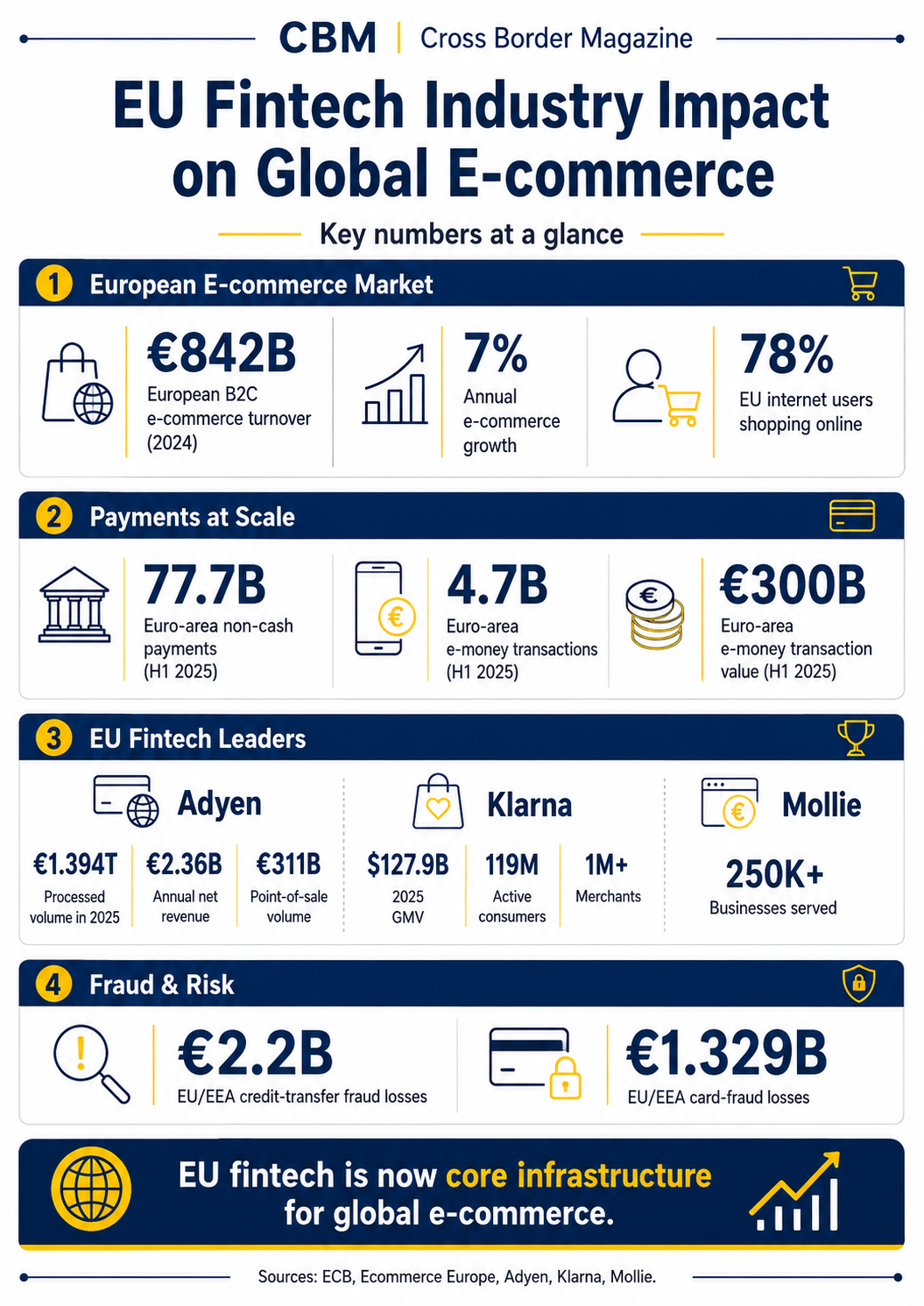
EU fintech’s global e-commerce impact can be summarised through several major figures:
| Indicator | Latest reported figure |
| European B2C e-commerce turnover | €842 billion |
| Annual European e-commerce growth | 7% |
| EU internet users shopping online | 78% |
| Euro-area non-cash payments in H1 2025 | 77.7 billion |
| Adyen processed volume in 2025 | €1.394 trillion |
| Adyen annual net revenue | €2.36 billion |
| Adyen point-of-sale volume | €311 billion |
| Klarna 2025 GMV | $127.9 billion |
| Klarna active consumers | 119 million |
| Klarna merchant network | More than 1 million |
| Mollie merchant network | More than 250,000 |
| Euro-area e-money transactions in H1 2025 | 4.7 billion |
| Euro-area e-money value in H1 2025 | €300 billion |
| EU/EEA credit-transfer fraud losses | €2.2 billion |
| EU/EEA card-fraud losses | €1.329 billion |
These numbers do not measure a single direct contribution to global e-commerce. No official statistical framework currently calculates exactly how much worldwide online revenue is generated by EU fintech.
However, the figures demonstrate the industry’s scale across payment processing, consumer finance, merchant acceptance, e-money and marketplace infrastructure.
The EU fintech industry has become a fundamental part of global e-commerce infrastructure.
Adyen processed approximately €1.394 trillion in 2025. Klarna facilitated $127.9 billion in annual merchandise volume and reached 119 million active consumers. Mollie serves more than 250,000 businesses, while euro-area e-money transactions reached approximately €300 billion in only six months.
These companies and payment systems help merchants:
The EU’s influence also extends beyond company performance. PSD2, open banking and Strong Customer Authentication have shaped payment regulation, security and financial innovation internationally.
Europe still faces challenges, including fragmented national payment habits, rising fraud losses and dependence on international card networks. Nevertheless, the numbers show that EU fintech has moved well beyond its regional market.




By continuing to use the site, you agree to the use of cookies. more information
The cookie settings on this website are set to "allow cookies" to give you the best browsing experience possible. If you continue to use this website without changing your cookie settings or you click "Accept" below then you are consenting to this.