
E-commerce logistics in the Balkans is becoming increasingly important, but it remains one of Europe’s most uneven operating environments. The region combines EU member states with non-EU markets, fast-growing online demand with uneven delivery maturity, and modern marketplace ecosystems with persistent friction around customs, payments and last-mile coverage.
What has changed is that the Balkans can no longer be treated as a peripheral extension of Western European e-commerce. Consumer adoption is rising, out-of-home delivery is expanding, and merchants are increasingly building cross-border models that depend on regional rather than purely national logistics. At the same time, the operational realities vary from one market to another, so any accurate assessment of e-commerce logistics in the Balkans must separate broad regional trends from country-specific conditions.
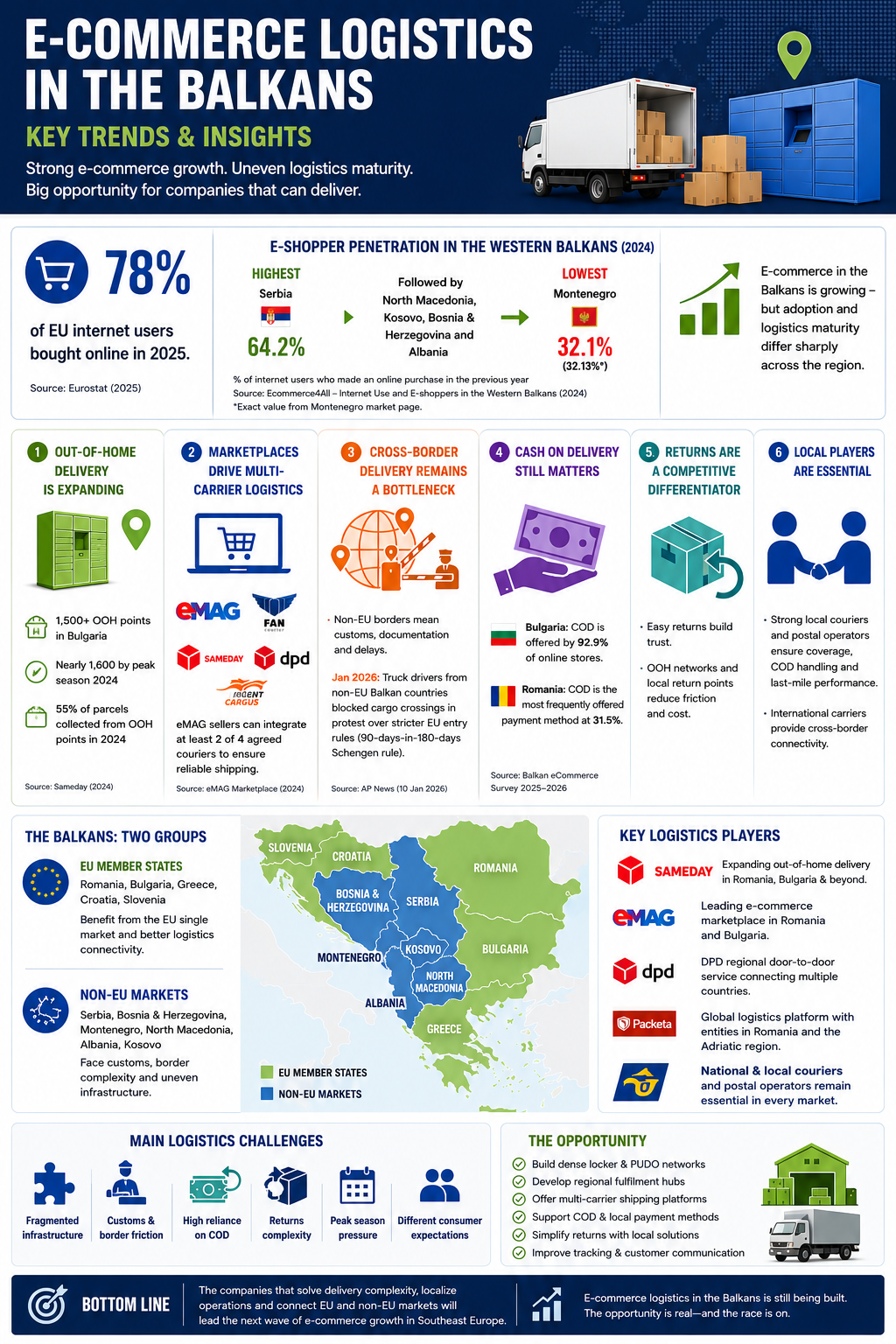
At the EU level, online shopping is already mainstream. Eurostat reports that 78% of EU internet users bought or ordered goods or services online in 2025, up from 62% in 2015. But that EU average hides a large maturity gap inside Southeast Europe. Eurostat also notes that the difference between internet use and actual online buying was especially high in Romania at 31 percentage points and in Bulgaria at 33 percentage points in 2025. In Montenegro, that gap was even wider at 49 percentage points.
In practical terms, this means that internet connectivity is not yet translating into online shopping at the same rate as in Europe’s most mature markets.
For the Western Balkans, the most useful benchmark comes from Ecommerce4All’s CEFTA-focused dataset. It identifies Serbia as the most developed market in the group, with 64.2% of internet users making an online purchase in the previous year. It also shows Montenegro as the lowest at 32.1%, with North Macedonia, Kosovo, Bosnia and Herzegovina, and Albania in between.
Ecommerce4All also notes that the CEFTA region covered by its platform has a total population of fewer than 20 million, which underscores both the fragmentation and the long-term potential of the region's non-EU part.
This is the first reason e-commerce logistics in the Balkans requires a dedicated strategy. The region is not moving in a single line. Romania, Bulgaria, Greece, Croatia, and Slovenia operate within the EU single market, while Serbia, Bosnia and Herzegovina, Montenegro, North Macedonia, Albania and Kosovo still sit outside that framework. As a result, the same merchant may face standard intra-EU parcel operations in one Balkan market and customs-related delivery friction in another. That structural split shapes everything from transit times to returns handling.
One of the clearest developments in e-commerce logistics in the Balkans is the rapid expansion of out-of-home delivery. Locker networks, partner pick-up points and postal collection locations are no longer a side option. They are becoming core infrastructure.
The strongest example comes from Bulgaria. Sameday states that, after only 2.5 years in the market, its active out-of-home delivery network in Bulgaria had reached around 1,500 points and was expected to approach 1,600 by the start of peak season, including 600 partner sites and more than 950 easybox lockers. The company also reports a 400% increase compared with the same period a year earlier.
The same Sameday announcement adds useful detail about how that network is being built. Its partner-office network was set to cover 171 localities by Black Friday, with more than 320 Bulgarian Posts offices, more than 60 Cashcredit offices, nearly 30 Fastpay locations, and 120 Mareshki pharmacies added as delivery points.
Sameday also says that 55% of the parcels it handled in Bulgaria in 2024 were collected from out-of-home delivery points, and that its regional out-of-home network across Bulgaria, Romania, and Hungary had reached almost 7,000 points.
For merchants, the meaning is straightforward. In parts of the Balkans, the delivery scale will not come only from adding more vans or depots. It will come from building dense hybrid networks that combine lockers, postal counters, pharmacy pick-up points, and retail partners. That matters not just for delivery costs but also for reducing failed deliveries, returns convenience, and consumer trust.
Another important feature of e-commerce logistics in the Balkans is the move toward multi-carrier operations. In more mature e-commerce markets, merchants often use several delivery partners to balance cost, service levels, and regional coverage. That same pattern is becoming increasingly visible in Southeast Europe.
A very direct example comes from eMAG Marketplace. In its own marketplace documentation, eMAG says sellers can integrate at least two of the four courier companies agreed by the platform: Urgent Cargus, FanCourier, DPD and SameDay. The wording matters because it shows that multi-carrier logistics is no longer an advanced tactic in one of the region’s most important marketplace ecosystems. It is becoming a baseline requirement.
The Balkan eCommerce Survey 2025–2026 points in the same direction, although its scope should be stated clearly: this edition covers Greece, Bulgaria, Romania, Croatia, and Hungary, not the entire Balkans.
In that sample, most merchants work with a limited number of courier partners, but moderate diversification is already the norm. The survey says that working with 2 to 5 couriers is the most common strategy, covering 60% to 80% of respondents across the surveyed markets. It also notes that exactly 2 couriers is most common in Croatia and Bulgaria, while 3 to 5 partners is more common in Hungary and Greece.
This is a key operational signal. E-commerce logistics in the Balkans is no longer just about having access to a courier. It is increasingly about being able to orchestrate several carriers, choose the right last-mile option by destination and service level, and combine domestic delivery with cross-border coverage.
Romania stands out because it sits at the intersection of a large domestic e-commerce market, a strong marketplace ecosystem, and widening regional parcel connectivity.
One piece of evidence comes from DPD Romania’s official Regional Services CEE offer. DPD describes a door-to-door parcel service from and to Romania covering Bulgaria, Greece, Hungary, Poland, Slovakia, Slovenia, Czechia, and Croatia. It also offers cash-on-delivery on those flows, which is particularly important in a region where local payment habits still shape delivery design.
DPD’s page also shows the practical realities behind cross-border service levels. It states a standard transit time of 2 to 5 working days, but adds that deliveries to remote destinations and islands in Greece may take up to 8 working days. That is a useful reminder that, even when a cross-border network exists, Balkan geography still matters. Markets in Greece and Croatia may be commercially attractive, but their delivery economics differ from those of a compact inland market.
Taken together, the DPD service map and the eMAG marketplace logistics model suggest that Romania is increasingly functioning as a regional anchor for e-commerce logistics in Southeast Europe. That does not mean it is the only hub, but it does mean that many Balkan delivery flows are becoming easier to coordinate from Romania than from more distant Western European locations.
Cash on delivery remains one of the most important operational differences between the Balkans and many Western European e-commerce markets. But to stay accurate, it is important to describe the available data precisely and not generalize beyond the scope of each source.
The Balkan eCommerce Survey 2025–2026 provides the clearest country-level figures for payment methods among surveyed online stores in five markets: Bulgaria, Greece, Romania, Croatia and Hungary.
In Bulgaria, the survey says cash on delivery is the dominant method, offered by 92.9% of surveyed stores. In Romania, cash on delivery is the most frequently offered method at 31.5%, ahead of debit or credit cards at 28.8% and bank transfers at 23.3%. These numbers use the survey’s own methodology and should be understood as store-offer distributions in the surveyed sample, not as a universal measure for all Balkan e-commerce transactions.
Why does this matter for e-commerce logistics in the Balkans? Because payment structure changes, delivery structure. Cash on delivery affects settlement, failed-delivery exposure, courier workflows, and consumer expectations. DPD Romania’s regional service page makes that connection explicit by detailing how its COD service works across countries such as Bulgaria, Greece, Hungary, Poland, Slovakia, Slovenia, Czechia and Croatia, including settlement currencies and processing rules.
In the Balkans, payments and logistics remain tightly linked.
The biggest long-term opportunity in e-commerce logistics in the Balkans is cross-border commerce, but that is also where the region remains most complex. EU Balkan markets benefit from the single market framework. Non-EU Western Balkan markets do not. That difference creates a practical divide around customs procedures, documentation, and delivery predictability.
The available data does not provide a single statistic that captures all of that complexity, but the operational contrast is evident in how service offerings are structured. DPD’s regional service is deeply integrated across the EU and nearby Central and Eastern European destinations, while Ecommerce4All treats the Western Balkans as a distinct CEFTA-based e-commerce environment with its own readiness profile and adoption curve.
That is why cross-border success in the Balkans depends not only on parcel linehaul capacity, but also on documentation, returns handling, and local delivery adaptation.
The numbers do not support a simplistic story that the Balkans are either fully mature or still marginal. The more accurate story is that the region is advancing unevenly.
The demand side is real. In 2025, 78% of EU internet users made online purchases, and Southeast Europe is part of that broader European shift. The Western Balkans also show a clear internal hierarchy, with Serbia at 64.2% and Montenegro at 32.1%.
The infrastructure side is moving as well. Sameday has built a Bulgarian out-of-home network of around 1,500 points, heading toward nearly 1,600, and says 55% of its parcels in Bulgaria were collected through out-of-home delivery in 2024.
The merchant side is also adapting. eMAG formalizes a multi-carrier model, while the Balkan eCommerce Survey shows that using 2 to 5 courier partners is now the most common setup across the five markets it surveyed.
That combination explains why e-commerce logistics in the Balkans is becoming strategically important. The region is not yet uniform, but it is no longer early-stage either. The most successful companies will be those that treat the Balkans as a set of connected but operationally different markets, build strong out-of-home and multi-carrier models, and adapt logistics design to local payment and cross-border realities.
E-commerce logistics in the Balkans is moving from a fragmented, locally driven delivery environment toward a more connected regional system. The shift is visible in the growth of out-of-home delivery, the rise of multi-carrier marketplace operations, the continued role of cash on delivery, and the emergence of Romania and Bulgaria as important logistics anchors.
But the region should not be oversimplified. EU Balkan markets and non-EU Western Balkan markets face different logistics realities. Some countries are already building dense parcel networks, while others remain earlier in the e-commerce adoption curve. Payment preferences also vary, with cash on delivery still playing a major role in several markets.
For retailers, the main lesson is that the Balkans require localization. Delivery options, payment methods, returns processes, and carrier partnerships must be adapted to the realities of each market.
For logistics providers, the opportunity is clear. The companies that can simplify cross-border flows, expand out-of-home delivery, support cash-on-delivery operations and provide reliable returns will be well placed to support the next wave of e-commerce growth in Southeast Europe.
E-commerce logistics in the Balkans is still being built. The race is no longer about whether the region will matter. It is about which companies can deliver reliably, locally and at scale.



By continuing to use the site, you agree to the use of cookies. more information
The cookie settings on this website are set to "allow cookies" to give you the best browsing experience possible. If you continue to use this website without changing your cookie settings or you click "Accept" below then you are consenting to this.