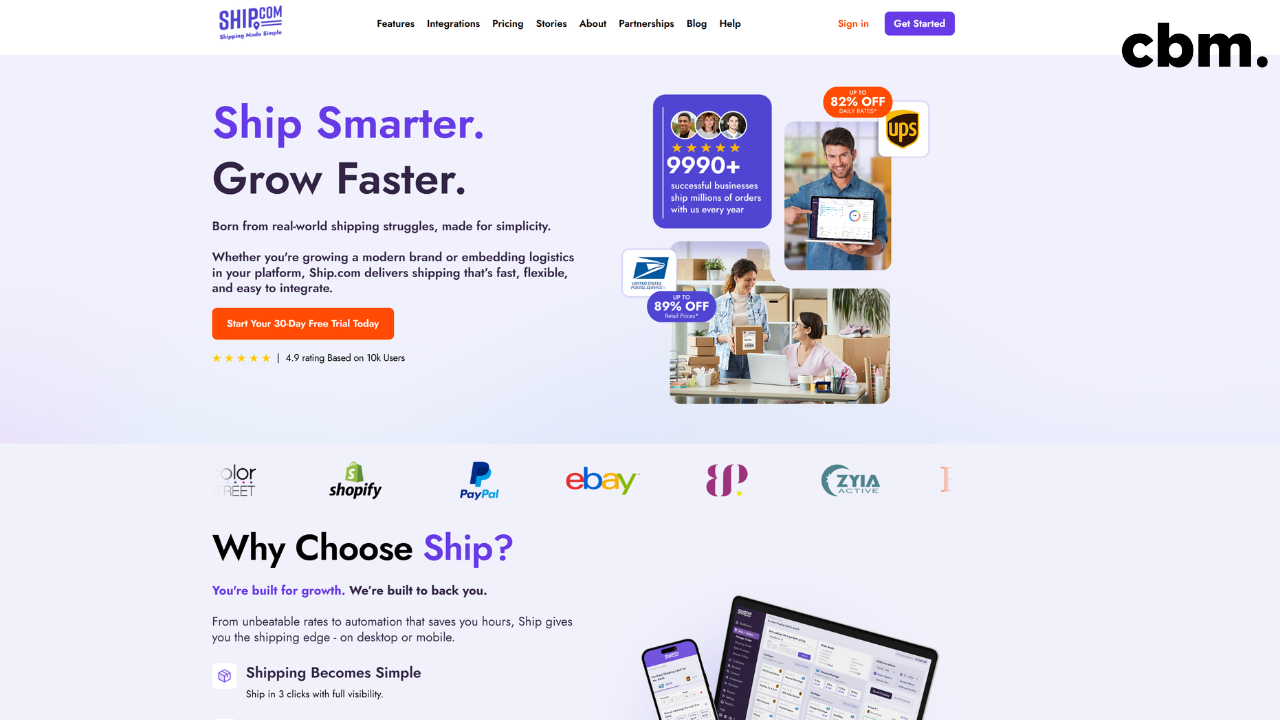
SHIP.com has launched two artificial intelligence tools designed to bring agentic commerce into one of the most operationally complex areas of e-commerce: shipping and fulfillment.
The company announced SHIP AI, an AI-powered shipping manager for online sellers, and SHIP MCP, a Model Context Protocol integration that exposes more than 35 shipping capabilities to Claude and other AI applications.
Together, the tools automate tasks such as order analysis, rate comparison, address correction, label preparation, and tracking. They also allow developers to connect AI agents directly to shipping infrastructure. The announcement is significant because much of the recent discussion around agentic commerce has focused on product discovery and payments. SHIP.com is extending the same concept deeper into the physical fulfillment layer.
That means AI agents are moving closer to handling not only what consumers buy and how they pay, but also how those purchases are shipped.
SHIP AI is designed to function more like a digital shipping manager than a traditional chatbot. Instead of simply responding to questions, the system can analyze incoming orders and prepare fulfillment work before the seller begins processing shipments.
According to SHIP.com, the system can determine package details, compare shipping options, correct addresses, flag inconsistencies, and prepare multiple orders for shipment simultaneously. Users can also ask the system to update dashboards, run reports and analyze variables such as shipping costs and delivery times.
Joe DiSorbo, founder and CEO of SHIP.com, described the distinction by saying that a general chatbot provides answers, while SHIP AI is designed to perform operational work. The goal is to move sellers away from manually processing every order and toward reviewing work AI has already prepared.
Shipping remains one of the most repetitive and time-consuming areas of online retail operations. A merchant processing multiple orders may need to verify addresses, calculate package dimensions, compare rates, select carriers, purchase labels and update order information.
SHIP.com says SHIP AI can automate much of that preparation. The company gives the example of a 20-order batch that could take around 25 minutes to process manually. Depending on the level of automation enabled, SHIP.com says the same batch could potentially be prepared in less than a minute with SHIP AI.
That claim is based on the company's own testing and should therefore be treated as a vendor-reported performance example rather than an independent benchmark.
Nevertheless, the broader operational shift matters. The merchant's role shifts from performing each shipping action manually to supervising and approving AI-generated decisions.
SHIP.com is not presenting SHIP AI as completely autonomous by default. Financial transactions remain under the merchant's control. Purchasing shipping labels, adding insurance or reloading an account balance normally requires seller approval, and the relevant costs are displayed before the transaction is completed.
This human-in-the-loop approach reflects a central challenge facing agentic commerce. Businesses want AI systems to remove repetitive operational work, but financial authority introduces considerably greater risk. SHIP.com's approach lets the AI analyze and prepare decisions while merchants decide how much authority they are willing to delegate.
According to the company, sellers could gradually expand the degree of automation as they become more comfortable with the system.
SHIP AI has been available to SHIP.com users since August 11, 2026. The company says that during the first week of beta availability, more than 30% of orders were purchased through SHIP AI.
This figure does not necessarily mean that 30% of all SHIP.com customers have adopted the technology, nor does it demonstrate long-term adoption. However, it provides an early indication that merchants are willing to experiment with AI-driven shipping workflows when those tools are integrated directly into the software they already use.
SHIP is offering the complete AI experience free to users for at least 30 days during the launch period.
The second product may ultimately have even larger implications for agentic commerce. SHIP MCP connects SHIP.com's shipping infrastructure to AI applications through Model Context Protocol. MCP is an emerging standard that allows AI systems to connect with external tools, software and data sources.
SHIP.com says its implementation exposes more than 35 shipping capabilities that developers can integrate into AI applications. These capabilities include rating shipments, creating labels, tracking packages, processing order information and managing shipping workflows.
Rather than forcing users to leave an AI environment and manually open separate shipping software, these functions can potentially operate directly inside the AI application.
SHIP MCP is available through Claude Desktop CLI and can also be found by searching for SHIP.com within Claude's connector directory. Developers can additionally access the technology directly through SHIP.com when building their own AI applications.
SHIP.com says some early customers have already embedded its capabilities into their own AI applications, enabling orders to be rated, labeled and tracked through those systems. DiSorbo described these integrations as early steps toward fully autonomous agentic commerce.
The distinction matters. SHIP AI primarily focuses on making existing merchant shipping operations more efficient, while SHIP MCP could make shipping itself a machine-accessible service that autonomous AI agents can call.
This development reflects a broader shift across e-commerce. Many of the highest-profile agentic-commerce initiatives have concentrated on the early stages of the customer journey. AI agents can increasingly discover products, compare alternatives, recommend purchases and initiate payments. Companies including Stripe, Alipay and major AI providers are already building infrastructure around these interactions.
But purchasing a physical product creates another requirement: the item still needs to leave a warehouse and reach the customer. A genuinely autonomous commerce system eventually needs access to inventory, fulfillment systems, shipping rates, carrier networks, delivery estimates, labels, tracking information, and returns processes.
SHIP.com is attempting to make part of that logistics infrastructure directly accessible to agents. The emerging agentic-commerce stack could therefore begin to resemble Discovery → Decision → Payment → Fulfillment → Delivery, rather than stopping once the transaction is authorized.
Agentic commerce also changes the way logistics technology needs to function. Most shipping platforms were originally designed for humans. A user logs into a dashboard, reviews orders, chooses a carrier, generates a label, and manages exceptions through a graphical interface.
AI agents require something different. They need structured, programmatic access to shipping capabilities so they can evaluate different options and perform actions automatically. SHIP MCP represents one approach to solving that problem. Rather than requiring an agent to navigate a human-designed web interface, the system exposes specific shipping actions through standardized tools.
That could eventually allow an AI agent to determine that a particular order needs expedited delivery, one carrier offers a better rate, an address needs correcting, or an alternative service would meet the customer's requested delivery date. The agent could then act on that information within predefined limits.
For merchants, the immediate benefit is operational efficiency. Shipping teams spend a lot of time on repetitive tasks that follow predictable rules. AI systems are particularly well suited to analyzing those workflows and preparing recommended actions.
But the longer-term implications extend further. As agentic commerce develops, merchants may increasingly operate in environments where software agents communicate directly with logistics platforms.
Instead of a human seller manually selecting a shipping method, an AI system could optimize thousands of shipments based on cost, speed, service level, and delivery probability. Smaller merchants could access capabilities that previously required dedicated logistics teams, while larger businesses could use agents to manage significant order volumes and let human employees focus on exceptions and strategic decisions.
Autonomous fulfillment also introduces important limitations. SHIP.com's own terms explicitly warn that AI-generated outputs may be inaccurate, incomplete or outdated and may not always reflect current carrier rules or rates.
Users are therefore responsible for reviewing and approving AI-generated outputs, including shipping labels, addresses, rate selections and customs or regulatory classifications. That is particularly important in cross-border commerce. Incorrect customs information, classifications or addresses can result in delays, additional costs or regulatory problems.
SHIP.com's terms also address automated clients such as AI assistants and autonomous agents. Actions carried out by an authorized automated client can be treated as actions taken by the user. As businesses give agents greater authority, questions of accountability will consequently become increasingly important.
The most important aspect of SHIP.com's announcement may not be automated label creation itself. It is the idea that AI systems can call logistics capabilities directly. That turns a shipping platform from a traditional software interface into infrastructure that autonomous commerce applications can use.
The same transformation is already occurring elsewhere in e-commerce. Payment companies are building agent-compatible payment mechanisms. Marketplaces and retailers are exposing product information to AI systems. AI platforms are creating tools that allow consumers to discover and purchase products without leaving a conversational interface. Shipping represents another piece of that puzzle.
Agentic commerce has often been presented primarily as a change to the shopping experience. Consumers tell an AI assistant what they want, and the assistant searches for the best option. But commerce does not end when the shopper presses, or no longer presses, the checkout button. Orders still need to be processed, packed, shipped, tracked, and delivered.
SHIP.com's new tools show how AI agents are beginning to move into that operational layer. SHIP AI focuses on automating the work merchants currently do inside shipping software. SHIP MCP goes one step further by allowing external AI applications to interact directly with shipping capabilities.
If this model expands, logistics platforms could increasingly become invisible infrastructure behind AI-driven commerce. The customer may interact with an AI assistant, the merchant may approve only exceptions, and software agents could manage much of what happens between the purchase and the doorstep.
For e-commerce, that would mark an important evolution in agentic commerce: from automating the transaction to automating its fulfillment as well.




By continuing to use the site, you agree to the use of cookies. more information
The cookie settings on this website are set to "allow cookies" to give you the best browsing experience possible. If you continue to use this website without changing your cookie settings or you click "Accept" below then you are consenting to this.