The Temu and QIMA partnership marks an important step in the evolution of global e-commerce compliance. As online marketplaces expand across more regions and product categories, platforms face growing pressure to ensure that products meet safety, quality, and regulatory requirements before reaching consumers.
Announced on April 29, 2026, the collaboration brings together Temu, a global e-commerce platform operating in more than 90 markets, and QIMA, a leading testing, inspection, and certification company. Through this partnership, QIMA’s compliance services will be integrated directly into Temu’s Seller Center, giving sellers easier access to product testing, certification, factory inspections, training, and digital compliance tools.
For Temu sellers, the agreement creates a more direct path to understanding and meeting product safety requirements. For consumers, it supports a safer and more trustworthy shopping experience. For the wider e-commerce industry, it signals a growing shift toward embedding compliance into everyday marketplace operations.
The Temu and QIMA partnership is designed to make product compliance more accessible and operational for sellers using the Temu platform. Instead of treating compliance as a separate or external process, Temu is bringing QIMA’s testing and certification resources directly into the Seller Center workflow.
This integration means sellers will be able to access independent compliance support through the same environment they already use to manage their products and operations. The goal is to make product testing, certification, and inspection a more routine part of selling online.
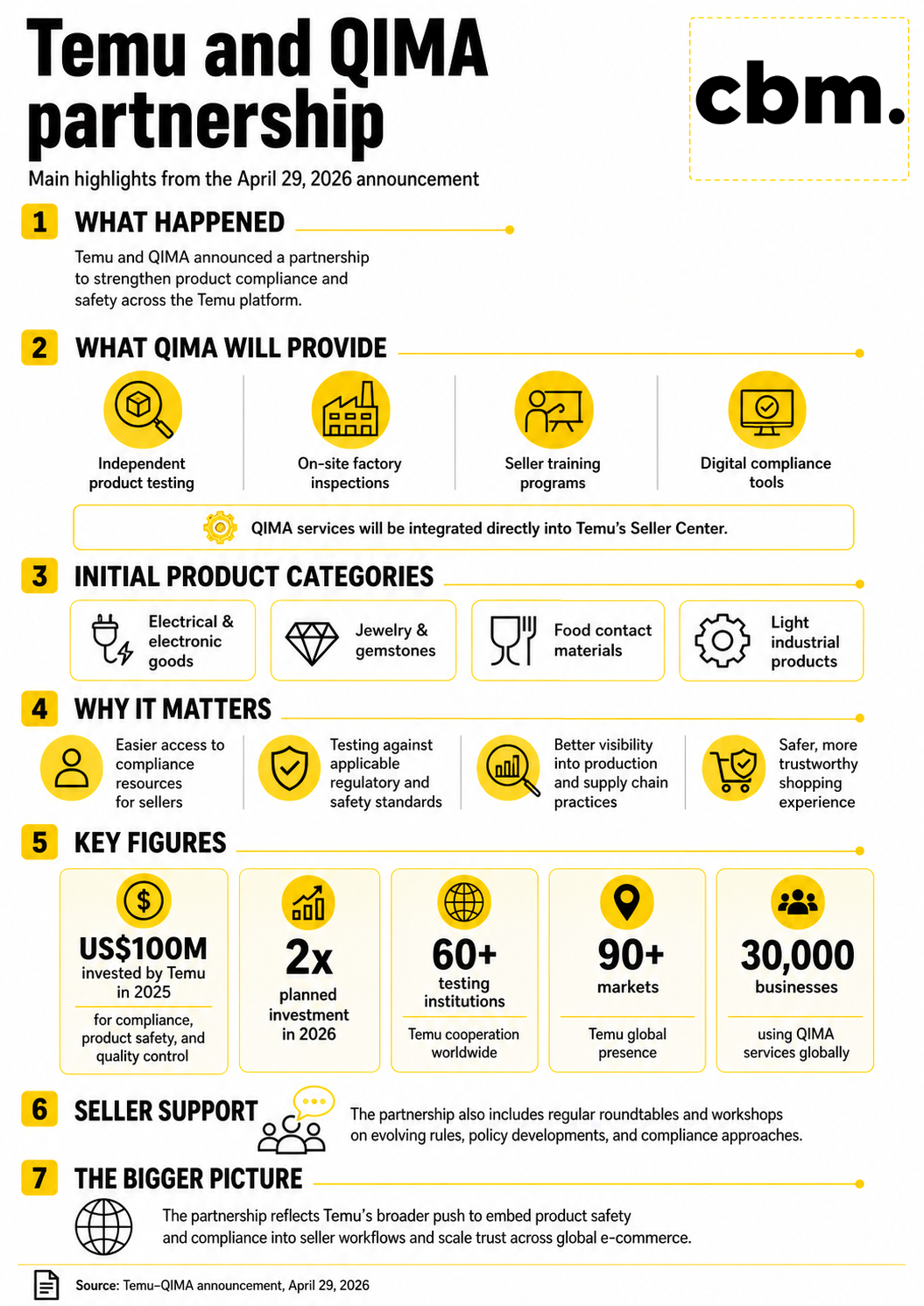
QIMA will provide a range of services under the partnership, including independent product testing, on-site factory inspections, seller training programs, and digital compliance tools. These services are intended to help sellers better understand regulatory requirements, improve product safety, and reduce the risk of non-compliant goods entering the marketplace.
The first phase of the Temu and QIMA partnership will focus on four initial product categories. These are electrical and electronic goods, jewelry and gemstones, food contact materials, and light industrial products.
These categories are particularly important from a compliance perspective because they often involve specific safety standards, material requirements, labeling rules, and market-by-market regulations. Electrical and electronic goods, for example, may require testing related to performance, safety, materials, and potential hazards. Food contact materials must meet strict standards to ensure they are safe for consumer use. Jewelry and gemstones may involve checks related to material composition, authenticity, and restricted substances.
Testing will be carried out against applicable regulatory and safety standards. By focusing first on these categories, Temu and QIMA are addressing areas where independent verification can play a significant role in strengthening consumer trust.
Another key component of the Temu and QIMA partnership is the introduction of on-site factory inspections for selected sellers. These inspections will allow QIMA to verify production processes and supply chain practices directly at the source.
Factory inspections are an important part of product compliance because they help identify potential risks before products reach consumers. While product testing evaluates whether an item meets relevant standards, factory inspections provide insight into how products are made, how quality controls are applied, and whether production practices align with required expectations.
For sellers, this can create opportunities to improve internal processes and address potential compliance gaps earlier. For Temu, it adds another layer of oversight to its broader product safety and quality control program.
The partnership also includes structured training programs designed to help sellers better understand testing standards and regulatory requirements across different markets. This educational component is especially important for sellers operating internationally, where product rules can vary significantly from one region to another.
Through training programs, roundtables, and workshops, sellers will receive guidance on evolving rules, policy developments, and compliance approaches. These activities are intended to support a more proactive approach to product safety, helping sellers stay informed as regulatory expectations change.
In global e-commerce, compliance is not static. Rules evolve, new standards are introduced, and different markets may apply different requirements to similar products. By offering regular education and engagement, the Temu and QIMA partnership aims to give sellers the knowledge they need to operate more responsibly and effectively.
The growth of cross-border e-commerce has created new opportunities for sellers and consumers, but it has also increased the complexity of product compliance. Online platforms now connect millions of consumers with manufacturers, brands, and business partners across many jurisdictions.
As platforms expand, ensuring product safety becomes more challenging. Sellers may need to comply with multiple regulatory systems, product categories may have different testing requirements, and consumers expect goods to be safe regardless of where they are produced.
This is why independent testing, inspection, and certification services are becoming increasingly important. They provide an additional layer of verification and help platforms build stronger systems for managing product safety.
Pierre-Nicolas Disser, CEO of Consumer Products at QIMA, emphasized this point by stating that independent compliance infrastructure becomes essential as e-commerce platforms serve more markets and more product categories. He also highlighted the significance of integrating these tools into Temu’s Seller Center, describing it as a step toward making compliance testing and certification part of routine seller operations.
The Temu and QIMA partnership builds on Temu’s wider product safety and compliance program. In 2025, Temu invested approximately US$100 million globally in compliance, product safety, and quality control. The company also plans to double that investment in 2026.
This level of investment reflects the increasing importance of compliance infrastructure for global marketplaces. It also shows that product safety is becoming a strategic priority, not just a regulatory obligation.
To date, Temu has established cooperation with more than 60 independent testing institutions worldwide. The partnership with QIMA represents one of the first integrations of third-party compliance tools directly into the Temu Seller Center workflow, making it a significant development in the company’s compliance strategy.
For sellers, the Temu and QIMA partnership could make it easier to navigate product testing and certification requirements. By integrating QIMA’s services into the Seller Center, Temu is reducing the distance between marketplace operations and compliance support.
Sellers may benefit from clearer access to testing services, more structured compliance guidance, and better visibility into what is required for specific product categories. The addition of training programs and workshops can also help sellers understand not only what they need to do, but why those requirements matter.
This is particularly valuable for sellers working across multiple markets. Instead of relying only on fragmented information or reacting to compliance issues after they arise, sellers can engage with more formalized support through the platform.
For consumers, the Temu and QIMA partnership is ultimately about trust. Online shoppers want confidence that the products they buy meet relevant safety and quality standards. This is especially important in categories such as electronics, jewelry, food contact materials, and industrial goods, where safety and material compliance can directly affect the customer experience.
By working with QIMA, Temu is adding independent compliance expertise to its platform ecosystem. Product testing, inspections, and seller education can help reduce risks and support a safer marketplace environment.
A Temu spokesperson stated that the company prioritizes product safety on its platform and described the partnership with QIMA as a concrete step in that direction. The spokesperson also emphasized the shared focus on providing consumers with a safe and trustworthy shopping experience while making compliance resources more accessible to sellers.
The Temu and QIMA partnership reflects a broader trend in e-commerce: compliance is moving closer to the core of platform operations. Rather than being handled only after products are listed or problems are detected, compliance tools are increasingly being embedded into seller workflows.
This shift could become more common as marketplaces face greater scrutiny from regulators, consumers, and industry stakeholders. Platforms that operate across many countries need scalable systems for managing product safety, and sellers need practical tools to keep up with regulatory requirements.
By integrating QIMA’s testing and certification services directly into the Seller Center, Temu is positioning compliance as part of the normal selling process. This approach may help create more consistent standards across the platform and encourage sellers to treat compliance as an ongoing responsibility.
Temu is a global e-commerce platform that connects consumers with millions of manufacturers, brands, and business partners. Operating in more than 90 markets worldwide, Temu focuses on providing affordable, high-quality products that help customers improve their everyday lives.
QIMA is a testing, inspection, and certification company that helps businesses create products consumers can trust. The company provides compliance solutions across consumer products, agri-food, and life sciences industries. Its services are used by 30,000 businesses globally.
QIMA combines technology, human expertise, and global compliance knowledge to support supply chain agility, sustainability, and product innovation.
The Temu and QIMA partnership is a significant development for product safety and compliance in global e-commerce. By integrating independent testing, certification, factory inspections, training, and digital compliance tools into Temu’s Seller Center, the partnership aims to make compliance more accessible and more practical for sellers.
For Temu, it strengthens an already growing investment in product safety and quality control. For QIMA, it extends the role of independent compliance infrastructure within a major global marketplace. For sellers and consumers, it supports a more transparent, reliable, and trustworthy e-commerce experience.
As online marketplaces continue to expand across countries and product categories, partnerships like this may become increasingly important. The future of e-commerce will not only depend on price, selection, and speed, but also on the ability of platforms and sellers to demonstrate that products are safe, compliant, and worthy of consumer trust.




By continuing to use the site, you agree to the use of cookies. more information
The cookie settings on this website are set to "allow cookies" to give you the best browsing experience possible. If you continue to use this website without changing your cookie settings or you click "Accept" below then you are consenting to this.