Amazon has signed a global strategic supply agreement with warehouse automation specialist AutoStore, establishing a framework that could allow the e-commerce giant to deploy AutoStore technology across its international fulfillment network.
AutoStore announced the agreement on 13 August 2026 and set the commercial terms for Amazon to procure AutoStore products and automation solutions globally. However, AutoStore stressed that the agreement does not currently include any firm purchasing commitments.
The deal nevertheless represents a significant development for the warehouse automation sector, bringing together one of the world's largest e-commerce fulfillment operators and one of the most established providers of cube-based automated storage and retrieval technology.
Under the agreement, AutoStore will have a framework through which Amazon can purchase its systems and solutions for facilities around the world.
The distinction between a supply agreement and an actual order is important. AutoStore has not disclosed any guaranteed volumes, deployment locations, investment values or implementation timetable.
Instead, the agreement effectively lays the commercial foundation for future procurement should Amazon decide to deploy AutoStore technology at additional fulfillment sites.
AutoStore described the agreement as a global framework covering its products and solutions, while confirming that no purchase commitments are included at this stage.
For Amazon, such an arrangement could provide another automation platform to support fulfillment operations as the company continues to invest heavily in warehouse robotics, artificial intelligence and automated inventory handling.
Norway-founded AutoStore develops automated storage and retrieval systems designed around a dense cubic storage grid.
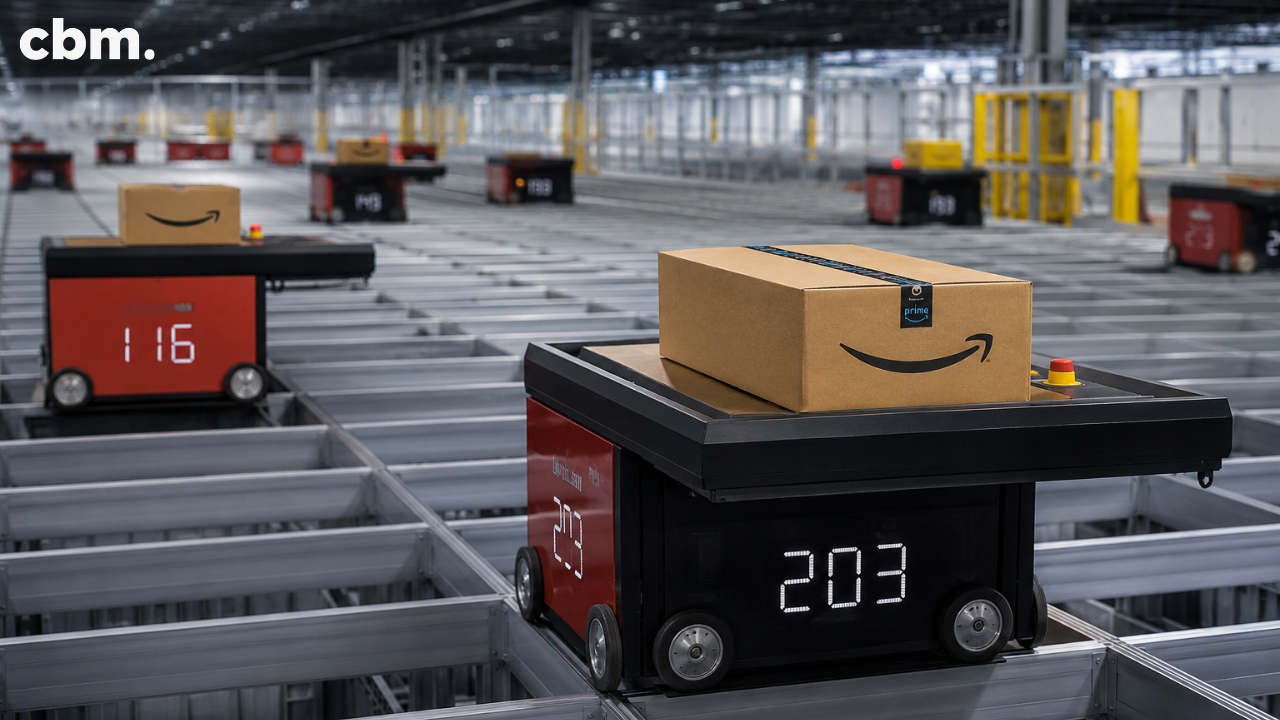
Rather than relying on conventional warehouse aisles and shelving, products are stored in bins stacked vertically inside a grid. Robots travel across the top of the structure, retrieving bins and delivering them to workstations where orders can be picked and processed.
The approach allows warehouses to store significantly more inventory within a smaller physical footprint while reducing the amount of manual movement required inside fulfillment centers.
AutoStore says it now has approximately 2,000 systems operating across 68 countries, serving retailers, logistics companies, industrial businesses and other fulfillment-intensive sectors.
The company increasingly positions its offering not simply as warehouse robotics, but as a broader fulfillment platform combining automation, software and AI.
Amazon already operates one of the most technologically sophisticated logistics networks in the world.
Warehouse automation is central to that strategy.
The company has spent years developing and deploying its own robotic systems while also acquiring and working with external automation technologies. Robotics is increasingly used to move inventory, organize products, assist picking and packing processes, and reduce the amount of repetitive physical movement required from warehouse employees.
The AutoStore agreement suggests that Amazon is continuing to evaluate multiple technological approaches rather than relying exclusively on internally developed systems.
For AutoStore, securing a global procurement framework with a customer of Amazon's scale also provides significant strategic validation.
In its Q2 2026 report, AutoStore CEO Mats Hovland Vikse described the Amazon agreement as further validation of the company's strategic direction and of the relevance of its technology for major global customers.
The agreement comes at a time when fulfillment automation is becoming increasingly important across the global e-commerce industry. Online retailers are under continuing pressure to process higher order volumes while simultaneously meeting increasingly demanding delivery expectations.
Customers now expect faster fulfillment, reliable inventory availability and greater visibility throughout the delivery process. At the same time, warehouse operators face rising labor costs and pressure to make better use of expensive logistics real estate.
AutoStore identifies continued e-commerce penetration, labor-cost inflation and increasing demand for operational efficiency as major structural drivers behind the long-term expansion of warehouse automation. Automated storage systems can potentially address several of those challenges simultaneously by increasing storage density, accelerating product retrieval and reducing repetitive warehouse movements.
The Amazon announcement coincided with AutoStore's second-quarter 2026 financial results. The company reported quarterly revenue of approximately $192 million, representing an increase of around 43% year on year. Order intake reached approximately $218 million, up around 45% compared with the same period in 2025. AutoStore's order backlog stood at approximately $596 million at the end of the quarter.
The company also reported a gross margin of around 72% and an adjusted EBITDA margin of approximately 45%. For the full 2026 financial year, AutoStore is currently targeting revenue of around $700 million. The company says it has also launched 14 new products and features during the past 12 months as it expands beyond its traditional core storage platform into additional warehouse automation applications.
The wider significance of the agreement extends beyond Amazon and AutoStore. Fulfillment has increasingly become a competitive differentiator in e-commerce. Retailers are no longer competing only through product assortment and price. Delivery speed, order accuracy, inventory availability and returns processing can directly affect the customer experience.
That places growing pressure on warehouse infrastructure. Automation allows operators to increase throughput without necessarily increasing warehouse size or workforce at the same rate. For large international retailers and marketplaces, these efficiencies can become particularly important because improvements made across dozens or hundreds of fulfillment centers can translate into substantial operational savings.
The Amazon-AutoStore agreement therefore highlights the increasing strategic importance of warehouse technology within the global e-commerce ecosystem.
Despite the potential scale of the partnership, the announcement should not be interpreted as confirmation of a major Amazon AutoStore rollout. Neither company has announced how many systems Amazon may acquire, which fulfillment centers could receive the technology, or how much Amazon could ultimately spend under the agreement.
AutoStore has explicitly stated that the framework does not contain purchasing commitments. Any future procurement would therefore represent a separate commercial decision. The agreement nevertheless removes part of the contractual groundwork that would otherwise be required for future deployments, potentially making it easier for Amazon to procure AutoStore technology across multiple markets.
Amazon's logistics operations have often influenced wider industry investment trends. Technologies deployed successfully at Amazon's enormous fulfillment scale can attract greater attention from retailers, marketplaces and third-party logistics providers seeking similar efficiency improvements. AutoStore says the majority of warehouses globally remain unautomated, suggesting significant potential for further expansion of automated fulfillment technology.
As e-commerce businesses look to shorten delivery times while controlling fulfillment costs, warehouse density and automation are likely to become increasingly important components of logistics strategy. For AutoStore, the new Amazon agreement provides access to potentially one of the largest automation customers in the world. For Amazon, it adds another proven technology platform to an increasingly sophisticated fulfillment ecosystem.
The immediate financial impact remains uncertain because no orders have yet been committed. But strategically, the agreement illustrates how quickly automation is becoming embedded in the infrastructure supporting global e-commerce.




By continuing to use the site, you agree to the use of cookies. more information
The cookie settings on this website are set to "allow cookies" to give you the best browsing experience possible. If you continue to use this website without changing your cookie settings or you click "Accept" below then you are consenting to this.