A report by Invesco about how China’s lower-tier cities are stepping up in consumption says that demand for online marketplaces is driven by lower-tier Chinese consumers. This shift allows merchants to take advantage of this rare occurrence.
The number of consumers that purchase from global marketplaces is increasing due to movement within the consumption dynamic in China. These consumers are looking for high-quality goods at a reasonable price. Online marketplaces offer diverse selections at different price ranges and values, which is why the consumer’s hunt starts there.
China currently only has four first-tier cities and 46 second-tier cities. According to Invesco’s research, the tier-three to tier-six cities are the ones that define the lower tier markets. Approximately 193 and 696 are third-tier and fourth-tier cities, which equals around 934 million Chinese shoppers (in 2017). That is three times greater than the population of the United States.
The vast majority of the Chinese population currently lives in lower-tier cities. This change of new increasing urban population allows the (e-commerce) consumer sector to flourish.
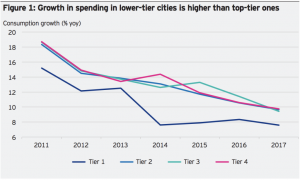
According to the research, lower-tier Chinese consumers are now ready to drive the overall consumption growth in China. As can be seen in the following graph, the consumption growth in lower-tier cities is currently growing increasingly higher than the growth in spending of tier-one cities.
An example is the capital city of Sichuan province, Chengdu, which is currently home to 16 million Chinese people. From 2013 to 2017, its average retail sales growth reached 11.6%. On the contrary, Beijing, the capital city of China has only reached an average sales growth of 7.4% during this period of time, even though the population is higher by 6 million.
The consumption sales are still one of the largest drivers for the world’s second-largest economy. As demand for higher-quality, higher-priced goods available on marketplaces is quickly increasing, it is now time for lower-tier cities to play a bigger role in driving the consumption growth in China.



By continuing to use the site, you agree to the use of cookies. more information
The cookie settings on this website are set to "allow cookies" to give you the best browsing experience possible. If you continue to use this website without changing your cookie settings or you click "Accept" below then you are consenting to this.