
The Nordic e-commerce market is entering 2026 with renewed momentum. After several years shaped by inflation, high interest rates, and cautious consumer spending, households across Sweden, Denmark, Finland, and Norway are gradually regaining confidence. At the same time, Nordic consumers remain highly price-conscious, digitally mature, and increasingly demanding when it comes to convenience, delivery flexibility, and transparent checkout experiences.
PostNord’s E-commerce in the Nordics 2026 Spring report, produced in collaboration with HUI Research, shows that online retail continues to be a major driver of retail growth across the region. Based on surveys with 4,000 consumers aged 18–79 across the four Nordic markets, the report highlights a market that is both unified by common digital habits and divided by important local differences.
The headline finding is clear: Nordic consumers are highly active online shoppers. Across the region, 86 percent of consumers shopped online during the last 30 days, up from 84 percent the previous year. More than eight out of ten Nordic consumers now shop online monthly, confirming that e-commerce has become a normal part of everyday purchasing behavior rather than a separate retail channel.
This growth is occurring in a market where consumers remain cautious with their money. Inflation may have stabilized, but the report shows that the habits formed during the cost-of-living squeeze have not disappeared. Nordic consumers continue to compare prices, look for promotions, and evaluate the full cost of purchase before completing an order.
For online retailers, this means growth opportunities remain strong, but competition is intensifying. Consumers expect competitive prices, convenient delivery, easy returns, and a smooth payment journey.
One of the most important findings is the strength of cross-border shopping. According to the report, 71 percent of Nordic consumers have made an online purchase from abroad during the past year. More than 40 percent shop online from abroad at least monthly, showing that international e-commerce is no longer occasional or exceptional.
China remains the most common country of origin for Nordic consumers’ latest international purchase, accounting for 27 percent of cross-border purchases. Germany and other European markets also play an important role, while the United States occupies a smaller, more brand-driven position.
The most common product categories for international purchases are clothes and footwear, followed by home electronics and beauty and health products. This reflects the role of global marketplaces in offering wide assortments, low prices, and trend-driven products.
Within the Nordic region, Sweden stands out as the most popular country for cross-border shopping. The report shows that Sweden is an important e-commerce destination for consumers in neighboring Nordic countries, especially Finland and Norway.
This reflects Sweden’s more mature domestic e-commerce market. Swedish retailers are better positioned to attract consumers from nearby markets because of broader assortments, stronger digital infrastructure, and relatively high consumer trust.
The rapid growth of international marketplaces is one of the most disruptive trends in Nordic e-commerce. Platforms such as Temu and Shein are gaining share by combining low prices, large product ranges, and app-based shopping experiences.
This poses a challenge for Nordic retailers, which typically operate under stricter rules governing consumer protection, product standards, and sustainability. Competing only on price will be difficult. Instead, local retailers need to emphasize trust, delivery reliability, product quality, easier returns, and stronger customer relationships.
The report also warns that upcoming regulatory changes could alter cross-border behavior. The planned removal of the €150 customs duty exemption for goods shipped from third countries to EU consumers may reduce impulse-driven cross-border purchases and shift some demand toward domestic or EU-based retailers.
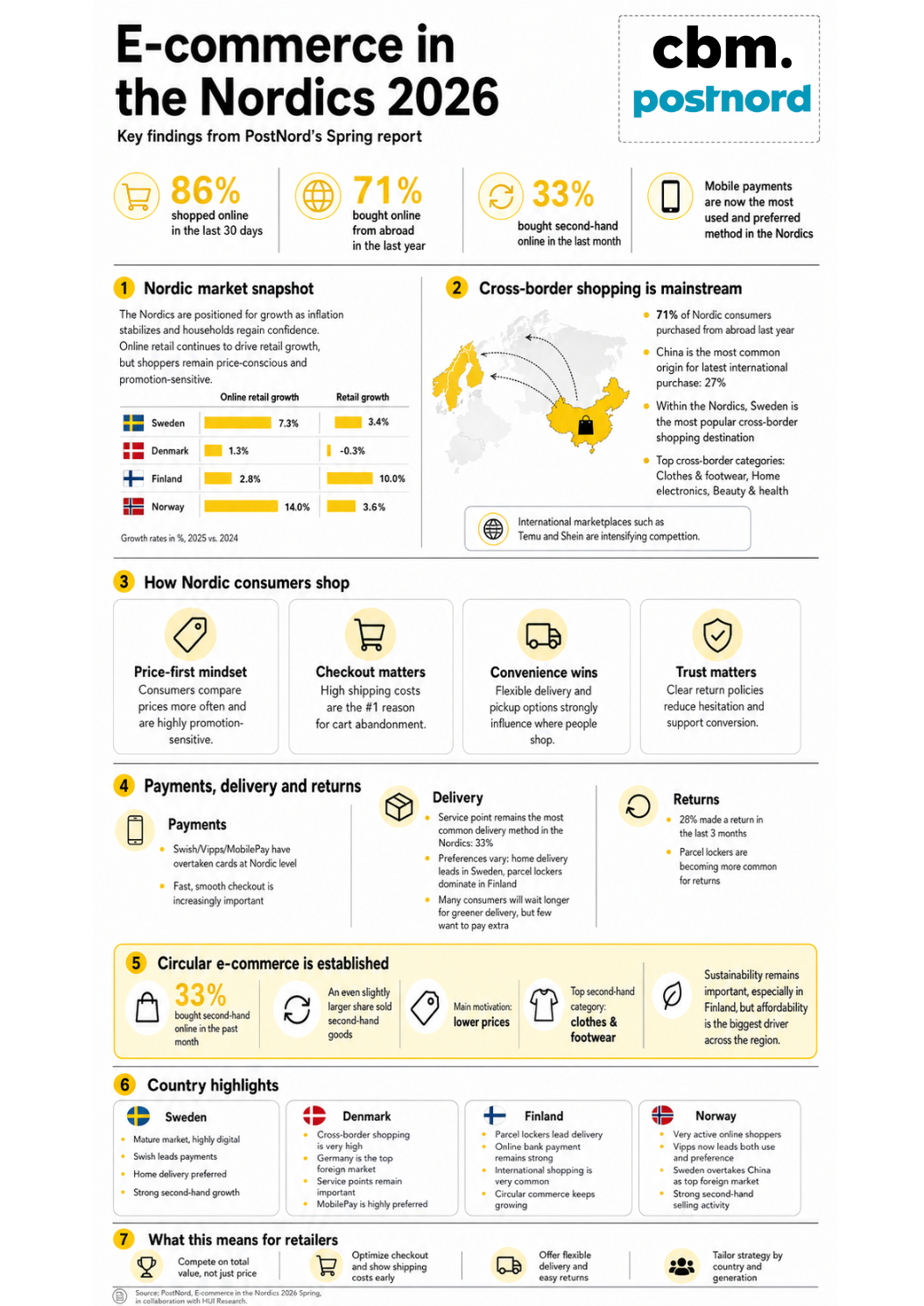
Payment behavior is changing quickly. Since 2024, Swish, Vipps, and MobilePay have been the most preferred payment methods in the Nordics. In 2026, they have also become the most widely used payment methods, surpassing credit cards across the Nordic region.
This is a major signal for retailers. Nordic consumers increasingly expect fast, familiar, and low-friction payment options. A complicated checkout can directly hurt conversion.
The report shows that checkout cancellations are becoming more common, often because shipping costs are too high, delivery options do not suit the customer, or return conditions are unattractive. In other words, the checkout is no longer just the final step in the purchase journey. It has become a point of comparison by which consumers decide whether the overall offer is good enough.
Delivery remains one of the most important competitive factors in Nordic e-commerce. At the Nordic level, service points are still the most common delivery method, used by 33 percent of consumers. However, preferences vary significantly by country.
In Sweden, home delivery is the most used and preferred option. In Denmark and Norway, service points remain highly important. In Finland, parcel lockers dominate, making Finland the strongest parcel locker market in the Nordics.
Across the region, flexibility is essential. Consumers want to choose the delivery method, pickup location, and delivery speed. However, while many say they are willing to wait longer for more sustainable delivery, fewer are willing to pay extra for it. This suggests that sustainability matters, but cost remains the stronger factor in decision-making.
Return behavior has remained relatively stable across the Nordics. At a regional level, 28 percent of consumers have returned a product during the last three months.
Younger consumers return more frequently, especially because they buy more fashion, a category traditionally associated with higher return rates. Older consumers tend to shop more deliberately and return fewer items.
The report also shows that return methods are evolving. Service points remain important, but parcel lockers are becoming more popular as a return option, particularly in Sweden and Finland. Retailers that make returns easy, visible, and predictable can reduce purchase hesitation, especially among consumers who see a clear return policy as a form of insurance.
Second-hand shopping has become a mainstream part of Nordic e-commerce. One in three Nordic consumers bought second-hand goods online during the past month, and a slightly higher share sold second-hand goods during the same period.
Clothes and footwear dominate circular e-commerce across the region. The main reason consumers buy second-hand is price, although sustainability still plays an important role, especially in Finland.
This finding is important because it shows that circular commerce is not only an environmental trend. It is also a response to economic pressure. Consumers are using second-hand platforms to access lower prices, find unique products, and maintain consumption while managing household budgets.
Generational differences are one of the strongest themes in the report. Consumers aged 18–29 shop internationally more often than older age groups. They are more exposed to global trends through TikTok, Instagram, and other social platforms, which influence what they discover and buy.
Younger shoppers are also more likely to buy and sell second-hand goods, cancel purchases during checkout, and expect fast, flexible delivery. They are highly digital, but also demanding and quick to switch retailers when the offer does not meet expectations.
Older consumers are more cautious. They shop internationally less often, tend to plan purchases more carefully, and are more likely to prefer familiar delivery and return methods. However, low prices can still influence their behavior, especially on platforms such as Temu.
Sweden remains one of the most active e-commerce markets in the Nordics, with 88 percent of consumers shopping online during the last 30 days. However, weekly shopping has declined, while monthly shopping has increased, suggesting that consumers are becoming more deliberate in their purchases.
Swish has become the most popular payment method, while home delivery remains central to the Swedish online shopping experience. Sweden also has a strong second-hand market, with platforms such as Vinted gaining popularity, especially among younger consumers.
Denmark has seen online shopping grow for the third consecutive year, with 85 percent of consumers shopping online during the last 30 days. Danish consumers are highly active cross-border shoppers, with 80 percent buying from abroad during the past year.
Germany is especially important for Danish consumers, while Zalando, Temu, and Amazon remain leading international marketplaces. Service points remain the most common delivery method, but home delivery options are highly valued.
Finland continues to grow as an e-commerce market, with 84 percent of consumers shopping online during the last 30 days. Finnish consumers are frequent international shoppers, with 80 percent buying from abroad during the past year.
Parcel lockers are the dominant delivery method in Finland, more so than in any other Nordic country. Online bank payments remain the most preferred payment method, although debit cards are growing among younger consumers. Finland also shows strong circular commerce behavior, with both price and sustainability motivating second-hand purchases.
Norway has one of the highest recent online shopping rates in the region, with 86 percent of consumers shopping online during the last 30 days. Cross-border shopping remains widespread, with 78 percent buying from abroad during the past year.
A notable shift is that Sweden has replaced China as the most popular country for Norwegian cross-border purchases. This may reflect a growing preference for closer, more reliable markets with faster delivery and easier returns.
Vipps has become both the most-used and most-preferred payment method in Norway, while service points remain the most common delivery method. Norwegian consumers are also highly active in second-hand selling.
A mix of growth, caution, and rising expectations defines the 2026 Nordic e-commerce landscape. Consumers are buying online more often, but they are also more selective. They compare prices, evaluate delivery options, expect easy payment options, and abandon checkouts when the overall offer does not feel right.
For retailers, the main message is that convenience and trust are now as important as assortment and price. The strongest opportunities lie in creating a seamless customer journey: transparent pricing, flexible delivery, familiar payment methods, clear return policies, and credible sustainability options.
At the same time, cross-border competition will intensify. International marketplaces have already become part of everyday Nordic shopping behavior. Local retailers need to respond not by copying every low-price tactic, but by building stronger value propositions around reliability, speed, service, relevance, and customer trust.
PostNord’s Spring 2026 report shows a Nordic e-commerce market that is recovering, evolving, and becoming more competitive. Online shopping is deeply embedded in consumer behavior, mobile payments are gaining dominance, cross-border shopping is mainstream, and circular commerce is now a normal part of the retail ecosystem.
The region is positioned for growth, but that growth will not be evenly distributed. Retailers that understand the differences between Sweden, Denmark, Finland, and Norway will be better placed to win. The same applies to those who recognize the differences between younger and older consumers, domestic and international shopping habits, and price-driven and convenience-driven behavior.
The future of Nordic e-commerce will belong to retailers that can combine competitive pricing with frictionless experiences, flexible logistics, trusted payment options, and a clear understanding of local consumer expectations.




By continuing to use the site, you agree to the use of cookies. more information
The cookie settings on this website are set to "allow cookies" to give you the best browsing experience possible. If you continue to use this website without changing your cookie settings or you click "Accept" below then you are consenting to this.