Artificial intelligence is becoming one of the most important forces shaping digital retail across Europe. What began as a tool for automation and analytics is now influencing how online stores attract customers, personalize shopping journeys, optimize pricing, forecast demand, and improve profitability. For retailers competing in a fast-changing market, AI is no longer a side project. It is increasingly central to growth.
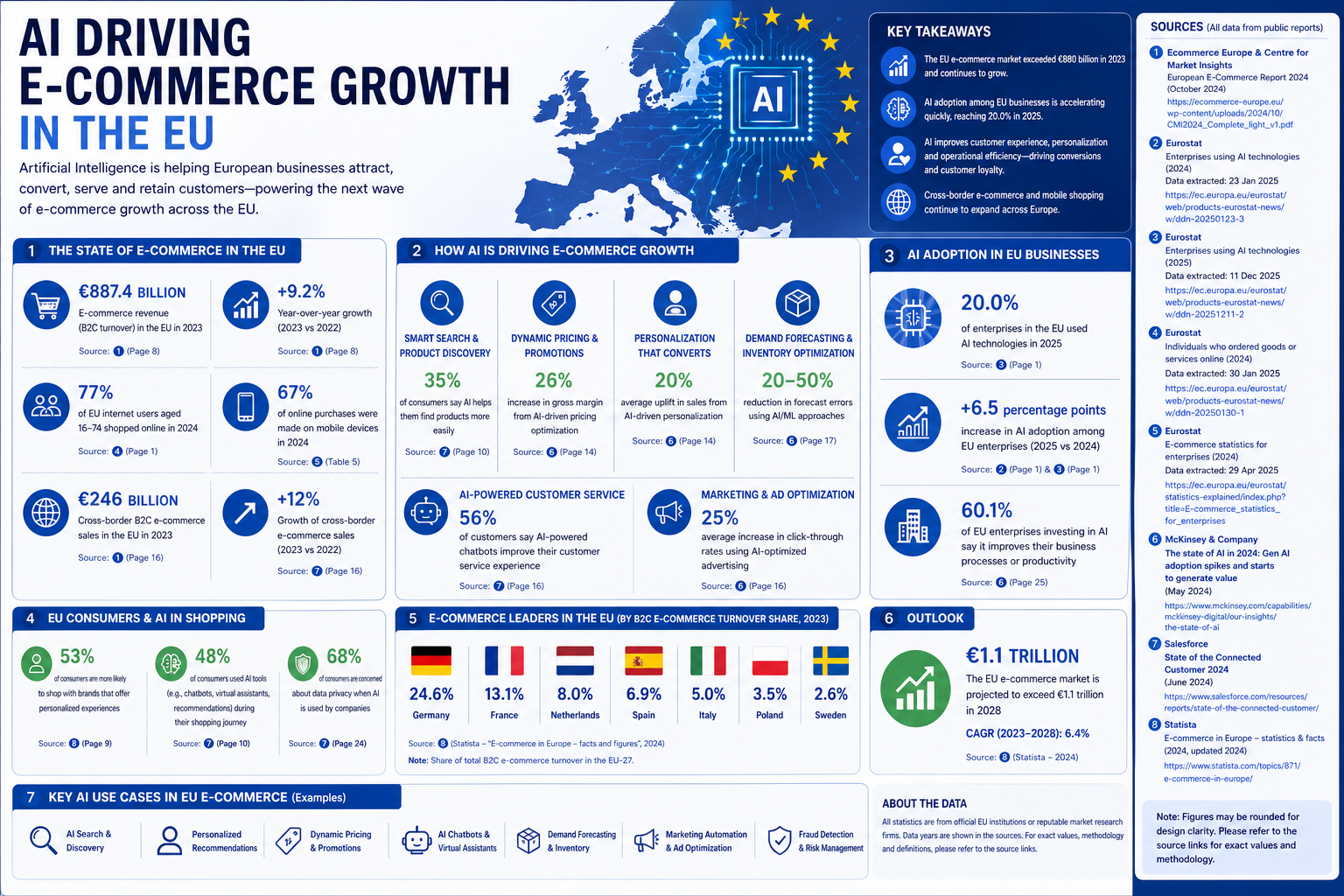
The data behind Europe’s online economy helps explain why this matters. European B2C e-commerce turnover reached €887.4 billion in 2023, and the market continues to expand as more consumers shift purchasing habits online. At the same time, AI adoption among businesses is accelerating, creating new opportunities for retailers that move early and execute well.
This combination of strong market demand and rising technology adoption is driving AI-driven e-commerce growth in the EU.
Europe is one of the world’s largest and most diverse e-commerce regions. It combines mature digital markets such as Germany, the Netherlands, and the Nordics with high-growth opportunities across Southern and Eastern Europe.
According to European market data:
These figures show a market with both scale and momentum. They also show why efficiency, relevance, and customer experience are becoming more important than simple traffic growth.
The strongest signal that AI will shape the future of retail in Europe is the speed of business adoption.
Recent EU data shows:
This matters because once adoption reaches critical mass, AI shifts from competitive advantage to competitive necessity. Businesses that fail to modernize risk slower growth, lower margins, and weaker customer experiences.
European retailers face a familiar challenge: customer acquisition is expensive, competition is intense, and shoppers expect seamless experiences across devices and channels.
AI helps solve these challenges by improving the economics of growth.
Instead of relying only on larger ad budgets or heavier discounting, retailers can use AI to increase the value of every visit, every transaction, and every customer relationship.
The most important growth levers include:
That is why AI is becoming essential for sustainable e-commerce expansion across the EU.
One of the fastest ways AI improves e-commerce performance is by helping shoppers find the right products faster.
Traditional search tools rely heavily on keywords. AI-powered search goes further by understanding context, intent, and behavior.
For example, instead of only matching exact terms, AI can interpret searches such as:
This reduces friction and shortens the path to purchase.
In large product catalogs, better discovery can significantly improve conversion rates while lowering bounce rates.
Consumers increasingly expect relevant experiences. Generic storefronts often underperform in competitive markets.
AI allows retailers to personalize:
The result is a shopping journey that feels more useful and less transactional.
Many retailers see personalization as one of the highest-return AI use cases because even modest improvements in conversion or basket size can scale quickly across thousands of orders.
Price sensitivity remains high across many European markets. Consumers compare offers quickly, especially in categories such as electronics, fashion, and home goods.
AI helps retailers adapt prices and promotions in real time based on factors such as:
This allows businesses to stay competitive without relying on unnecessary blanket discounts.
For retailers managing multiple countries and currencies, pricing intelligence can be especially valuable.
Inventory problems damage growth in two ways:
AI forecasting models use historical sales, seasonality, promotions, and customer trends to improve planning accuracy.
For European retailers operating across multiple warehouses, markets, and languages, better forecasting can create a major operational advantage.
Benefits often include:
Customer support remains expensive and difficult to scale, especially for brands selling across multiple countries and languages.
AI assistants and chat tools can now handle many common tasks such as:
This improves response speed while reducing support costs. It also helps smaller retailers offer service levels that previously required larger teams.
The impact of AI is visible across major European e-commerce players.
Zalando uses AI to improve fashion recommendations, search relevance, and customer engagement. In a category where inspiration and fit matter, personalization can directly influence revenue.
OTTO has invested in AI for demand forecasting and inventory optimization, helping improve planning efficiency in a large retail operation.
Allegro applies intelligent systems to search relevance, marketplace optimization, and fraud prevention.
ASOS has explored AI-driven personalization and trend analysis to improve digital shopping experiences.
bol.com uses automation, recommendations, and service enhancements to improve conversion and customer satisfaction.
These examples show that AI is not limited to one country or one retail model. It is becoming a pan-European growth engine.
The EU market has unique characteristics that make AI especially valuable.
With 67% of online purchases made on mobile devices, retailers must optimize smaller screens, faster decisions, and shorter attention spans.
AI helps by improving:
Cross-border B2C sales worth €246 billion show that consumers are increasingly willing to buy from sellers in other EU markets.
AI can support cross-border growth through:
Although AI offers major opportunities, success is not automatic.
Poor product data weakens recommendations, search, and forecasting.
Disconnected systems limit automation and slow execution.
European businesses must align AI use with privacy expectations and regulatory requirements.
The best programs focus on measurable commercial outcomes rather than technology hype.
Not every company needs enterprise-scale budgets to benefit from AI.
Strong starting points include:
The goal should be practical wins that compound over time.
As adoption rises, AI will likely become embedded across the full retail value chain.
The next phase may include:
Retailers that build strong data foundations and implement high-value use cases early will be best positioned to lead.
The evidence is clear that AI is driving e-commerce growth in the EU. Europe already has a massive digital retail market, strong consumer adoption, and rapidly increasing business investment in AI. Companies are using intelligent systems to improve discovery, increase conversions, optimize operations, and create better customer experiences.
The next chapter of European e-commerce growth will not be defined only by who has the biggest catalog or the largest ad budget. It will be defined by who applies AI most effectively.



By continuing to use the site, you agree to the use of cookies. more information
The cookie settings on this website are set to "allow cookies" to give you the best browsing experience possible. If you continue to use this website without changing your cookie settings or you click "Accept" below then you are consenting to this.