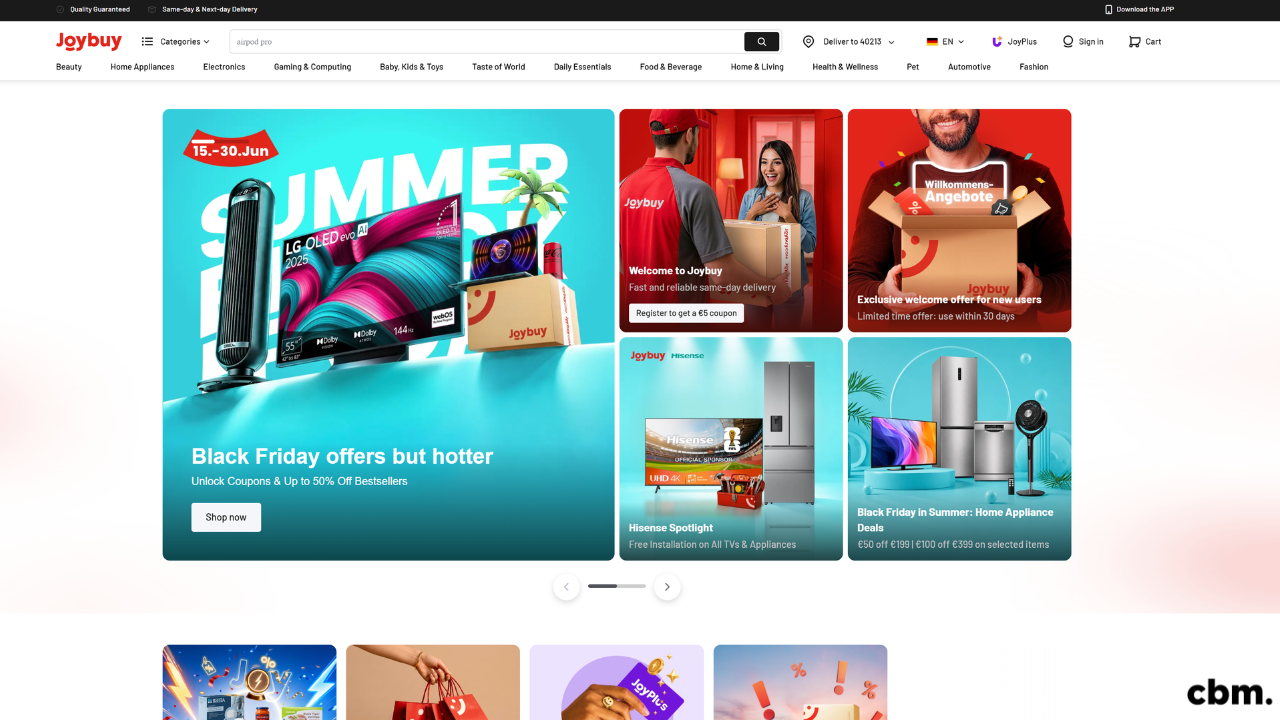
Joybuy, the European online retail platform owned by JD.com, is preparing for a significant shift in strategy. After launching in Europe as a first-party online department store, the company is now opening its platform to selected third-party sellers from both Europe and China.
The move marks an important step in JD.com’s European expansion. Until now, Joybuy has mainly operated as a retailer that buys, owns and stocks the products it sells. By allowing outside brands and sellers onto the platform, Joybuy is moving closer to a marketplace model, while still trying to maintain a more curated and controlled shopping experience than many open marketplaces.
For European e-commerce, this is more than just another marketplace launch. Joybuy’s entry comes at a time when the European online retail market is becoming increasingly competitive, with Amazon, Temu, Shein, TikTok Shop, AliExpress, Zalando, Bol and national retailers all fighting for consumer attention. JD.com is entering that race with a proposition built around logistics, product range, brand control, and fast delivery.
Joybuy officially launched in several European markets in March 2026, including the United Kingdom, Germany, France, the Netherlands, Belgium and Luxembourg. The platform entered the market as a full-category online retailer, offering products across electronics, appliances, beauty, homeware, groceries and daily essentials.
The new marketplace model changes the business's structure. Instead of selling only products Joybuy purchases and holds in its own inventory, the platform will begin selling products from selected third-party partners. These sellers are expected to include both European and Chinese brands seeking a stronger route into the European consumer market.
This is a strategic evolution. First-party retail gives Joybuy more control over pricing, inventory, fulfillment and customer experience. A marketplace model, however, allows the company to expand its product catalog faster, attract more brands, and increase consumer choice without carrying all inventory itself.
The key difference is that Joybuy does not appear to be positioning itself as a fully open marketplace where any seller can join. Instead, the company is testing a curated marketplace approach, focused on trusted brands and selected partners. That distinction matters. In Europe, concerns around product safety, counterfeit goods, low-quality imports and marketplace compliance are growing. A more controlled seller environment could help Joybuy differentiate itself from platforms that rely heavily on broad cross-border seller networks.
The decision to open Joybuy to outside sellers reflects the realities of European e-commerce. A first-party retail model can create trust, but it is expensive and slower to scale. Building a broad assortment requires capital, stock, warehousing, and demand forecasting. A marketplace model gives Joybuy a faster route to category expansion.
For JD.com, the goal is clear: Joybuy needs to become more relevant to European shoppers. Consumers are unlikely to change shopping habits unless the platform offers strong prices, familiar brands, fast delivery, and enough product variety to make it worth returning.
Opening to third-party sellers helps solve the assortment problem. European sellers can bring local brands, region-specific products, and established consumer trust. Chinese sellers can bring price competitiveness, manufacturing depth, and product categories where China already has strong supply chain advantages, such as electronics, home goods, accessories and lifestyle products.
The result could be a hybrid marketplace that combines European brand credibility with Chinese supply chain efficiency. If Joybuy manages that balance well, it could become a more serious challenger in Europe’s crowded marketplace landscape.
One of the most important parts of Joybuy’s marketplace strategy is fulfillment. Sellers will reportedly have different options: their products can either be stored in Joybuy’s warehouses or shipped directly to consumers by suppliers.
This gives Joybuy flexibility. Products held in Joybuy’s logistics network can benefit from faster delivery and tighter service control. Products shipped directly by suppliers may allow the platform to expand its catalog more quickly, particularly for long-tail products or categories where immediate local stock is less essential.
This hybrid model resembles the logic used by major marketplaces such as Amazon and TikTok Shop, where sellers can either use platform-managed fulfillment or handle logistics themselves. However, JD.com’s advantage is that logistics has always been central to its business model. In China, JD.com built its reputation around supply chain control, warehousing, and delivery speed. In Europe, the company is trying to bring that same operational identity to Joybuy.
Joybuy’s European expansion is supported by JoyExpress, JD.com’s delivery service in the region. The service has been positioned around same-day and next-day delivery in major European cities, supported by warehouses and depots across the continent.
This logistics infrastructure is one of Joybuy’s biggest potential differentiators. Many Chinese-linked e-commerce platforms in Europe have grown through cross-border shipping models, often competing on price but facing criticism around delivery times, product compliance or customer service. Joybuy is trying to present a different model: local or regional fulfillment, fast delivery, and a more controlled retail experience.
For shoppers, this could make Joybuy feel closer to Amazon than to Temu or Shein. The platform is not simply connecting European consumers with overseas suppliers. It is trying to build a local operating model backed by JD.com’s supply chain capabilities.
For sellers, the logistics element could also be attractive. European brands that want to reach new customers may see Joybuy as an additional sales channel with fulfillment support. Chinese brands that want to enter Europe may see Joybuy as a more structured alternative to selling independently across multiple local platforms.
Joybuy’s expansion naturally invites comparisons with Amazon. JD.com is one of China’s largest retail and e-commerce companies, and its European strategy directly targets markets where Amazon already has a strong presence.
However, competing with Amazon in Europe will not be easy. Amazon has enormous brand recognition, a mature seller ecosystem, Prime membership, advertising tools, fulfillment infrastructure, and deep consumer loyalty. Joybuy will need to prove that it can offer something clearly better or different.
Its main competitive pillars appear to be price, fast delivery, trusted brands, and a broad product range. The launch of a subscription-style delivery service also suggests that Joybuy understands the importance of repeat purchasing and loyalty in the European market.
The challenge is scale. Marketplaces become more valuable when they have more sellers, more products, more buyers, and more data. Joybuy’s move to open to third-party sellers is therefore necessary if it wants to become a long-term competitor rather than a niche retail platform.
For European sellers, Joybuy could become a new route to marketplace growth. Many brands and retailers are already dependent on Amazon, Zalando, Bol, eBay, or national platforms. A new marketplace backed by JD.com could give sellers another channel to reach consumers in multiple European countries.
The opportunity is especially relevant for brands looking for international expansion without building separate local e-commerce operations in each market. If Joybuy can offer cross-border visibility, fulfillment support, and traffic generation, it may appeal to sellers who want a faster route into countries such as the UK, Germany, France and the Netherlands.
There is also a China-facing angle. JD.com has been promoting itself as a bridge between European brands and Chinese consumers. Its activities around European brand partnerships suggest that JD.com is not only trying to sell Chinese products in Europe, but also to bring European products into China through its broader ecosystem.
That dual-direction strategy could make Joybuy more attractive to European brands. A partnership with JD.com may eventually offer access not only to European shoppers but also to Chinese consumers through JD.com’s domestic and cross-border channels.
For Chinese sellers, Joybuy could offer a more controlled, brand-oriented path into Europe. Over the past few years, Chinese e-commerce platforms have grown rapidly in European markets, but they have also faced increasing scrutiny over product safety, customs, taxation, sustainability and consumer protection.
A curated marketplace operated by JD.com could help Chinese brands present themselves in a more premium and compliant environment. Instead of competing purely on low prices, selected Chinese sellers may use Joybuy to build trust, improve delivery times, and reach European consumers through a platform that emphasizes logistics and quality control.
This could be particularly important as the EU increases pressure on low-value imports and marketplace accountability. The future of Chinese e-commerce in Europe will likely depend less on ultra-cheap cross-border parcels and more on local fulfillment, compliance, transparency, and reliable service.
Joybuy’s model appears to be aligned with that shift.
Joybuy’s European strategy stands out because it is not only about low prices. While price competitiveness will remain important, JD.com seems to be building the platform around a broader promise: trusted products, fast fulfillment, recognizable brands, and a more structured customer experience.
That makes Joybuy different from the stereotype of Chinese e-commerce platforms focused mainly on cheap goods shipped directly from overseas factories. JD.com’s background is in retail infrastructure, logistics and supply chain technology. In Europe, that could help Joybuy position itself as a more reliable alternative for consumers who want value but are also concerned about delivery speed and product quality.
This does not mean Joybuy will automatically succeed. Europe is fragmented, competitive, and highly regulated. Consumer habits differ widely between countries. Local champions remain strong in several markets. Amazon is deeply entrenched. And new platforms need time, marketing investment, and seller adoption before they become part of everyday shopping behavior.
Still, the move to open Joybuy to third-party sellers gives JD.com a much better chance of building momentum.
Joybuy’s shift comes at a time when marketplaces are becoming increasingly central to European e-commerce. Consumers are comfortable buying through platforms that aggregate products, brands, reviews, promotions, and fulfillment options in one place. Sellers, meanwhile, are using marketplaces to expand faster across borders.
This marketplace-first environment creates opportunities for new entrants, but it also raises expectations. European shoppers now expect broad selection, fast delivery, easy returns, transparent prices, secure payments, and reliable customer service. Any new marketplace must meet those standards from the beginning.
Joybuy is entering the market with the support of JD.com’s logistics network and retail experience, giving it a stronger starting point than many new platforms. But the next stage will depend on execution: seller quality, product availability, delivery reliability, marketing effectiveness, and consumer trust.
The opening of Joybuy to European and Chinese sellers should be seen as the beginning of a new phase, not the endpoint. The platform is still young in Europe, and its marketplace model will likely develop gradually.
In the short term, Joybuy will probably focus on selected sellers and categories where it can maintain control over quality and service. Electronics, home goods, beauty, groceries, appliances, and lifestyle products are likely to remain important areas. Over time, the platform may expand into more categories as it builds traffic and operational confidence.
The summer promotional campaign is also important. Joybuy is trying to create consumer awareness quickly, using discounts and seasonal shopping events to introduce shoppers to the platform. This is a familiar tactic in marketplace expansion: attract users with deals, prove the service experience, and then convert first-time buyers into repeat customers.
For European e-commerce players, Joybuy is now a platform to watch closely. It may not immediately threaten Amazon’s dominance, but it adds another serious competitor to an already crowded market. More importantly, it introduces a different operating model to the region: a Chinese retail giant that combines marketplace expansion with local logistics infrastructure.
Joybuy’s decision to open its European platform to selected third-party sellers from Europe and China marks a major strategic shift for JD.com. The company is moving beyond a first-party online retail model and building a marketplace designed to scale faster, broaden its product range, and strengthen its position in Europe.
The move could create new opportunities for European brands, Chinese sellers, and cross-border e-commerce operators. It also increases competitive pressure on Amazon and other established marketplaces, particularly if Joybuy can deliver on its promise of fast fulfillment, competitive prices, and a curated product experience.
Joybuy’s success is not guaranteed. Europe is one of the most complex and competitive e-commerce regions in the world. But with JD.com’s logistics capabilities, brand partnerships and marketplace ambitions, Joybuy is becoming one of the most important new players in European online retail.
For sellers, the message is clear: Europe’s marketplace landscape is changing again. Joybuy may still be new, but its opening to third-party sellers suggests that JD.com is preparing to play a much larger role in the future of European e-commerce.



By continuing to use the site, you agree to the use of cookies. more information
The cookie settings on this website are set to "allow cookies" to give you the best browsing experience possible. If you continue to use this website without changing your cookie settings or you click "Accept" below then you are consenting to this.