Data has always been one of the most valuable assets available to an e-commerce business. Yet having more data does not necessarily mean understanding customers better — and it certainly does not guarantee higher revenue.
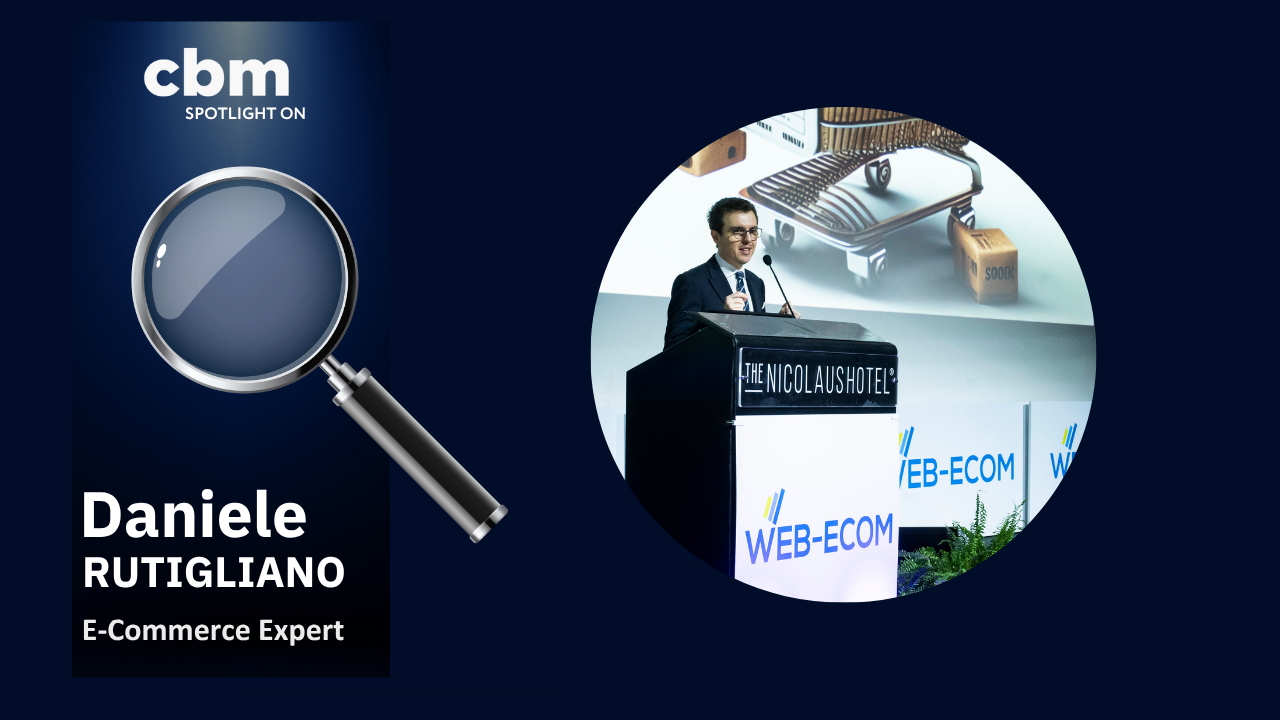
For Daniele Rutigliano, e-commerce expert, the real opportunity lies in turning the information companies already possess into concrete decisions. From identifying friction in the customer journey to improving retention and personalising marketing, data becomes valuable only when businesses know what question they are trying to answer.
As artificial intelligence makes increasingly sophisticated analysis accessible to companies of every size, Rutigliano believes the competitive divide will not simply be between businesses with more or less data. It will be between those capable of transforming it into action and those that continue merely collecting it.
CBM: Companies have access to unprecedented amounts of customer information today. Are e-commerce businesses actually making good use of it?
Daniele Rutigliano: There are essentially two very different situations.
On one side, you have companies — particularly small and midsize businesses — that still don't have a genuinely data-driven culture. Some may not even have a CRM system in place.
On the other side, there are businesses collecting enormous amounts of information but struggling because that data is distributed across different platforms, databases and servers.
So simply having data isn't enough. Companies need accurate information, properly integrated systems and, most importantly, the expertise required to interpret what the data is telling them.
Artificial intelligence is making that process considerably easier because it can accelerate analysis, identify correlations and even allow people to interrogate complex datasets using natural language. But AI cannot compensate for incomplete or poor-quality information.
"The goal shouldn't be to collect as much information as possible. It should be to transform the right data into better decisions."
CBM: With so many metrics available, which KPIs should online retailers really be paying attention to?
Daniele Rutigliano: Understanding customers has always been fundamental to marketing. The better you understand their needs and behaviour, the better positioned you are to encourage repeat purchases, generate referrals and create relevant campaigns.
There are many metrics an e-commerce company can monitor, but some of the most important are Customer Acquisition Cost (CAC), Average Order Value (AOV), Customer Lifetime Value (CLV) and Time Between Purchases (TBP).
Each tells you something different.
CAC tells you how much you're investing to acquire a customer. CLV helps you understand how valuable that customer could be throughout the relationship. AOV shows the average value of their transactions, while TBP tells you how frequently they're coming back.
Put those pieces together and you begin developing a much clearer picture of the customer.
We're still going to need segmentation and broader customer groups, but the direction is increasingly towards personalisation. E-commerce marketing is gradually moving closer to a one-to-one model.
CBM: How does a company actually transform those metrics into higher revenue?
Daniele Rutigliano: Collecting information is only the beginning. There needs to be a process behind it.
You identify a problem or an opportunity, formulate a hypothesis, take a specific action and then measure what happens.
Imagine, for example, that your data shows an unusually high checkout abandonment rate in one particular country.
The number itself isn't the answer. It's the starting point.
You then need to understand why it's happening. Are shipping costs too high? Are delivery times too long? Are customers missing their preferred local payment method? Is there another source of friction?
Once you've developed a hypothesis, you implement a change and compare performance before and after that intervention.
That's when data becomes valuable. You're no longer simply observing a dashboard; you're using information to make a measurable business decision.
"The real value doesn't come from having more dashboards. It comes from using their information to make measurable improvements."
CBM: One of the challenges you mentioned is having information scattered across multiple systems. How can retailers build a clearer customer view?
Daniele Rutigliano: It depends on the maturity of the business and what it's trying to achieve.
Web analytics platforms can tell you how visitors arrive at your website and how they navigate it. Behavioural analytics tools such as Microsoft Clarity, Hotjar or Mouseflow can go further by using session recordings, heat maps and interaction data to identify friction in the customer journey.
More advanced businesses can introduce Customer Data Platforms, or CDPs, which combine information from different sources to create unified customer profiles.
Once you have that integrated view, the information can then be activated across different channels to create much more personalised customer communications.
CBM: Artificial intelligence is changing virtually every aspect of e-commerce. What difference does it make when working with data?
Daniele Rutigliano: AI can dramatically accelerate the analytical process.
It can identify correlations across complex datasets and make information accessible to people who might previously have required specialist analytical knowledge. Natural-language interaction is particularly interesting because it reduces some of the barriers between decision-makers and the information contained within their systems.
But there's an important limitation.
AI cannot fix fundamentally bad data.
If your information is inaccurate, incomplete or poorly integrated, introducing AI isn't suddenly going to create a reliable business intelligence system. The foundations still matter.
Companies need to collect accurate information and connect their systems properly before they can expect AI to generate meaningful insights.
CBM: Smaller e-commerce businesses may hear terms like CDPs, AI and advanced analytics and assume that becoming data-driven requires a major investment. Does it?
Daniele Rutigliano: Not necessarily.
Many SMEs already have a surprising amount of useful data. It might exist inside their e-commerce platform, analytics tools, advertising accounts, CRM or customer service software.
You don't need to begin with an enormous technological infrastructure.
Start with a business objective.
Identify the information that can help you understand that particular objective and then use the tools you already have available.
Platforms such as Google Analytics 4 and Microsoft Clarity, combined with advertising platform data and the reports generated by the e-commerce platform itself, can already reveal customer behaviours, weaknesses in the purchasing journey and potential opportunities for growth.
The important thing is not how sophisticated the technology is. It's whether you're using the information to answer a meaningful business question.
For Rutigliano, becoming data-driven is ultimately less about accumulating technology and more about changing how companies make decisions.
A metric should lead to a question. The question should generate a hypothesis. The hypothesis should result in an action. And that action should produce something that can be measured.
That cycle turns information into commercial intelligence — and commercial intelligence into revenue.
It is also the approach Rutigliano will explore through practical examples during his workshop, “Data as a Revenue Driver: From Insight to Competitive Advantage,” at the EU Cross-Border E-commerce Forum 2026 in Liège on September 9 at 11:15 a.m.
For e-commerce businesses, his message is straightforward: competitive advantage will not come from simply possessing more information than everybody else. It will come from knowing which data matters, understanding what it means and, above all, acting on it.



By continuing to use the site, you agree to the use of cookies. more information
The cookie settings on this website are set to "allow cookies" to give you the best browsing experience possible. If you continue to use this website without changing your cookie settings or you click "Accept" below then you are consenting to this.