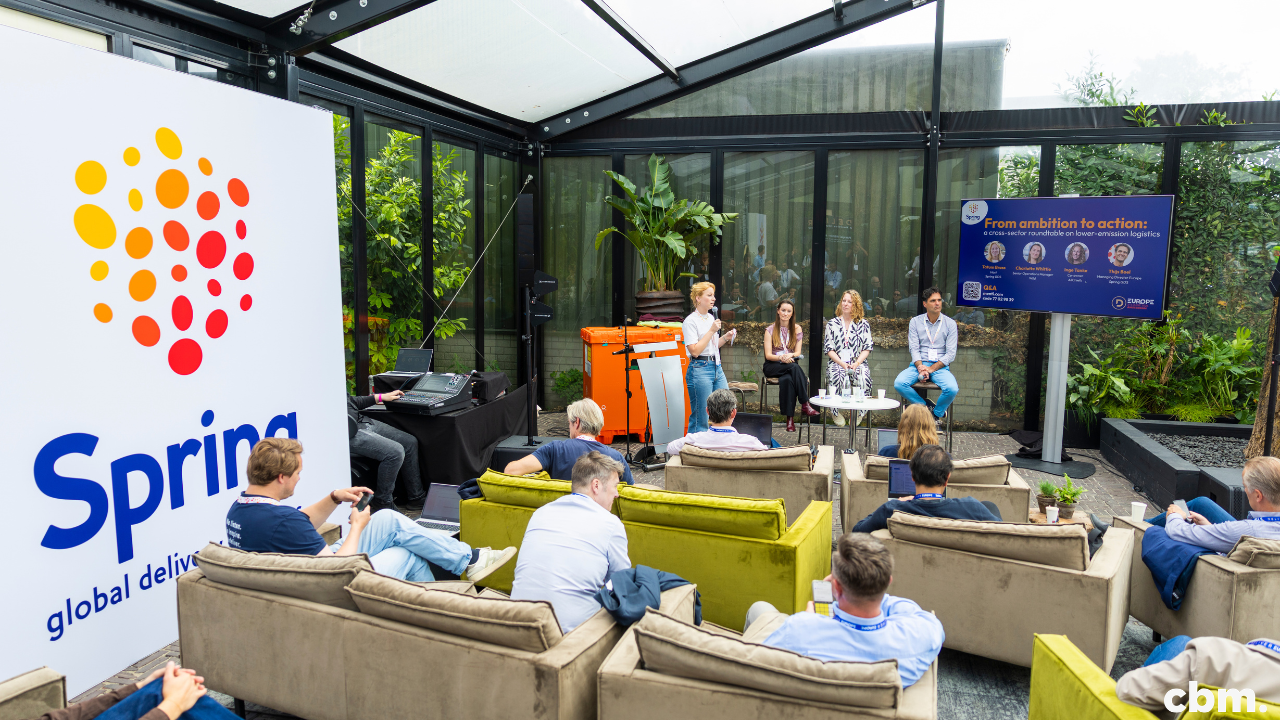
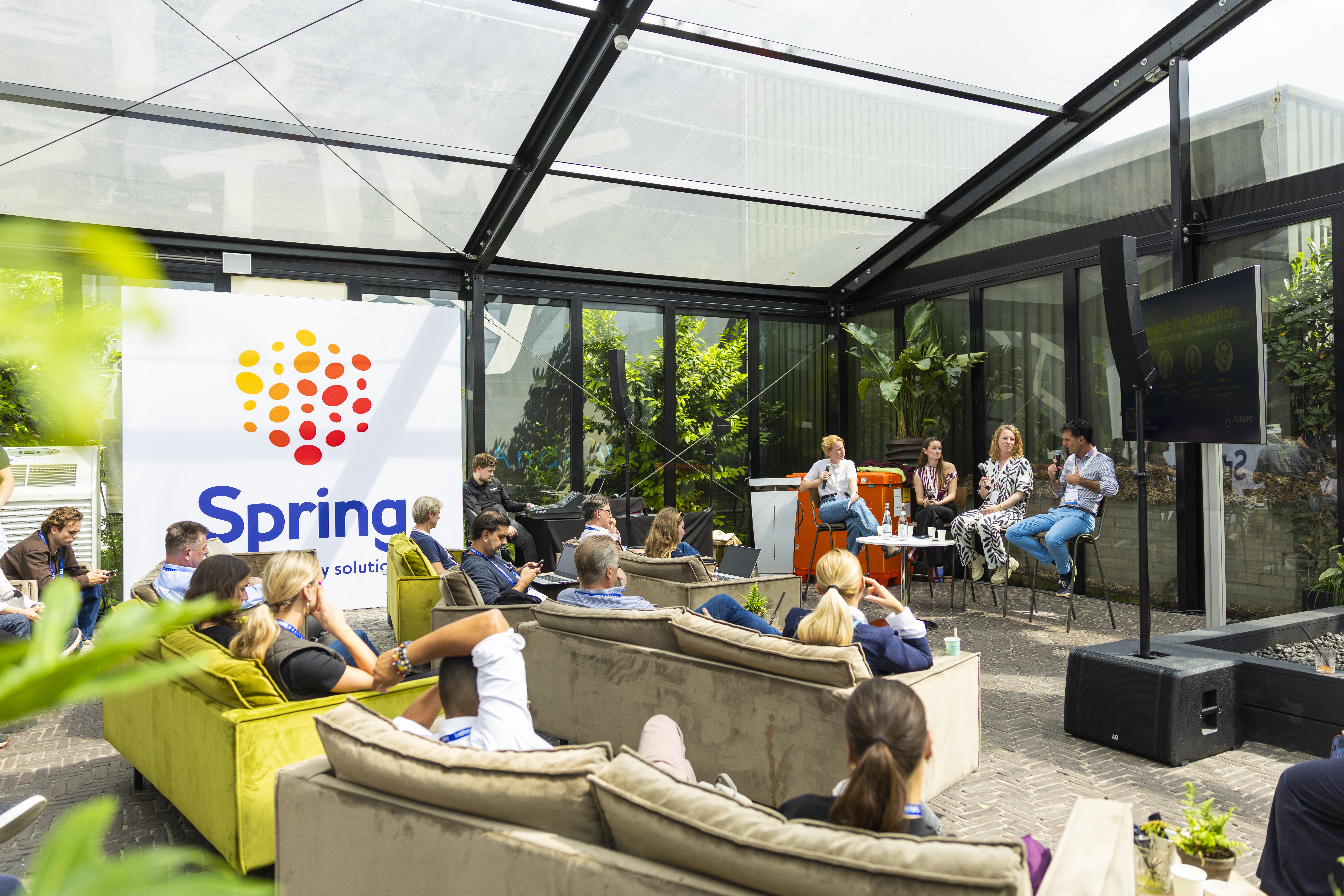
Achieving a net-zero carbon footprint is no longer an optional marketing gimmick; it is a strategic necessity. Companies across the globe are committing to ambitious net-zero targets. However, translating these goals into daily operations is highly complex and riddled with structural barriers. During a panel discussion in the Sustainability Lounge, three industry experts tackled the burning question: How do we bridge the gap between green ambitions and the stubborn realities of daily logistics?
Led by moderator Tatum Bross (Spring GDS), panelists Inge Tanke (AllChiefs), Charlotte Whittle (Wild), and Thijs Boel (Spring GDS Europe) shared their perspectives. The result was a pragmatic yet hopeful analysis of the supply chain, emphasizing that collaboration, operational efficiency, and data-driven innovation are the keys to driving genuine change.
While many e-commerce and logistics companies have set bold climate goals for the coming decades, putting them into practice often reveals significant challenges. As moderator Tatum pointed out, sustainability is a journey that cannot be taken alone. To make a real impact, businesses must look beyond their immediate internal operations and take their entire value chain into account.
As a consultant specializing in sustainable logistics, Inge witnesses firsthand how companies struggle to prioritize their carbon reduction levers. When a business sets a net-zero target, finding the most cost-effective path to that goal is paramount. Often, companies initially focus on reducing their Scope 1 and Scope 2 emissions (direct and indirect emissions from their own operations).
For product-driven and e-commerce brands, attention also quickly shifts toward raw materials and the end-of-life cycle of their goods. Logistical decarbonization (which frequently falls under Scope 3) is sometimes deprioritized. Inge explained that the level of focus on logistics largely depends on the specific brand, primarily because decarbonizing transport is inherently complex and relies heavily on external parties.
One of the most critical takeaways from the discussion is that the feasibility of sustainability varies drastically depending on the transport mode. Thijs Boel explained that for regional networks, such as European road freight, the necessary technology is already largely available. Electric vehicles, optimized routing, and biofuels offer immediate and tangible reduction pathways.
The real headache for global logistics providers lies in air freight. Spring GDS contributes to the PostNL group goal to reach net-zero by 2040, but as Thijs admitted, solving the sustainability equation for air freight remains a massive hurdle. The technical solutions required to operate intercontinental flights entirely emission-free at scale simply do not exist yet. This represents the widest gap between industry ambitions and current physical realities.
On the retail side, brands experience their own share of operational frustrations. Charlotte, Operations Manager at the circular personal care brand Wild, highlighted a chronic lack of sustainable options during carrier tendering processes. In the real world, the most cost-efficient, reliable, and speedy shipping options are rarely the ones pioneering sustainability. Charlotte issued a strong call to action for the transport sector, stating that carriers need to raise the bar and establish clear sustainability benchmarks, noting that it is still not talked about enough during commercial tenders.

If the green transition is moving too slowly, which stakeholder should steer the ship? Should brands take charge by demanding greener services, should logistics providers proactively invest in infrastructure, or should the industry wait for strict government regulations?
Thijs warned against the blame game. If the industry spends its time debating which party should move first, it creates a vicious circle where everyone stands still. Relying solely on regulators means companies will only meet the absolute minimum requirements. On the other hand, if transport providers only adapt when customers demand it (or offer to pay extra), progress stalls.
According to Thijs, real acceleration occurs only when all actors in the chain realize that sustainability unlocks additional value beyond a "green stamp." Logistics is a thin-margin business. The moment sustainability is coupled with cost reductions, stronger employer branding, or increased customer retention, the entire dynamic of the conversation shifts.
From Wild's perspective, Charlotte balanced this view by pointing out internal expertise limitations. Brands certainly carry the responsibility to stimulate consumer demand and educate their audience. However, they must also lean heavily on the technical expertise of their carriers. A retail brand rarely possesses specialized in-house logistics knowledge, meaning they depend on the green solutions put forward by their logistics providers.
Conversely, Inge placed the responsibility slightly more onto the brands—to the amusement of the audience. Because logistics is a fierce cost game, logistics service providers (LSPs) naturally move faster when there is active market demand. If a brand like Wild explicitly grades carriers on their sustainability vision during tenders, it rewards the providers who choose to innovate. If procurement ultimately selects carriers based on the lowest price alone, it becomes impossible for transport providers to sustain their green investments. Furthermore, the operational flexibility required to optimize transport—such as accepting slower delivery windows to increase truck fill rates—rests firmly with the brand.
Despite the long road ahead to an entirely zero-emission industry, the panel highlighted several highly practical solutions that are currently shrinking environmental impacts.
To tackle the difficult air freight sector, Inge sees massive potential in market-based accounting mechanisms, specifically the book-and-claim system. Currently, Sustainable Aviation Fuel (SAF) is extremely scarce and expensive. It would be logistically highly inefficient to transport physical SAF across the world just to pump it into the exact airplane carrying a specific company's e-commerce parcels.
Through a book-and-claim framework, a brand can purchase the environmental attributes (credits) of SAF. The actual fuel is then injected into the supply chain at an airport located close to the SAF production facility. The buyer funds the greening of global aviation without overcomplicating the physical distribution process. According to Inge, this sends a powerful demand signal to the market, giving investors the financial security required to build more SAF factories. Logistics providers like Spring GDS are already actively participating in these programs.
Thijs illustrated that making a profound impact does not always require high-tech breakthroughs; sometimes it comes down to smart, tangible hardware. He pointed to Spring GDS’s signature orange pallet box on display at the lounge. Instead of relying on single-use wooden pallets, cardboard layers, and plastic shrink-wrap, the company invested millions into a robust, reusable, and collapsible plastic pallet box network.
| Traditional Logistics | Orange Pallet Box |
| Single-use wood & cardboard | 100% Reusable heavy plastic |
| Significant trapped air | Standardized & structured |
| Waste issue for local agent | Circular return stream |
| Higher transportation costs | Optimized truck fill rate = lowered carbon & cost |
These boxes allow parcels to be stacked tightly and securely. In transport logistics, maximizing the truck's volume capacity directly drives down both CO2 emissions per parcel and overall freight costs. The return on investment for this multi-million project was achieved incredibly quickly. Furthermore, it solved a major operational headache for destination delivery partners, who are no longer left saddled with mountains of commercial cardboard waste.
Representing the brand perspective, Charlotte demonstrated how upstream product design reshapes downstream logistics efficiency. Wild’s business model centers on a durable, refillable case that customers keep for life, ordering refills online. These refills are uniquely engineered to ship in flat, recycled cardboard packaging that fits directly through a standard household letterbox.
By utilizing this "large letter" format, Wild completely eliminates e-commerce's biggest environmental sin: shipping empty air. Because the packaging is incredibly compact and seamlessly integrates into existing postal sorting streams or Spring GDS’s reusable roll cages, material waste is minimized, and single-use plastic tape is completely banished from their fulfillment operations.
An insightful question from the audience directed the conversation toward a major industry talking point: how can a data-rich environment like logistics leverage AI to advance sustainability? The panel’s responses revealed an industry navigating a complex digital transition.
Although logistics generates billions of data points daily via telematics, warehouse management systems, and tracking scans, Inge tempered expectations regarding immediate, widespread AI deployment. The road freight sector remains highly fragmented, consisting predominantly of small to medium-sized carriers. Many of these operators lack the infrastructure to clean and structure their data. Before an organization can deploy advanced AI models, it must achieve baseline data correctness—an area where many companies are still on a journey.
Thijs validated these data-cleansing challenges. Sophisticated e-commerce clients increasingly demand highly customized, lane-specific carbon emission reports per parcel. Because Spring GDS operates as an asset-light network orchestrator—meaning they manage a vast network of partners rather than owning planes or trucks—consolidating disparate data streams was a monumental task.
It took their data engineering teams nearly two years to build a single, reliable "source of truth." Now that this solid foundation is laid, the real optimization can begin. Moving forward, the company can deploy analytical tools to identify routing anomalies, uncover inefficiencies, and calculate exact CO2 reduction strategies based on a customer's specific shipment profile.
According to Charlotte, the value of AI for retail brands does not have to depend on complex autonomous driving algorithms. Instead, the immediate value lies in predicting and preventing operational errors. For example, brands can use machine learning to optimize inventory forecasting, avoiding reactionary, last-minute air freight shipments when a product unexpectedly sells out. Similarly, AI can flag address formatting issues before a label is printed, preventing failed deliveries. Eradicating "return to sender" loops is, after all, one of the most effective ways to instantly cut logistics emissions.
While sustainability is an excellent corporate objective, e-commerce has traditionally thrived on the pillars of speed, convenience, and rock-bottom prices. Where does the consumer draw the line when a brand opts for green logistics?
When asked about the compromises customers refuse to make, Charlotte noted that Wild focuses heavily on quality and ingredient transparency. Formulating products that are 96% natural makes production considerably more challenging and costly. However, because the brand's core mission resonates deeply with its audience, Wild has cultivated a highly supportive community willing to pay a premium for sustainable personal care.
From a logistical standpoint, choosing to avoid air freight occasionally means international customers must wait slightly longer for their orders. Wild purposefully utilizes slower, surface-based postal networks. Because this green shipping trade-off is communicated transparently at checkout, the slightly longer transit time has proven to be a non-issue for their customer base.
To close the discussion, Tatum asked each panelist for a definitive takeaway for the audience. The consensus was clear: the era of sustainability as a mere compliance exercise is over, and the rewards of taking action extend far beyond environmental metrics.
The green transition in logistics has reached a critical inflection point. The industry's pioneering front-runners—representing the first 10 percent of the market—have successfully proved what is operationally possible. The defining challenge for the next three years is scaling these practices across the remaining 80 percent of the mass market. True impact will be achieved only when reusable transit hardware, biofuel insetting, and the elimination of shipped air become the industry standard rather than a premium niche. And as this discussion made abundantly clear, that transformation begins by taking the first practical step today.



By continuing to use the site, you agree to the use of cookies. more information
The cookie settings on this website are set to "allow cookies" to give you the best browsing experience possible. If you continue to use this website without changing your cookie settings or you click "Accept" below then you are consenting to this.