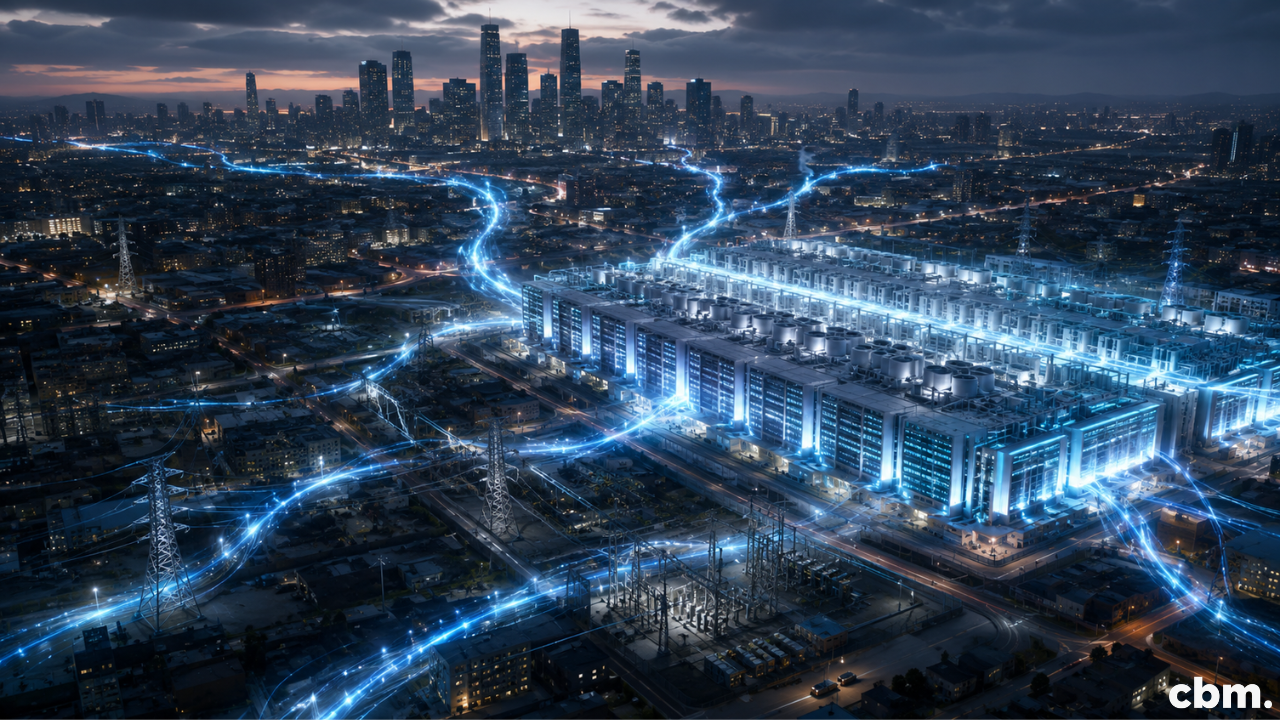
Artificial intelligence is often presented as a software revolution. But the numbers tell a more physical story.
AI does not run in the abstract. It runs inside data centers. Those data centers require electricity, water, cooling systems, chips, land, substations, transformers, fiber connections, backup power and skilled workers. As AI moves from experimentation to global implementation, these physical requirements are becoming one of the technology’s biggest constraints.
The issue is not whether AI can scale in theory. The issue is whether the world can, in practice, build enough infrastructure to support it.
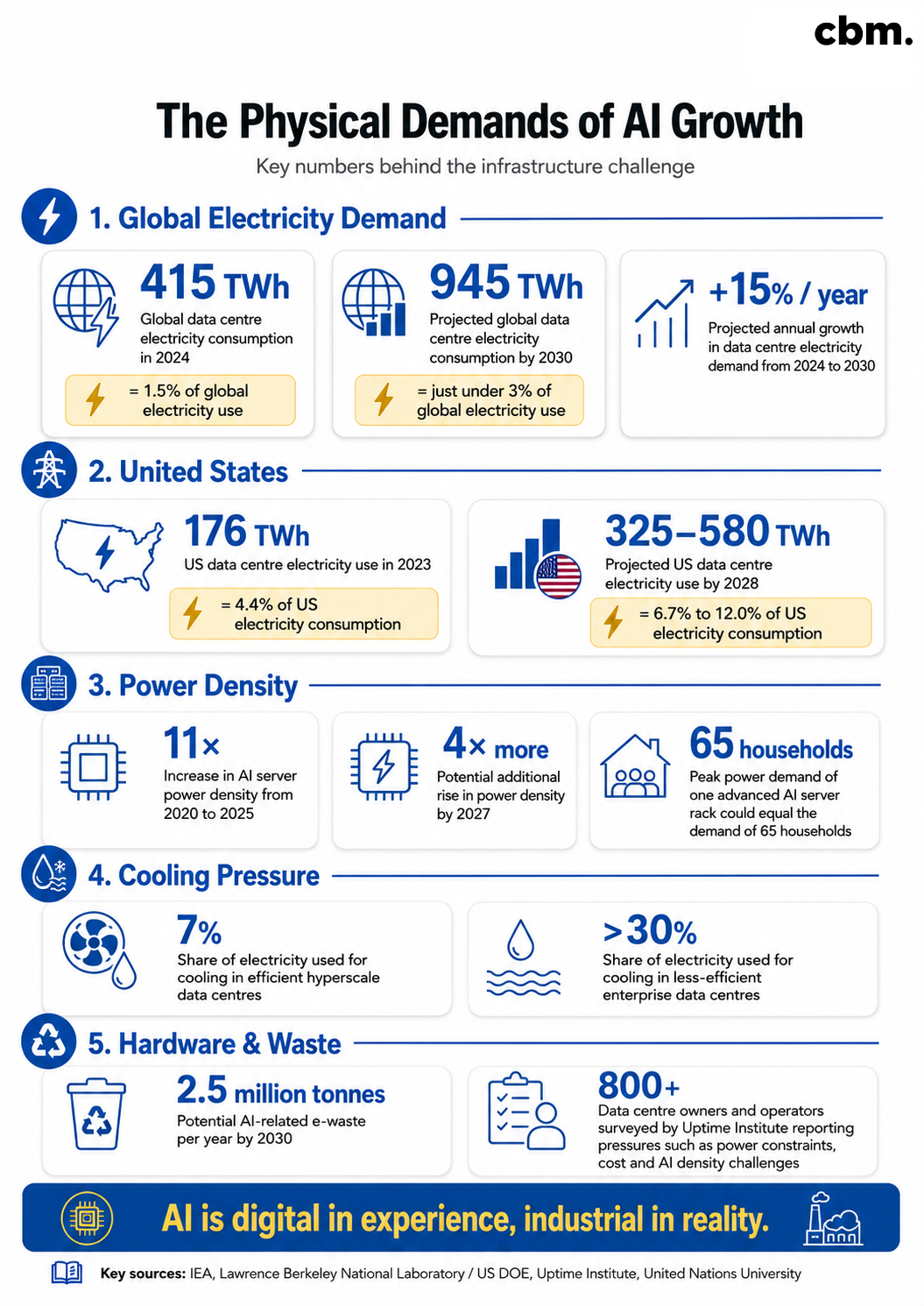
According to the International Energy Agency, global data center electricity consumption was around 415 TWh in 2024, equal to roughly 1.5% of total global electricity consumption. In the IEA’s base case, this figure is projected to more than double to around 945 TWh by 2030, reaching just under 3% of total global electricity demand. That means data center electricity use is expected to grow by around 15% per year between 2024 and 2030, more than four times faster than growth in overall electricity consumption from other sectors.
These figures reveal the central problem: AI is not only a digital technology. It is becoming a major physical infrastructure challenge.
The first number to understand is 415 TWh.
That is the IEA’s estimate for global data center electricity consumption in 2024. To put this in perspective, data centers already consumed around 1.5% of the world’s electricity before the full global implementation of AI.
This matters because the AI boom is arriving atop an existing digital infrastructure. Cloud computing, streaming, enterprise software, financial systems, e-commerce, online advertising, and social media already require large data center networks. AI adds a new and more intensive layer of demand.
Traditional data center workloads were already significant, but AI workloads are different. They require high-performance GPUs, dense server clusters, advanced networking, and more powerful cooling systems. This means that AI does not simply increase the number of servers. It changes the type of infrastructure required.
The key point is that AI begins from a high baseline. The world is not moving from zero to AI infrastructure. It is adding AI to an already energy-intensive digital economy.
The IEA projects global data center electricity consumption to reach around 945 TWh by 2030 in its base case. That is more than double the 2024 level.
This is one of the most important numbers in the AI infrastructure debate.
A rise from 415 TWh to 945 TWh means an increase of roughly 530 TWh in just six years. That additional demand exceeds the total annual electricity consumption of many countries.
The number also explains why governments, utilities, and energy companies are becoming increasingly involved in AI strategy. AI expansion is no longer only a question for technology companies. It is also a question for power markets, grid planners, and national energy policy.
The challenge is not only total consumption. It is also speed. A 15% annual growth rate in data center electricity consumption is extremely fast for an infrastructure-heavy sector. Electricity grids, substations, transmission lines, and power generation assets are not built at software speed.
This creates one of the main physical walls of AI: demand can grow faster than infrastructure can respond.
By 2030, data centers could account for just under 3% of global electricity consumption, according to the IEA base case.
At first glance, 3% may not sound overwhelming. But this global percentage can be misleading for three reasons.
First, data center demand is highly concentrated. AI infrastructure is not evenly distributed across the world. It tends to cluster around major cloud regions, fiber routes, energy hubs, financial centers, and technology markets.
Second, data centers require reliable, continuous power. A large AI facility cannot depend on an intermittent or uncertain electricity supply. It needs firm capacity, high uptime, and stable grid connections.
Third, local grids can become stressed even if the global electricity share remains modest. A national or global average hides local bottlenecks. One region may have enough electricity on paper but lack the transmission capacity, substations or transformers needed to connect a new AI data center campus.
This is why the data center energy debate should not focus only on the global percentage. The more important question is whether the right amount of power can be delivered to the right locations at the right time.
The United States provides one of the clearest examples of how quickly data center electricity demand is growing.
A Lawrence Berkeley National Laboratory report, backed by the US Department of Energy, estimated that US data centers consumed 176 TWh of electricity in 2023. That represented around 4.4% of total US electricity consumption.
The report also estimated that US data center electricity use could rise to between 325 TWh and 580 TWh by 2028. That would represent between 6.7% and 12.0% of total US electricity consumption.
This range is important because it shows how uncertain the future still is. The lower and upper estimates depend on factors such as AI adoption, server shipments, hardware efficiency, cooling choices, and utilization rates.
But even the lower end of the projection is significant. Moving from 176 TWh in 2023 to 325 TWh in 2028 would mean a major increase in just five years. The upper estimate of 580 TWh would imply a much more dramatic transformation of US electricity demand.
This is why AI infrastructure has become a strategic issue in the US. It affects grid planning, power generation, corporate energy procurement, environmental policy, and regional development.
The US forecast range of 325 TWh to 580 TWh by 2028 should not be treated as a single guaranteed outcome. It is a scenario range.
This distinction matters.
AI energy demand is difficult to forecast because several forces act simultaneously. Demand for AI services may grow faster than expected. Hardware may become more efficient. Models may become smaller and more specialized. Inference may become cheaper. Or, on the other hand, AI may be embedded in almost every digital workflow, creating much higher demand.
The wide range indicates that the future of AI infrastructure remains open. But it also shows that even conservative scenarios require serious planning.
If the lower scenario materializes, the US still needs major investment in power infrastructure. If the upper scenario materializes, the country faces a much larger energy planning challenge.
The safe conclusion is not that one exact number will happen. The safe conclusion is that AI has made data center electricity demand too large to ignore.
AI’s physical challenge is not only about total electricity use. It is also about power density.
The IEA reports that the power density of AI servers increased by a factor of 11 between 2020 and 2025. By 2027, it could rise by another four times.
This is one of the most important technical constraints in AI infrastructure.
A traditional data center may have enough physical space but not enough power and cooling capacity per rack. AI servers concentrate huge amounts of computing power in a small area. That creates intense local heat and requires more advanced electrical and cooling systems.
The IEA also notes that an individual server rack in an advanced data center could, by 2027, have peak power demand equivalent to that of 65 households.
This number illustrates why AI data centers are different from older facilities. The challenge is not only building more square meters of data center space. It is building facilities capable of supporting extremely dense computing environments.
In practical terms, this means more pressure on transformers, power electronics, cooling systems, backup power, and facility design.
The image of an AI rack drawing peak power equivalent to that of 65 households helps explain the cooling problem.
Every watt of power a server uses eventually becomes heat. The more power concentrated in each rack, the more difficult it becomes to remove that heat safely and efficiently.
Cooling already accounts for a significant share of data center energy use. The IEA notes that cooling can account for around 7% of electricity use in efficient hyperscale data centers, but more than 30% in less efficient enterprise data centers.
AI increases the importance of cooling by altering the facility's thermal profile. High-density GPU clusters often require liquid cooling, direct-to-chip cooling or other advanced thermal management systems.
This creates several consequences:
The more AI scales, the more the data centers become a thermal engineering challenge.
The range from 7% to over 30% of electricity used for cooling shows how much facility design matters.
Efficient hyperscale data centers can reduce the cooling share through advanced design, better airflow, liquid cooling, climate-aware siting and operational optimization. Less efficient facilities may spend a much larger share of their electricity simply removing heat.
This is critical for AI because cooling inefficiency multiplies the energy burden. If compute demand rises quickly and cooling systems are inefficient, total electricity consumption grows faster.
However, cooling optimization is not straightforward. A system that reduces electricity use may require more water. A system that reduces water use may consume more electricity. A facility in a cooler climate may need less cooling but may still face grid or connectivity constraints.
This is why AI sustainability cannot be judged by one number alone. Electricity, water, carbon intensity, and location all matter.
Water is becoming one of the most politically sensitive physical constraints for AI data centers.
The reason is simple: data centers often need water for cooling, especially when evaporative systems are used. Water consumption varies widely depending on location, design, climate, and cooling technology.
United Nations University researchers have warned that AI infrastructure creates pressure not only on electricity systems but also on water, land and e-waste systems. A recent Reuters report on UNU research stated that data centers could double their power and water consumption by 2030 due to growing AI demand.
The water issue is highly local. A data center in a water-rich region does not create the same risk as a facility in a drought-prone or water-stressed region. This is why public opposition can emerge even when a company claims to have made global sustainability progress.
For communities, the question is not only whether the data center is efficient. The question is whether local water resources are being used to support global AI services.
This is one of the clearest examples of AI's physical nature. A digital service can create very real local resource conflicts.
AI infrastructure also creates an e-waste challenge.
United Nations University researchers have warned that AI infrastructure could generate up to 2.5 million tonnes of e-waste per year by 2030.
This matters because AI hardware evolves quickly. GPUs, servers, networking equipment, batteries, cooling systems, and power components may be replaced frequently as newer generations become more efficient or more powerful.
The environmental impact of AI is therefore not limited to electricity use during operation. It also includes the manufacturing, transportation, replacement, and disposal of hardware.
This creates a lifecycle problem.
A model may become more efficient over time, but if the infrastructure supporting it requires rapid hardware turnover, the environmental burden does not disappear. It shifts into supply chains, mining, manufacturing, and waste processing.
Responsible AI infrastructure must therefore include recycling, reuse, material recovery and longer hardware lifecycle planning.
The physical constraints are being raised not only by environmental groups or external critics. Data center operators themselves are reporting them.
Uptime Institute’s 2025 Global Data Center Survey, based on responses from more than 800 data center owners and operators, highlights rising costs, worsening power constraints, AI density challenges, staffing issues, supply chain delays and technological uncertainty.
This is important because it shows that the bottlenecks are operational rather than theoretical.
Operators are facing real constraints in securing power, upgrading facilities, hiring staff, managing supply chains and adapting to AI workloads. The industry is resilient, but it is also under pressure.
This is another reason why AI implementation may be slower or more uneven than the hype suggests. Demand for AI can grow quickly, but the infrastructure required to deliver it depends on slower physical systems.
Financial sector forecasts also point to significant growth in data center power demand.
Goldman Sachs Research has forecast that global data center power demand could increase by around 165% from 2023 levels by 2030.
This type of forecast should be treated differently from IEA or DOE-backed estimates. It is a market outlook, not a public-agency baseline. But it remains useful because it shows that energy demand growth is now central to investor expectations for AI.
The direction of travel is consistent across multiple sources: AI is increasing demand for data center capacity, and that capacity requires large amounts of power.
The exact number may vary by methodology. The trend is clear.
The physical walls of AI are not limited to energy and water. AI also depends on specialized hardware.
Advanced AI systems require GPUs, AI accelerators, high-bandwidth memory, networking equipment, optical components, power electronics, and advanced packaging. These supply chains are complex and concentrated.
A shortage in any one of these components can slow deployment.
This is why AI infrastructure is vulnerable to semiconductor supply constraints, export controls, manufacturing bottlenecks, geopolitical tensions and competition for advanced memory and packaging capacity.
The key issue is that software demand can scale almost instantly, but chip supply cannot. Semiconductor manufacturing requires years of planning, enormous capital investment, and highly specialized production capacity.
AI’s global implementation therefore depends not only on model development but on the physical ability to manufacture and deliver the hardware required to run those models.
AI also requires land. Large data center campuses need server halls, cooling systems, substations, backup generators, batteries, security perimeters, access roads, and sometimes adjacent energy infrastructure.
This creates pressure in regions where suitable land, grid access, and connectivity overlap. The best data center locations are not just empty plots. They must combine power availability, fiber access, regulatory approval, water or cooling resources, construction capacity, and political acceptance.
This is where local resistance can become a barrier. Communities may question whether data centers consume too much electricity or water, whether they create enough permanent jobs, whether they increase local energy costs, or whether they place too much pressure on public infrastructure.
This means AI companies need more than technical capacity. They need a social license to build.
The numbers point to one conclusion: AI growth is becoming physical growth.
By 2027, an advanced AI rack could draw peak power equivalent to 65 households.
Cooling can represent around 7% of electricity use in efficient hyperscale facilities but more than 30% in less efficient enterprise data centers.
AI infrastructure could generate up to 2.5 million tonnes of e-waste per year by 2030.
These numbers show that AI is no longer only a model race. It is an infrastructure race.
The data suggests that AI’s global implementation will be shaped by six physical bottlenecks. The first is electricity. AI requires large volumes of reliable power.
The second is grid capacity. Electricity must be delivered to specific locations, not just generated somewhere in the system. The third is cooling. Higher power density creates more heat and requires more advanced thermal management.
The fourth is water. Cooling choices can create local water stress and political opposition. The fifth is hardware. AI depends on complex semiconductor and component supply chains.
The sixth is land and permitting. Data centers need physical space, public acceptance, and regulatory approval. These bottlenecks do not mean AI will stop growing. They mean AI growth will be more uneven, more expensive, and more dependent on infrastructure planning than many early expectations suggested.
AI feels digital because users experience it through software. But its foundations are industrial. It runs on electricity. It depends on the chips. It produces heat. It may consume water. It requires land. It generates hardware waste. It needs power grids, cooling systems, fiber networks, transformers, substations, and skilled workers.
The central question for AI is therefore changing. The first question was: Can AI become intelligent enough to transform business and society? The next question is: can the physical world support AI at a global scale?
The answer will depend not only on better models, but on energy systems, data center design, chip manufacturing, cooling technology, water management, regulation, and public trust.
AI may be the defining digital technology of the decade, but its limits are increasingly physical.




By continuing to use the site, you agree to the use of cookies. more information
The cookie settings on this website are set to "allow cookies" to give you the best browsing experience possible. If you continue to use this website without changing your cookie settings or you click "Accept" below then you are consenting to this.