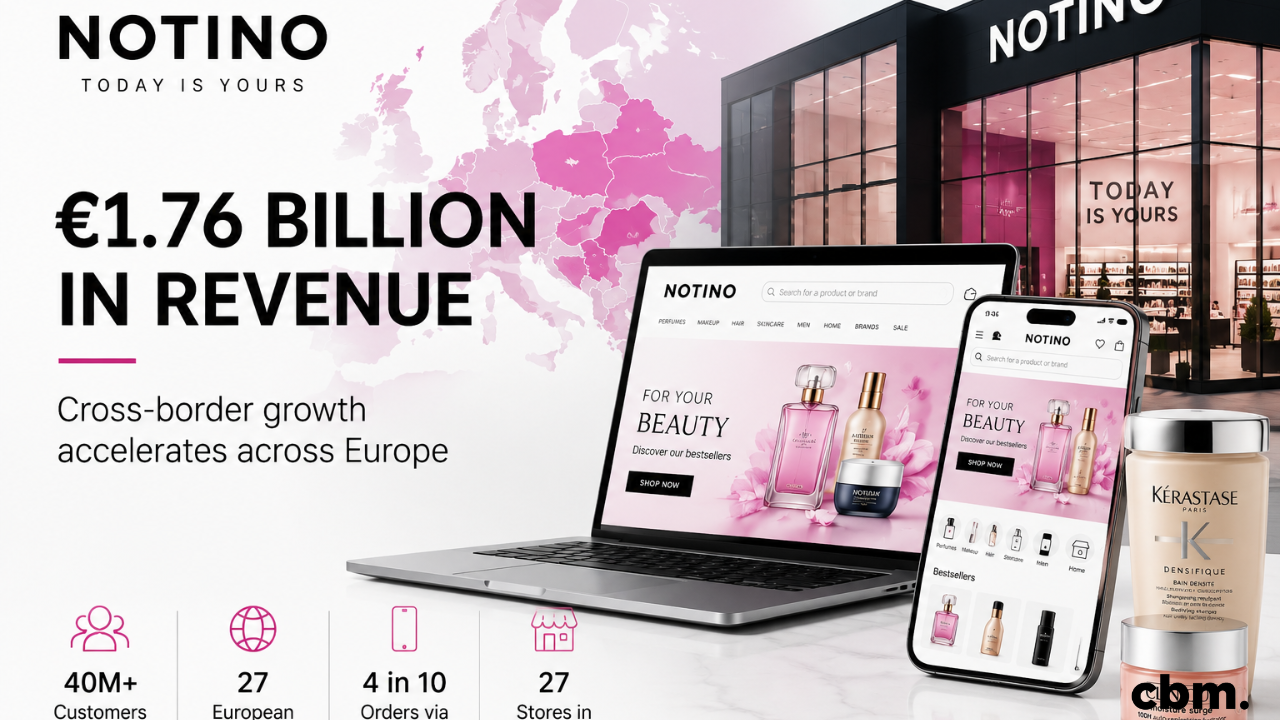
Czech beauty retailer Notino generated €1.76 billion in revenue during its latest financial year, reinforcing its position as one of Europe’s most successful cross-border e-commerce businesses.
The Brno-based company closed fiscal year 2025, covering May 2025 to April 2026, with revenue growth of 11.5% year on year. Notino now serves more than 40 million customers across 27 European markets, supported by a combination of localized online stores, mobile commerce, physical retail and beauty-service partnerships.
Although growth slowed during the Black Friday and Christmas shopping period, the company reported a significant acceleration in early 2026. Revenue growth reached 27% during the opening months of the calendar year, suggesting that the retailer entered its new financial period with renewed momentum.
The results demonstrate how a retailer originating in Central Europe can build a large cross-border business by combining regional localization with centralized technology, logistics and brand management.
Poland generated more than 15% of Notino’s total revenue, making it the company’s largest national market.
The Czech Republic, where Notino is headquartered, accounted for approximately 12%, while Italy contributed 9%. Romania represented a further 7% of annual revenue.
The geographical distribution of its sales highlights the genuinely cross-border nature of Notino’s business. Rather than depending heavily on its domestic market, the retailer has built substantial operations across Central, Eastern, Southern and Western Europe.
Croatia and Lithuania were the company’s fastest-growing markets during the financial year, with revenue in both countries rising by more than 25%.
These results also illustrate the opportunity available in smaller European markets. While Germany, France, Italy and Spain are often considered the primary destinations for international e-commerce expansion, markets in Central and Eastern Europe can offer strong growth where competition, customer acquisition costs and online retail penetration differ from those in the continent’s largest economies.
Notino’s latest performance forms part of a much longer period of rapid expansion.
The company generated approximately €737 million in revenue in 2021. Four years later, annual revenue had increased by more than €1 billion to reach €1.76 billion.
In 2022, the company reported turnover of more than €1.03 billion, representing year-on-year growth of 32%. At that stage, Notino said customers were purchasing the equivalent of 3.5 products every second.
Fiscal year 2024 revenue subsequently reached approximately €1.58 billion, up 18% year on year. The latest €1.76 billion result therefore represents continued double-digit expansion, although at a more moderate annual rate than in some previous periods.
Notino nevertheless said it continued to grow faster than the wider European e-commerce market while maintaining a sufficiently strong financial position to keep investing in its infrastructure and customer experience.
Mobile commerce has become a central element of Notino’s customer-retention and sales strategy.
Approximately four out of every ten orders are now placed through the Notino mobile app. The company has invested in simplifying the purchasing process, improving digital services, increasing personalization and introducing a loyalty program designed to encourage repeat purchases.
The proportion of app-based orders is particularly significant for the beauty sector, where frequent purchases, product discovery, personalized recommendations and loyalty incentives can encourage customers to return regularly.
An app can also provide retailers with a more direct relationship with customers than conventional web traffic. It reduces dependence on search engines, marketplaces and paid advertising channels while creating additional opportunities for personalized offers, product reminders and loyalty rewards.
Notino’s loyalty program was initially introduced in the Czech Republic, Slovakia and Hungary. The retailer plans to refine the program using customer feedback before expanding it gradually into additional European markets.
This controlled approach reflects one of the central challenges of cross-border e-commerce: a program that performs well in one market may need to be adapted to different customer expectations, pricing environments and purchasing habits elsewhere.
Despite its origins as an online retailer, Notino is increasingly developing an omnichannel model.
The company currently operates 27 physical stores across eight European countries. Revenue generated through those stores increased by almost 30% year on year, substantially faster than the company’s overall annual growth rate.
Notino opened its first physical store in Croatia during the latest financial year and plans to open its first Slovenian store in Ljubljana in autumn 2026.
The expansion demonstrates that physical retail can complement rather than replace an e-commerce-led strategy.
Beauty products can be difficult to evaluate entirely online. Fragrance, makeup and skincare customers may want to test products, receive advice or compare different options in person before purchasing. Stores can therefore support product discovery and build trust, while the online platform provides a broader range, convenient delivery and repeat-order functionality.
Physical locations can also serve as local brand-building tools in markets where a retailer is less established. They give customers a visible point of contact while strengthening the credibility of the broader online operation.
The retailer’s strategy now extends beyond selling physical products.
Through the Notino Partner platform, customers can book appointments with participating beauty salons. The service connects more than 8,000 salons with customers in five European countries and processed approximately 1.5 million bookings during the latest financial year.
Notino plans to introduce the service in Croatia and Austria during 2026.
The platform gives the company an opportunity to become involved in a wider portion of the customer journey. Instead of interacting with consumers only when they purchase cosmetics, Notino can also participate when they book hair, skincare or other beauty services.
This model can potentially create a reinforcing ecosystem. Customers discover products through the website or app, visit stores to test them and use the same brand to access related professional services.
For cross-border retailers, this broader ecosystem approach can provide an advantage over competitors focused exclusively on product transactions.
Notino has also reorganized its senior leadership as the company prepares for its next stage of growth.
After more than six years leading the business, Zbyněk Kocián transferred management responsibility to three co-CEOs: Bartosz Kliś, Lukáš Havlásek and Jakub Šedý.
Responsibilities have been divided across three main areas of the business. The company believes that the structure will accelerate decision-making and allow it to manage an increasingly complex European operation more effectively.
Šedý oversees areas including finance, legal affairs, human resources, facilities, logistics and strategy. He said Notino had maintained healthy profitability, increased absolute EBITDA, improved working-capital efficiency and reduced net debt, although the latest figures remained subject to final audit at the time of his statement.
According to Šedý, Notino recorded growth of more than 20% in every month from February 2026 onwards.
The operational changes are intended to create a more agile organization capable of continuing to invest in technology, logistics, customer experience and talent while preserving financial discipline.
Notino’s growth provides a useful example of the infrastructure required to scale a cross-border retail business across Europe.
Operating in 27 markets requires more than translating a website. Retailers must manage different languages, currencies, payment preferences, delivery expectations, product regulations, promotional calendars and customer-service requirements.
Notino says it operates in 27 countries and works across 22 languages. Its workforce numbers more than 2,800 employees, according to the company’s careers information.
The company combines these local market capabilities with centralized investment in areas such as technology, inventory, logistics and digital customer experience.
This balance is important. Excessive centralization can produce a customer experience that feels disconnected from individual markets, while excessive decentralization can duplicate costs and create operational complexity.
Notino’s scale suggests that it has been able to build a common European retail platform while maintaining sufficient local adaptation to compete in very different national markets.
Notino’s €1.76 billion revenue result offers several lessons for retailers pursuing international growth.
First, successful cross-border expansion need not begin in Europe’s largest markets. Notino grew from the Czech Republic and made Poland its largest revenue source, while some of its fastest growth is now coming from Croatia and Lithuania.
Second, localization must extend beyond language. Mobile behavior, loyalty schemes, delivery options, physical retail and beauty-service partnerships all need to reflect how customers shop in each country.
Third, omnichannel retail can strengthen an online-first business. Notino’s store revenue grew by almost 30%, indicating that physical locations are becoming a meaningful contributor rather than a secondary brand exercise.
Finally, direct customer relationships are becoming increasingly valuable. With 40% of orders coming through its app, Notino is reducing its dependence on external discovery and acquisition channels while creating more opportunities for repeat purchases and personalized engagement.
Notino enters fiscal year 2026 with a larger customer base, a new leadership structure and further physical and digital expansion planned across Europe.
The company’s annual growth rate of 11.5% is lower than the exceptional increases recorded in some earlier years. However, the acceleration to 27% growth during the first months of 2026 indicates that momentum may be strengthening again.
Its progress also shows that European e-commerce growth is increasingly being driven by retailers capable of combining digital scale with local market execution.
Notino is no longer simply a Czech online perfume retailer selling internationally. It has developed into a multi-market European beauty platform incorporating e-commerce, mobile shopping, stores, loyalty services and salon bookings.
The next challenge will be maintaining that local relevance and operational efficiency as the business grows larger and competition in European beauty retail intensifies.




By continuing to use the site, you agree to the use of cookies. more information
The cookie settings on this website are set to "allow cookies" to give you the best browsing experience possible. If you continue to use this website without changing your cookie settings or you click "Accept" below then you are consenting to this.