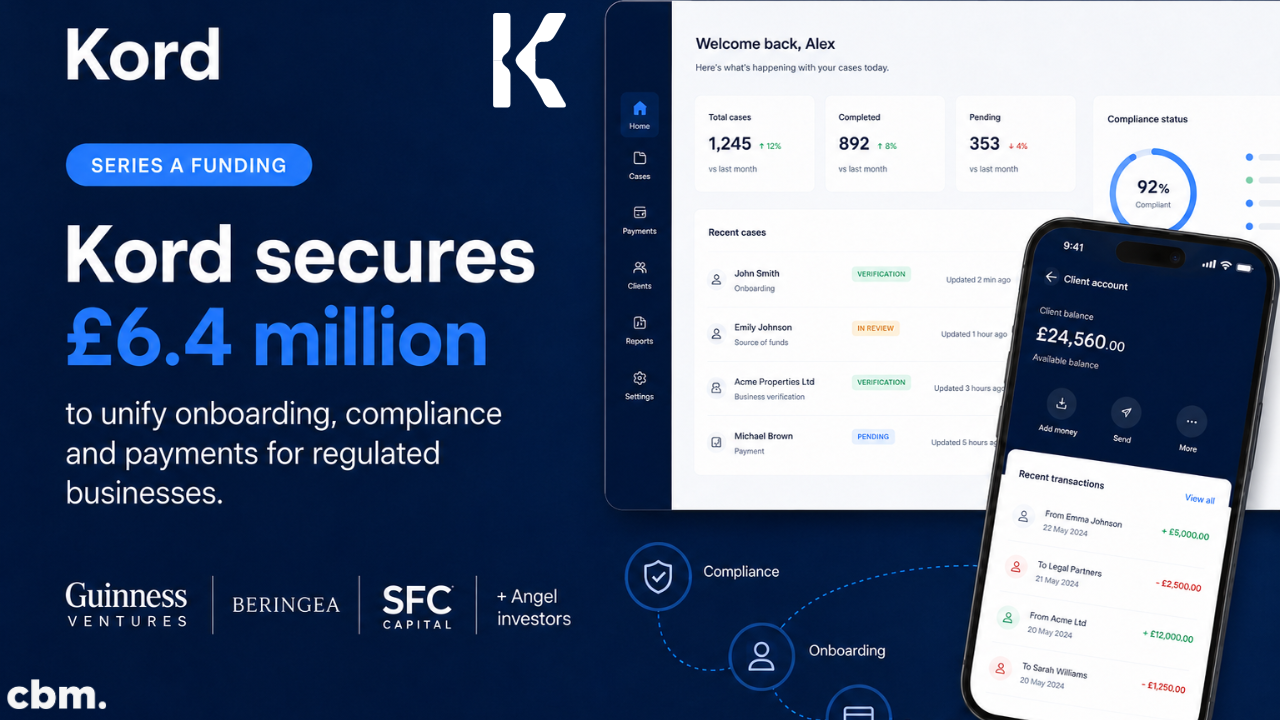
UK fintech company Kord has raised £6.4 million in Series A funding to expand its platform for customer onboarding, regulatory compliance and payment processing.
The round was led by Guinness Ventures, with participation from Beringea, SFC Capital and angel investors. The investment brings Kord’s total funding to approximately £9 million since the company's founding in 2020.
Kord plans to use the new capital to expand its team, accelerate product development and attract more customers across the property, legal and financial-services sectors.
The company is addressing a persistent problem in regulated industries: businesses often rely on several disconnected systems to verify customers, conduct anti-money-laundering checks, manage documents and process payments. Kord aims to bring those processes together within one platform.
Kord is a London-based fintech infrastructure company founded by CEO James Owusu. It operates as the business-to-business brand of Checkboard Limited.
Its platform is designed for regulated organizations such as estate agents, law firms, conveyancers, lenders and brokers.
Kord combines several services that companies would traditionally obtain from different providers, including:
The company’s main objective is to integrate customer identity, compliance information, and payment activity into a single workflow.
This can reduce duplicated administration and provide businesses with a clearer record of who the customer is, where the funds came from and how the transaction was processed.
Kord intends to use the Series A funding to strengthen its technology and expand across regulated industries. Many companies still use one provider for identity verification, another for compliance checks, a separate platform for documents and an external payment service.
This fragmented approach can create delays, increase costs and make oversight more difficult. Customers may also be required to submit the same information several times as they move between estate agents, mortgage providers, conveyancers and law firms.
Kord wants to replace this fragmented process with a more coordinated digital transaction system. Rather than offering only an identity-verification tool, the company is developing infrastructure that connects onboarding, compliance decisions and the movement of money.
One of Kord’s central ideas is that customer identity and payment activity should not be handled separately. A business may verify a customer successfully during onboarding but use a different platform to receive or distribute funds.
When those systems are disconnected, it can be difficult to maintain a complete view of the transaction. Kord allows businesses to collect customer information, verify identity documents, complete compliance checks, review the source of funds, and manage payments within the same environment.
The company also provides digital wallets and client-money accounts for regulated organizations. This integrated model is intended to create a stronger audit trail and reduce manual work. It may also help businesses identify inconsistencies between the person completing the onboarding process and the individual or organization sending the money.
Fraud prevention is an important part of Kord’s proposition.
Generative AI has made it easier to produce manipulated documents, false images and convincing digital identities. Regulated companies therefore need to compare customer information against multiple data sources.
Kord says its API-based platform helps businesses verify identity information and detect suspicious discrepancies.
The company describes its payment infrastructure as a closed-loop environment in which identity, compliance data and payment activity remain connected.
This approach is designed to reduce risks such as impersonation, payment diversion and account substitution during high-value transactions.
For regulated businesses, the ability to connect a verified identity directly to the movement of money could become increasingly valuable as digital fraud becomes more sophisticated.
The property sector is one of Kord’s main target markets. Buying or selling a property involves several parties, including buyers, sellers, estate agents, lenders, solicitors and conveyancers.
Different organizations may need to complete their own identity, compliance and source-of-funds checks. This can lead to duplication and longer transaction times. Kord wants businesses to complete identity verification, anti-money-laundering screening, document collection and payments through a more coordinated system.
Reducing administrative friction could help transactions move more quickly and lower the risk of delays caused by missing or repeated documentation. However, Kord cannot remove every cause of failed property transactions. Financing problems, broken chains, survey findings and changing customer circumstances also play important roles.
Its value lies in simplifying the compliance and payment stages.
Law firms and conveyancers are another important market segment because they frequently handle large sums of client money. These businesses must verify customer identities, screen for sanctions, establish the source of funds and maintain records of the checks they complete.
Kord combines these compliance functions with payment processing and client-money accounts. The platform is designed to create a clear record of how funds were received, held and transferred.
This is important because compliance involves more than completing a check. A regulated company may need to demonstrate which documents were reviewed, when the review took place, which risks were identified and why a transaction was approved. Kord aims to centralize that information within an audit-ready record.
Kord’s funding reflects wider investor interest in fintech companies that provide infrastructure to regulated industries.
Investment is increasingly moving beyond consumer banking applications toward business-to-business services such as:
These services are becoming more important as traditionally paper-based sectors adopt digital processes.
Property and legal services still rely heavily on emails, PDF documents, manual checks, bank transfers and disconnected software. Kord is betting that companies will increasingly prefer integrated platforms instead of purchasing multiple separate tools.
Kord describes its technology as modular, allowing customers to adopt individual services or combine several functions. A business could use Kord only for identity verification or source-of-funds checks while retaining its existing payment platform.
Another customer could use the full system for onboarding, compliance, client accounts and payments. This flexibility may help Kord serve industries with different requirements.
An estate agent may prioritize identity checks and source-of-funds verification, while a law firm may require detailed compliance records and client-money services. Kord also offers API-based integration, allowing its technology to connect with existing customer management, accounting, and case management systems.
Following the Series A round, Kord will focus on product development, recruitment and customer acquisition. Its main challenge will be proving that the platform can scale across different regulated industries while remaining simple to use.
Integration will also be critical. Law firms, financial-services companies and property businesses already depend on specialist software. Kord’s ability to connect with those systems could determine how quickly customers adopt its platform.
The company is expanding at a time when regulated businesses face two competing pressures. Customers expect faster and more convenient digital experiences, while regulators require stronger identity checks, fraud controls and record-keeping.
Kord is attempting to meet both demands by building compliance directly into the transaction process.
Kord’s £6.4 million Series A is ultimately an investment in digital trust infrastructure.
The company is not trying to remove compliance from regulated transactions. It wants to make compliance more connected, efficient and easier to manage.
By bringing together identity verification, anti-money-laundering checks, source-of-funds analysis, client accounts and payments, Kord is addressing a structural weakness in many regulated industries.
Customer information and customer money are still frequently managed through separate systems.
The new funding gives Kord additional resources to expand its platform and strengthen its position across property, legal and financial services.
As digital fraud becomes more advanced and regulated industries continue to modernize, platforms that connect identity, compliance and payments could become an increasingly important part of Europe’s fintech market.




By continuing to use the site, you agree to the use of cookies. more information
The cookie settings on this website are set to "allow cookies" to give you the best browsing experience possible. If you continue to use this website without changing your cookie settings or you click "Accept" below then you are consenting to this.