Marketplace usage across the EU has become one of the most important indicators of how European e-commerce is evolving. Online marketplaces are now a major route to market for businesses, a default shopping environment for consumers, and a growing concern for regulators as cross-border platforms reshape competition, customs flows, product safety checks, and digital commerce policy.
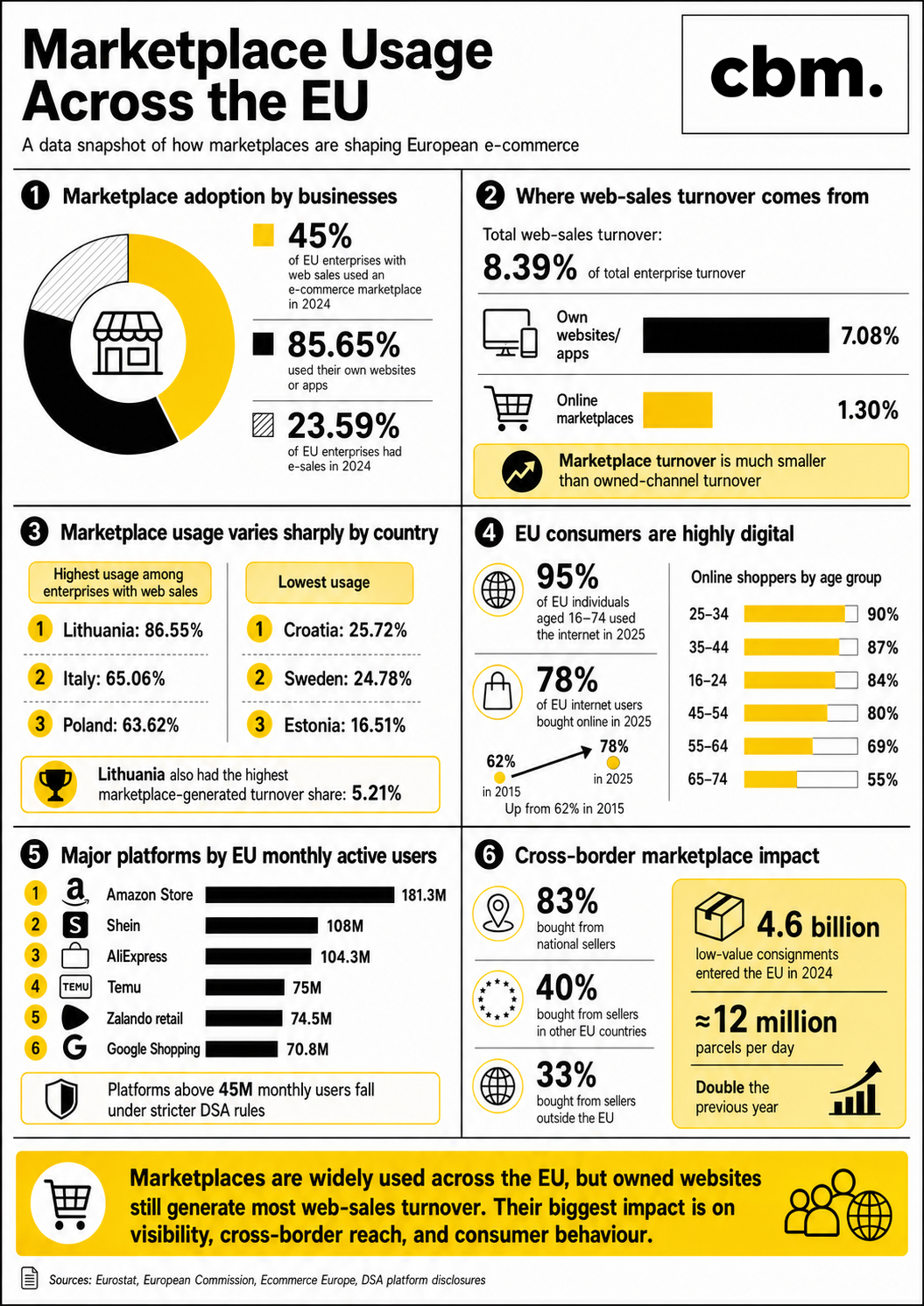
The clearest official snapshot comes from Eurostat’s 2024 enterprise e-commerce data. In 2024, 45% of EU enterprises with web sales used an e-commerce marketplace, while 85.65% used their own websites or apps. This shows that owned e-commerce channels remain the dominant route for web sales, but marketplaces are now used by nearly half of businesses that sell online through websites or apps.
The marketplace story becomes more nuanced when looking at turnover. EU enterprises generated 8.39% of total turnover from web sales in 2024. Of that, 7.08% came from own websites or apps, while only 1.30% came from online marketplaces. In other words, marketplace adoption is widespread, but marketplace turnover still accounts for a much smaller share of enterprise revenue than that of owned digital channels.
| Indicator | Latest figure | Market meaning |
| EU enterprises with e-sales | 23.59% in 2024 | Almost one in four EU enterprises sold electronically |
| EU enterprises using only websites/apps for e-sales | 17.99% in 2024 | Web sales remain the main e-sales route |
| EU enterprises using only EDI-type sales | 2.9% in 2024 | EDI is smaller in adoption but important in turnover |
| EU enterprises using both web sales and EDI | 2.7% in 2024 | Multichannel e-sales remain limited |
| Enterprises with web sales using own websites/apps | 85.65% in 2024 | Owned channels dominate seller infrastructure |
| Enterprises with web sales using marketplaces | 45% in 2024 | Marketplaces are a major secondary sales channel |
| Total enterprise turnover from e-sales | 19.49% in 2024 | Nearly one-fifth of enterprise turnover came from e-sales |
| Total enterprise turnover from web sales | 8.39% in 2024 | Web sales are significant but smaller than EDI sales |
| Total enterprise turnover from own websites/apps | 7.08% in 2024 | Owned e-commerce captures most web-sales turnover |
| Total enterprise turnover from marketplaces | 1.30% in 2024 | Marketplace revenue share remains comparatively low |
Eurostat’s enterprise data shows that EU e-commerce is not a simple “marketplaces versus websites” story. Businesses often use marketplaces for visibility, discovery, new customer acquisition, and cross-border reach, while their own websites and apps remain the stronger revenue base.
Marketplace usage across the EU is uneven. Some markets show very high reliance on marketplace channels among enterprises with web sales, while others remain strongly oriented toward owned websites and apps.
The highest marketplace usage rates among enterprises with web sales in 2024 were recorded in Lithuania at 86.55%, Italy at 65.06%, and Poland at 63.62%. At the other end of the scale, the lowest marketplace usage rates were recorded in Estonia at 16.51%, Sweden at 24.78%, and Croatia at 25.72%.
| EU country | Marketplace usage among enterprises with web sales, 2024 |
| Lithuania | 86.55% |
| Italy | 65.06% |
| Poland | 63.62% |
| Croatia | 25.72% |
| Sweden | 24.78% |
| Estonia | 16.51% |
Lithuania is the clearest outlier. It had the highest marketplace usage rate among enterprises with web sales and also the highest share of total enterprise turnover generated via marketplaces, at 5.21%. This is far above the EU average of 1.30% marketplace-generated turnover.
The most important commercial finding is that marketplaces are widely used, but they do not yet dominate enterprise turnover. Eurostat states that in 2024, e-commerce turnover via own websites or apps was more than five times that via marketplaces.
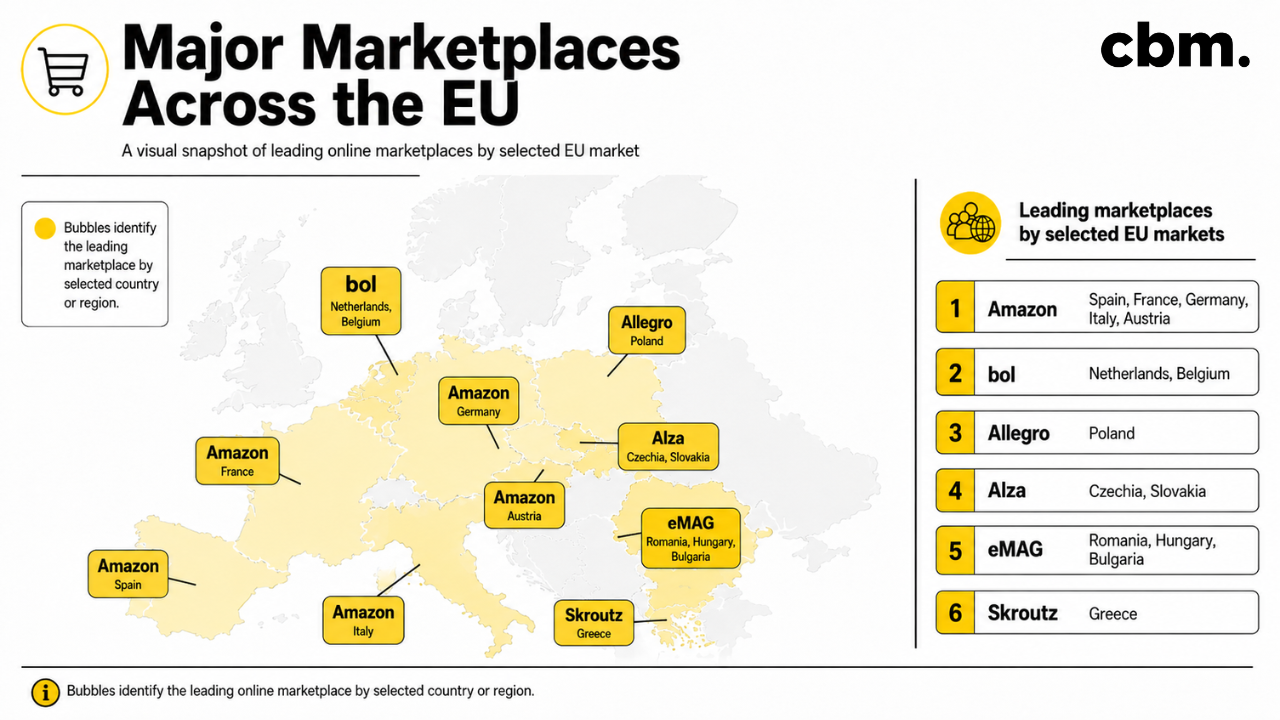
This matters because marketplace usage can be misleading if measured only by adoption. A business may list products on Amazon, Zalando, eBay, Etsy, ManoMano, Kaufland, Bol, Allegro, or another marketplace, but still generate most of its digital revenue through its own web shop, B2B portal, app, or direct ordering environment.
| Web sales channel | Share of total EU enterprise turnover, 2024 |
| Own websites or apps | 7.08% |
| Online marketplaces | 1.30% |
| Total web sales | 8.39% |
For brands, retailers, and B2B sellers, this suggests that marketplaces are often best understood as reach channels rather than as the core revenue infrastructure. They help sellers drive traffic, test new markets, and acquire customers, but owned platforms remain central to controlling margins, owning customer data, shaping the brand experience, and driving repeat purchases.
Marketplace usage across the EU is supported by a large and mature online shopping population. In 2025, 95% of EU individuals aged 16 to 74 had used the internet in the previous 12 months, and 78% of those internet users had bought or ordered goods or services online.
Online shopping penetration has grown steadily over the past decade. In 2015, 62% of EU internet users bought online. By 2025, that figure had increased to 78%, a gain of 16 percentage points in ten years.
| Consumer indicator | EU figure |
| Individuals aged 16–74 using the internet in the previous 12 months | 95% in 2025 |
| Internet users buying or ordering online | 78% in 2025 |
| Internet users buying online in 2015 | 62% |
| Ten-year increase in online buyer penetration | +16 percentage points |
| Internet users who never bought online | 15% in 2025 |
| E-shoppers reporting no problem when purchasing online | 63% in 2025 |
The strongest online shopping age group in the EU is 25–34, where 90% of internet users bought online in 2025. This is followed by 35–44 at 87%, 16–24 at 84%, and 45–54 at 80%. Older groups remain less active but still meaningful, with 69% of internet users aged 55–64 and 55% aged 65–74 buying online.
Eurostat’s 2025 consumer data also shows that online shopping frequency is relatively balanced across light and medium users. Among EU individuals who bought or ordered goods or services online in 2025, 34% purchased one or two times, while 33% purchased three to five times.
This is important for marketplace strategy because marketplaces benefit from habitual shopping behaviour. A consumer who buys online several times a year is more likely to compare prices, subscribe to delivery programs, use marketplace search, check reviews, and move between domestic and cross-border platforms.
The scale of marketplace usage across the EU becomes especially visible in Digital Services Act data. Under the DSA, platforms with more than 45 million monthly users in the EU are classified as Very Large Online Platforms or Very Large Online Search Engines.
As of the European Commission’s list updated on 29 April 2026, several marketplace and commerce-adjacent services exceeded this threshold. Amazon Store reported an average of 181.3 million monthly active users in the EU; Shein reported 108 million; AliExpress reported 104.3 million; Temu reported 75 million; Google Shopping reported 70.8 million; and Zalando reported an average of 74.5 million in retail.
| Platform or service | EU average monthly active users |
| Amazon Store | 181.3 million |
| Shein | 108 million |
| AliExpress | 104.3 million |
| Temu | 75 million |
| Zalando retail monthly average | 74.5 million |
| Google Shopping | 70.8 million |
| Booking.com | Above 45 million |
These figures should not be read as buyer counts or order volumes. They are active user or active recipient figures reported under the DSA framework. However, they clearly show the scale of marketplace exposure in the EU and explain why large platforms now sit at the centre of European e-commerce regulation.
Cross-border marketplace activity is one of the strongest forces behind the current EU e-commerce debate. The European E-commerce Report 2025 estimates that the EU-27 accounted for 81% of total European e-commerce turnover in 2024 and has experienced steady annual e-commerce growth of 7–9% since 2022. The same report estimates that EU-27 e-shopper penetration reached 72% in 2024 and was forecast to reach 74% in 2025.
The report also shows the cross-border structure of EU online purchasing in 2024. Among individuals who purchased online in the last three months, 83% bought from national sellers, 40% from sellers in other EU countries, and 33% from sellers in the rest of the world (non-EU countries).
| Cross-border online purchasing source, EU-27 2024 | Share of online purchasers |
| National sellers | 83% |
| Sellers from other EU countries | 40% |
| Sellers from non-EU countries | 33% |
This data highlights a key marketplace reality: domestic e-commerce remains the foundation of EU online shopping, but cross-border buying is now deeply embedded in consumer behaviour. Marketplaces make that cross-border buying easier by solving for search, payment, product discovery, trust signals, delivery options, and customer support.
Marketplace usage across the EU is also visible in parcel flows. In 2024, the EU saw 4.6 billion low-value consignments worth €150 or less enter the bloc, a volume of around 12 million parcels per day, and twice that of the previous year, according to European Commission figures cited in policy discussions on e-commerce imports. Reuters also reported that 91% of e-commerce shipments valued at less than €150 came from China in 2024.
This parcel surge is closely associated with the growth of ultra-low-cost and cross-border marketplaces such as Temu, Shein, AliExpress, and similar platforms. It has pushed marketplace usage from a commercial question into a policy issue involving customs, product safety, VAT collection, environmental impact, and fair competition.
The EU’s Digital Services Act has made the largest marketplaces more accountable because their scale creates systemic risks. Platforms with more than 45 million monthly EU users must comply with stricter DSA rules, including obligations on illegal content, advertising transparency, recommender systems, reporting, and risk mitigation.
This matters for marketplace sellers because the regulatory environment around platforms is tightening. The more marketplaces become central to EU commerce, the more they are expected to control product safety, seller transparency, counterfeit risks, dark patterns, consumer protection, and traceability.
In practical terms, marketplace usage across the EU is not only growing as a sales channel. It is also becoming a compliance environment. Sellers using marketplaces increasingly need to understand platform rules, EU consumer law, product compliance, customs requirements, VAT obligations, and country-specific expectations.
The central contradiction in EU marketplace data is clear: marketplace usage is high, but turnover remains relatively low. Nearly half of EU enterprises with web sales use marketplaces, but only 1.30% of total enterprise turnover comes through marketplace web sales.
This means marketplaces are strategically important even when they are not the largest revenue channel. They influence discovery, price transparency, customer expectations, delivery standards, returns behaviour, and cross-border competition.
For many sellers, marketplaces are not replacing direct e-commerce. Instead, they are becoming part of a multi-channel sales model in which businesses balance reach against dependence.
For EU retailers and brands, the data points to a dual-channel reality. Owned websites and apps still capture most web-sales turnover, but marketplaces are too large to ignore. A business that avoids marketplaces may protect its margins and customer data, but it may also miss a large share of consumer search and discovery.
For cross-border sellers, marketplaces can reduce barriers to entry. They offer access to established traffic, payments, consumer trust, and delivery expectations. This is particularly relevant in fragmented European markets where language, payment preferences, returns expectations, and logistics infrastructure vary from country to country.
For B2B and wholesale businesses, the marketplace question is more selective. Eurostat’s broader e-sales data shows that EDI-type sales remain important in turnover, especially in sectors such as manufacturing and wholesale. In 2024, EU enterprises generated 11.07% of total turnover from EDI-type sales, compared with 8.39% from web sales.
This suggests that in B2B, the future may not be a simple shift from traditional sales to public marketplaces. Instead, the market is likely to evolve through a mix of private portals, procurement platforms, industry-specific marketplaces, EDI integrations, and owned digital commerce infrastructure.
Marketplace usage across the EU is strong, uneven, and strategically important. On the seller side, 45% of EU enterprises with web sales used marketplaces in 2024. On the consumer side, 78% of EU internet users bought online in 2025. On the platform side, major marketplaces now reach tens or hundreds of millions of monthly active users across the EU, led by Amazon Store at 181.3 million, Shein at 108 million, AliExpress at 104.3 million, and Temu at 75 million.
The most important takeaway is that EU e-commerce is increasingly marketplace-influenced, even if it is not yet marketplace-dominated in turnover. Owned websites and apps still generate most web-sales revenue. Still, marketplaces shape where consumers search, how sellers expand cross-border, how prices are compared, and how regulators approach the future of online commerce.




By continuing to use the site, you agree to the use of cookies. more information
The cookie settings on this website are set to "allow cookies" to give you the best browsing experience possible. If you continue to use this website without changing your cookie settings or you click "Accept" below then you are consenting to this.