
The European e-commerce landscape has entered a new phase. With the launch of its Joybuy platform, JD.com lands in Europe with a clear ambition: to replicate its highly efficient, logistics-driven model and compete directly with Amazon on its strongest capabilities.
This is not a typical marketplace expansion. It is a strategic move that signals a structural shift in how global e-commerce players approach the European market.
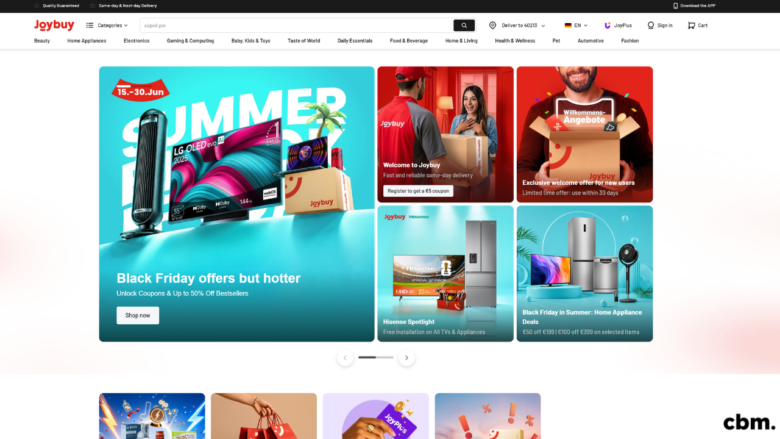
JD.com enters Europe with a simultaneous rollout across major markets, including the UK, Germany, France, the Netherlands, Belgium, and Luxembourg.
The platform launches with:
This broad assortment shows that JD.com is not entering Europe as a niche player. Instead, JD.com lands in Europe with a full-scale generalist marketplace strategy, positioning itself as a direct alternative to Amazon from day one.
What truly differentiates JD.com as it enters Europe is not pricing but logistics.
The company brings its well-known operational strengths into the European market:
Behind this promise is a robust infrastructure:
As JD.com lands in Europe, it introduces a logistics-first model that prioritizes speed, reliability, and customer experience. This approach mirrors its success in China and directly challenges Amazon’s fulfillment leadership.
JD.com enters Europe with a fundamentally different strategy from other Chinese e-commerce players.
While platforms like Temu or AliExpress rely heavily on cross-border shipping and ultra-low prices, JD.com focuses on:
This enables JD.com to compete in higher-value categories where fast delivery and product quality are critical. As a result, JD.com lands in Europe positioned closer to Amazon’s model than to discount-driven marketplaces.
The timing of this expansion is not accidental. JD.com lands in Europe amid several structural shifts:
Europe is a highly attractive market due to its size, maturity, and strong consumer demand for fast, reliable delivery.
To accelerate its entry, JD.com has combined marketplace launch with strategic investments and partnerships, allowing it to quickly establish a competitive presence.
As JD.com enters Europe, it is not targeting market gaps—it is competing head-on with Amazon’s core capabilities.
Both companies now align on key factors:
The competitive battlefield is shifting toward fulfillment excellence, where speed and operational efficiency define success.
JD.com’s strategy suggests that superior logistics can be a decisive advantage, even in a market where price competition remains intense.
The fact that JD.com lands in Europe at scale will have significant implications for the entire ecosystem.
Retailers and marketplaces will need to invest heavily in fulfillment capabilities to remain competitive.
Companies positioned between low-cost and premium offerings may struggle as JD.com captures a strong middle position.
Major players are likely to expand warehouse networks and last-mile delivery solutions to match rising expectations.
Fast delivery, including same-day options, may become a standard rather than a premium feature.
JD.com lands in Europe not just as a new competitor, but as a force accelerating the evolution of e-commerce in the region.
The market is shifting from:
Towards:
In this context, JD.com’s entry marks a turning point. As JD.com lands in Europe, it sets a new benchmark for operational excellence and raises the bar for every player in the market.



By continuing to use the site, you agree to the use of cookies. more information
The cookie settings on this website are set to "allow cookies" to give you the best browsing experience possible. If you continue to use this website without changing your cookie settings or you click "Accept" below then you are consenting to this.